
Close Menu
  • Featured
    • News
    • Consumption
    • Environment
    • Industry
    • Opinion
    • Policy
    • Production
    • Storage
    • Transmission
  • About Us
  • Advertise
  • Contact Us

Subscribe to Our Newsletter

News, investigations, and analysis — our top stories every morning to start your day right.

Trending
nuclear power plant
Nuclear Industry: Global Investment Accelerates as Energy Demand Rises
The Key Benefits of Oil
CO2 Emissions: How Carbon Dioxide Affects the Environment and the Planet
Facebook X (Twitter) LinkedIn YouTube TikTok
Energy Reporters
Facebook X (Twitter) RSS
Subscribe
  • Featured
  • News
    nuclear power plant

    Nuclear Industry: Global Investment Accelerates as Energy Demand Rises

    11/06/2026

    Researchers Discover That Diamonds Can Generate Electricity

    09/03/2026

    South Africa: Thousands of Dead Sardines Disrupt Koeberg Nuclear Power Plant

    08/28/2026
    Illustration of Abu Dhabi National Oil Company's $11 billion financing deal for future gas production projects.

    ADNOC Secures $11 Billion for Gas Expansion, Transforming Energy Future and Boosting Local Economies

    12/19/2025
    Illustration of Energy Transfer LP's Lake Charles LNG project suspension and strategic shift to pipeline infrastructure.

    Energy Transfer Suspends Lake Charles LNG Project, Sparking Concerns Over Job Losses and Future Energy Solutions

    12/19/2025
  • Use

    How energy subsidies affect the market and consumers

    08/11/2026

    Steps to make your business more energy efficient

    06/16/2026

    How to conduct an energy audit for your home

    05/19/2026

    The impact of energy consumption on climate change

    05/12/2026

    Tips for choosing the best energy provider

    05/05/2026
  • Climate

    CO2 Emissions: How Carbon Dioxide Affects the Environment and the Planet

    10/14/2026

    Ocean Warming: A Growing Threat to Marine Ecosystems and the Global Environment

    10/09/2026
    renewable energy industry

    The Benefits of Renewable Energy for the Climate

    09/15/2026

    How to evaluate the carbon footprint of your energy use

    07/21/2026

    The connection between energy use and water resources

    07/07/2026
  • Industry
    nuclear power plant

    Nuclear Industry: Global Investment Accelerates as Energy Demand Rises

    11/06/2026

    How France Produces Its Electricity: Nuclear Power at the Heart of a Changing Energy Mix

    10/02/2026

    The Importance of Oil in Logistics

    09/10/2026
    A bunch of black and white objects with a green arrow above them

    The Ongoing Bribery Case Against Hithium’s Chairman Wu Zuyu Highlights the Stakes for Battery Investors

    02/22/2026
    Illustration of Ford's strategic shift from electric vehicles to gas and hybrid models.

    Ford Reveals $19.5 Billion Charge as EV Strategy Unravels, Impacting Jobs and Future Mobility Choices

    12/17/2025
  • Opinion
    lighted city skyline at night

    Korean Companies Are Losing Ground to China: Why Governance Failures at Conglomerates Like Young Poong Group Matter More Than Ever

    03/22/2026

    Pulling back the curtain on Turkey’s natural gas strategy

    09/01/2020

    How West Africa can expand power supply and meet climate goals

    06/15/2020

    Review: Oil and the Great Powers: Britain and Germany, 1914 to 1945

    06/09/2020

    Eastern Mediterranean gas: testing the field

    05/27/2020
  • Policy

    Understanding dynamic pricing in electricity markets

    06/23/2026

    The influence of artificial intelligence on energy management

    06/02/2026
    renewable energy industry

    How government policies are shaping the energy sector

    04/14/2026

    What you need to know about smart energy management

    02/24/2026

    Trump Administration Faces Delays in Finalizing 2026 Biofuel Quotas, Raising Questions About Future Energy Policies

    12/14/2025
  • Output
    nuclear power plant

    Nuclear Industry: Global Investment Accelerates as Energy Demand Rises

    11/06/2026

    The Key Benefits of Oil

    10/20/2026

    How France Produces Its Electricity: Nuclear Power at the Heart of a Changing Energy Mix

    10/02/2026

    The Importance of Oil in Logistics

    09/10/2026

    Researchers Discover That Diamonds Can Generate Electricity

    09/03/2026
  • Storage
    renewable energy industry

    How energy storage can stabilize renewable sources

    06/30/2026

    Innovations in battery technology for energy storage

    03/17/2026
    Illustration of Venezuela's oil storage facilities nearing maximum capacity amid U.S. sanctions.

    Venezuela Faces Oil Storage Crisis as Tanker Restrictions Expose Vulnerabilities in Energy Infrastructure and Economy

    12/18/2025
    time lapse photography of square containers at night

    ‘Mega Batteries’ are Powering the Future of Energy Consumption

    10/23/2025
    Illustration of a gravity-based energy storage system integrated into a skyscraper, utilizing renewable energy sources.

    Gravity Battery Innovation Transforms Skyscrapers into Renewable Energy Storage, Revealing New Possibilities for Urban Sustainability

    10/18/2025
  • Grid

    Understanding energy grids and their modernization

    04/28/2026
    Illustration of Ovintiv and Pembina's collaboration on LNG export from the Cedar LNG facility.

    Ovintiv Agreement for Cedar LNG Capacity Sparks New Era in North American Energy Collaboration and Innovation

    12/16/2025
    Illustration of Star Catcher Industries' power beaming technology at NASA's Kennedy Space Center.

    Star Catcher Achieves Breakthrough, Sets New 1.1-kW Power Beaming Record, Transforming Future Energy Solutions

    11/25/2025
    Illustration of U.S. LNG exports navigating global market challenges and expanding into Asian regions amidst rising competition.

    US LNG Export Dominance Faces Challenge as Sellers Explore New Markets Beyond Europe’s Energy Demand

    11/23/2025
    Illustration of the race to develop new pipelines in response to California refinery closures and rising fuel prices.

    California Refinery Closures Drive Urgent Pipeline Race, Transforming Energy Supply Dynamics on the West Coast

    11/19/2025
Energy Reporters

Does the West owe its rise to fossil fuels?

Rosemary PotterRosemary Potter09/13/20180
Share Twitter Facebook LinkedIn Telegram WhatsApp Email Copy Link
Follow Us
Google News
Conference of the Big Three at Yalta makes final plans for the defeat of Germany. Here the "Big Three" sit on the patio together, Prime Minister Winston S. Churchill, President Franklin D. Roosevelt, and Premier Josef Stalin. February 1945. (Army) Exact Date Shot Unknown NARA FILE #: 111-SC-260486 WAR & CONFLICT BOOK #: 750
Share
Twitter Facebook LinkedIn WhatsApp Email Copy Link

Human agency enjoys the pole position in explaining historical phenomenon. From the genius of Napoleon, Churchill, and Roosevelt to the Enlightenment philosophers and scientists who brought us rationalism, empiricism, secularism, and new technologies, the West has no shortage of heroes. These great men harnessed the resources of the nation state, birthed a liberal economic order of free trade, and helped establish Western dominance and a liberal international order in the last two decades.

Yet Western values have not produced universal rationality, nor have they created a more peaceful world. As a graduate student in history, I was never satisfied with the prominence given to human agency and was attracted to more structural explanations of why changes have taken place over time. This brought me to energy and a fascination with the role of fossil fuels in enabling the West’s military and economic rise over the last two hundred years. Before fossil fuels, energy came from human and animal labor, wind and water mills, and wood and other biomass. The change to coal permitted the Industrial Revolution to begin in earnest in the early 1800s and then, particularly with the advent of oil, increasing movement of people and goods.

Coal and then oil allowed Western powers, who besides the United States and arguably Russia depending on your viewpoint are less populous and have less land and fewer resources than non-Western powers, to enjoy an exponential advantage, something that humanity has never experienced before. This rise, however, has brought tremendous costs. By framing the problem of climate change as one that dovetails with the rise of the West, we can begin to grapple with what is truly going on, what the fallout will be, and what activities might ease the fall.

The giant leap

The growth of world population, economy, and energy use over the last two hundred years has been truly exceptional. The world population grew from 1 billion in 1820 to 7.6 billion in 2018.

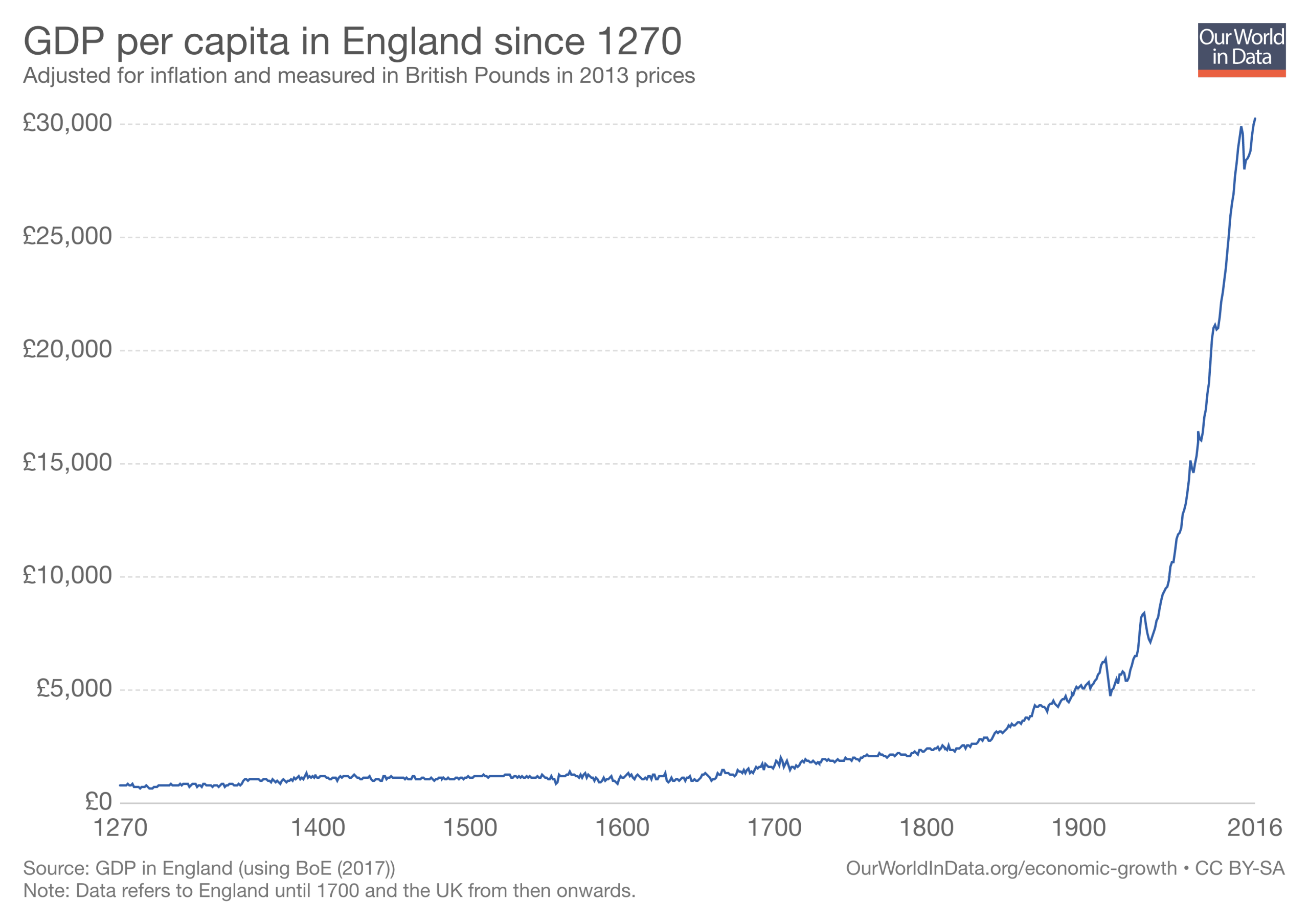
Economic growth, while notoriously difficult to measure, has been equally spectacular. GDP-per-capita figures for the United Kingdom show a clear take off beginning in the nineteenth century, then accelerating greatly in the twentieth.
Energy and fossil fuel use have followed similar chronologies as population and GDP-per-capita growth. Coal overtook traditional biofuels in the nineteenth century with oil and natural gas growing in spectacular fashion in the twentieth.
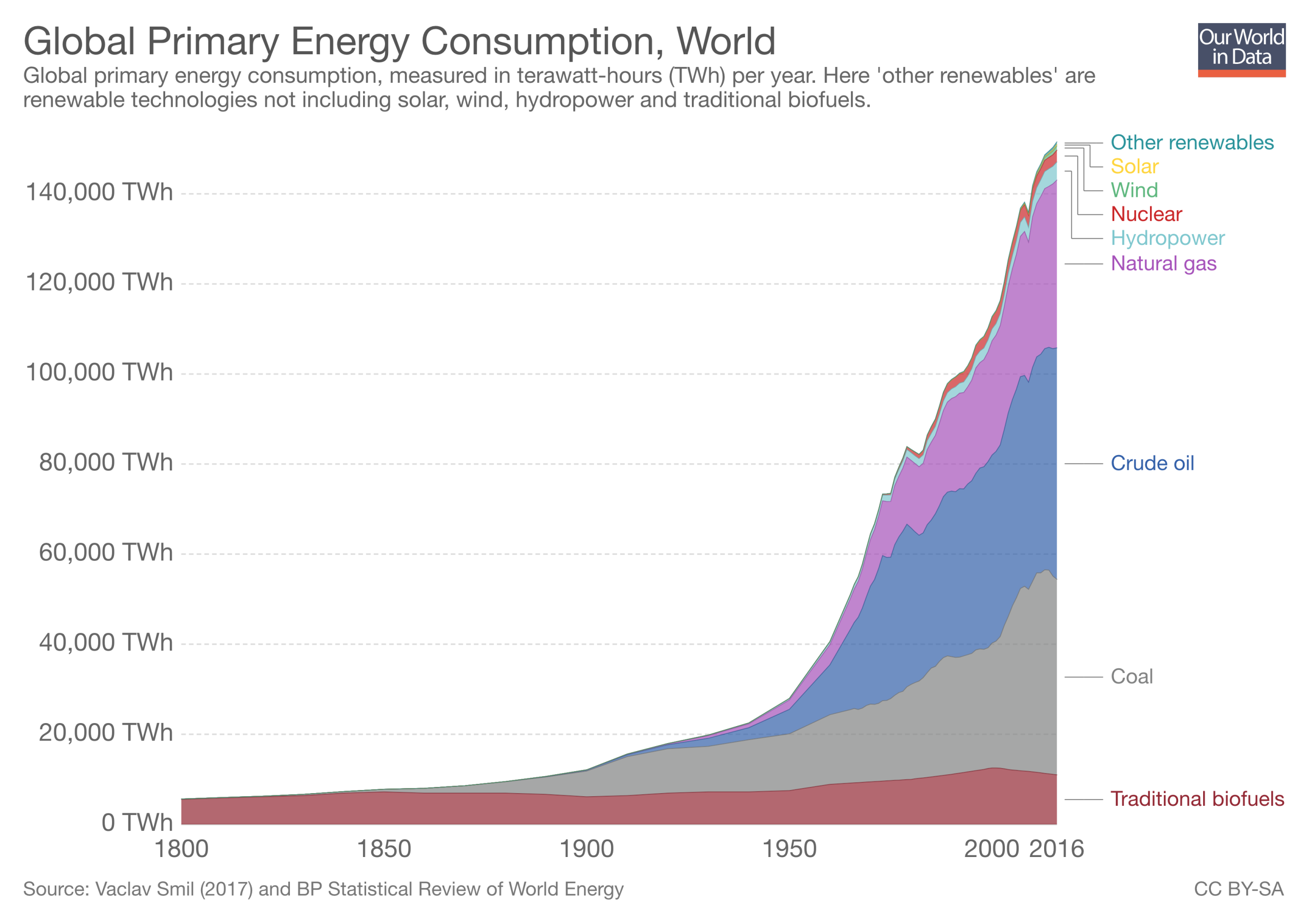
The last two decades have coincided with tremendous growth in population, wealth and energy use, alongside the rise of the West. The data is perhaps most remarkable for the period since 1950. Many have referred to Western Europe’s economic growth in the 1950s and 1960s as an economic miracle. While postwar recovery economic growth tends to be robust across most cases, the existence of cheap, abundant fossil fuels from the Middle East and elsewhere played a central role.

The explosion after the Second World War tells us two things. First, Enlightenment philosophy predated the tremendous growth in human population and economic activity. By the data above, energy and technology had more consequence than philosophy. Second, even if cultural and intellectual factors helped the West separate initially, fossil fuels arrived at the moment when the West was ascending and helped amplify the extent of its dominance.

Ships or fuel?

I have argued previously that the national security interests of Britain and the United States drove these hegemons to embrace coal and oil for their navies in a quest to maintain world power. Britain is an island, as is the United States for practical purposes, since two vast oceans separate it from any viable competitor. Naval power has been the sine non qua for these hegemons, and fossil fuel dominance has underpinned their naval power. Naval power, in turn, allows hegemons to scour the globe to secure fossil fuel supplies.

Two counterfactuals about fossil fuels and naval power are fun to imagine. The first is ancient Athens, which initially rose to power through its naval genius. Athens attracted allies, much like Britain and the United States, partly through coercion but also through the attractiveness of the system of free trade that it backed in the Aegean. Its main challenger, Sparta, was a land-based force and could not compete with Athens until it committed to building up its own naval skills and ships. Sparta finally defeated Athens due to the latter’s manpower and ship shortage, as well as Persian backing. It seems fair to say that Athens would have maintained its superiority with fossil-fuelled ships.

The second is Ming China, whose emperor funded seven overseas expeditions from 1405 to 1433. Naval investments halted thereafter, as the emperor must have deemed this not worth the cost. This decision was regretful four centuries later, when Western gunboat diplomacy helped keep China, Japan and other Asian peoples subservient and open for trade. Catching up in a naval arms race in the era of fossil fuels still eludes Asian powers. Japan was a partial exception but foundered in the Second World War because of its lack of oil supplies.

What goes up, always comes down, unless it’s lighter than air

These lyrics come from a children’s song about gravity that my wife and I used to play for my now five-year-old daughter. The fossil fuel binge and concomitant explosion in economic growth and population took humanity to new heights, enabled the rise of the West, and ensconced it, for now. The developments of the last two hundred years are incredible accomplishments, but they have also wrought horrendous consequences.

The gravity of this binge is already weighing down the West and the planet. World power is slowly shifting to non-Western countries, particularly as fossil fuels slowly lose their strategic importance. More importantly, fossil fuels have wrought serious destruction on the planet’s atmosphere and environment.

Ideas are the only things that can overcome gravity. Carbon capture and sequestration, renewables, energy efficiency, and carbon markets are all viable ways to bring us a soft landing. It has not been my intention to chastise the West for turning to fossil fuels, but to compel us to appreciate how much of the West’s rise was due to them. By being aware of our past, we can better understand our current predicament.


Subscribe to Our Newsletter

News, investigations, and analysis — our top stories every morning to start your day right.

coal fossil fuels hegemony naval power oil
Follow on Google News Follow on X (Twitter)
Share. Facebook Twitter LinkedIn Telegram WhatsApp Email Copy Link
Previous ArticleInvestors claim billions in VW case 
Next Article Scholars blast EU climate directive 
Rosemary Potter
  • X (Twitter)

Rosemary Potter is a Berlin-based journalist for Energy Reporters, covering European energy markets, cross-border policy, industry innovation, and the challenges of energy transition. With journalism training in the U.S., she combines investigative depth with a continental outlook. Her reporting amplifies the perspectives shaping Europe’s energy future across sectors, borders, and technologies. Contact: rosemary.potter@energy-reporters.com

Keep Reading

The Key Benefits of Oil

The Importance of Oil in Logistics

How energy subsidies affect the market and consumers

Add A Comment
Leave A Reply Cancel Reply

Subscribe to Our Newsletter

News, investigations, and analysis — our top stories every morning to start your day right.

Trending
nuclear power plant
Nuclear Industry: Global Investment Accelerates as Energy Demand Rises
The Key Benefits of Oil
CO2 Emissions: How Carbon Dioxide Affects the Environment and the Planet
News by category
  • Featured
  • News
  • Use
  • Climate
  • Industry
  • Opinion
  • Policy
  • Output
  • Storage
  • Grid
Information
  • About Us
  • Advertise
  • Meet the Team
  • Contact Us
  • Legal Notice
  • Privacy Policy

Subscribe to Our Newsletter

News, investigations, and analysis — our top stories every morning to start your day right.

Facebook X (Twitter) RSS
© Energy-Reporters.com. All rights reserved.

Type above and press Enter to search. Press Esc to cancel.