




| IN A NUTSHELL |
|
Recent advancements in quantum technology have sparked new possibilities for the future of internet communication. Engineers at the University of Pennsylvania have successfully transmitted quantum data using conventional fiber-optic cables, paving the way for a potential quantum internet. This breakthrough involved the development of a silicon “Q-chip” that can manage both quantum and classical data simultaneously. The significance of this innovation lies not only in the technical achievement but also in its compatibility with existing internet infrastructure, which could expedite the integration of quantum networks into everyday use.
Challenges of Scaling Quantum Networks
Quantum networks rely on the unique properties of quantum particles, such as entanglement, where the state of one particle can instantly influence another, regardless of distance. This phenomenon holds promise for exponentially increasing computational power by linking quantum processors. However, a major challenge lies in maintaining the quantum state, which can collapse upon measurement. This issue complicates the scaling of quantum networks as traditional data routing methods involve frequent measurements.
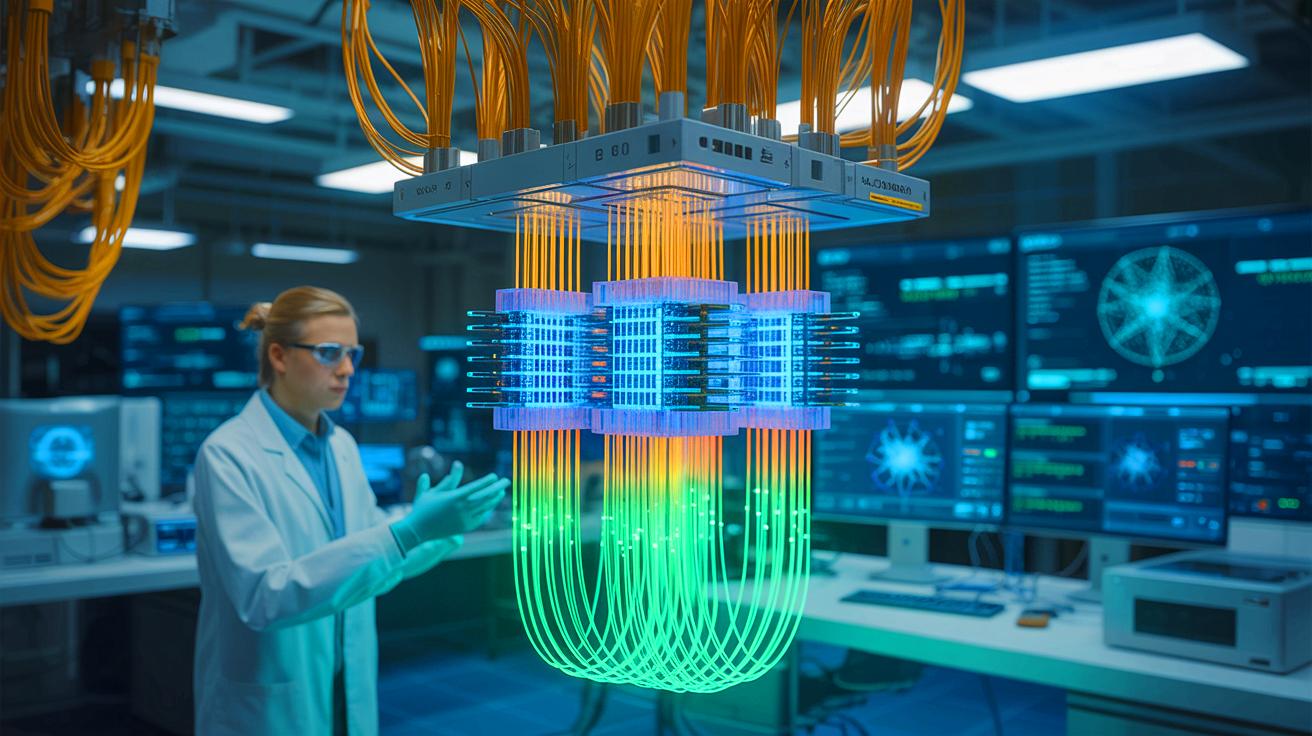
The University of Pennsylvania’s team addressed this challenge by designing the Q-chip, which integrates quantum data transmission with classical internet protocols. The chip pairs a classical optical signal with the quantum data it guides. This optical signal, or “header,” can be measured and used for routing without disturbing the accompanying quantum data. The approach allows the quantum information to be embedded within the familiar framework of internet protocols, facilitating its transmission over existing fiber-optic lines.
Furthermore, the team implemented an error-correction system that leverages the classical signal to detect and correct disruptions in the quantum data without direct measurement. This innovation ensures high data fidelity, maintaining accuracy above 97% in tests. Such advancements bring us closer to a robust quantum network capable of operating alongside current internet technologies.
Integrating Quantum and Classical Internet Protocols
The development of the Q-chip marks a significant step towards integrating quantum communication with the classical internet. By routing quantum data using the same protocols that manage traditional data, the researchers demonstrated a seamless merge of the two technologies. The Q-chip functions like a train, where the classical signal acts as the engine, and the quantum data follows in secure “cars.” This model ensures that the quantum data remains unmeasured and intact until it reaches its destination.
According to Yichi Zhang, the study’s lead author, the ability to wrap both types of data into internet-style packets could revolutionize how information is transmitted globally. The integration of quantum and classical protocols not only simplifies the implementation process but also reduces the need for completely new infrastructure. Liang Feng, a professor involved in the research, emphasized that this breakthrough allows for practical experiments on live commercial networks, such as those operated by Verizon.
The potential applications of such integrated networks are vast, ranging from highly secure communication to new forms of data processing and storage. As this technology develops, it could usher in a new era of connectivity, similar to the impact of the internet’s expansion in the 1990s.
Overcoming Environmental Challenges
Quantum networks face additional hurdles beyond technical integration, particularly from environmental factors. External conditions such as temperature changes, construction vibrations, and seismic activity can introduce noise into the network, potentially disrupting the delicate quantum states. The Penn team tackled this issue by developing an error-correction system that uses the classical signal to infer and correct potential errors in the quantum data.
This approach allows for continuous monitoring and adjustment without directly measuring the quantum particles, preserving their states. The system’s effectiveness was demonstrated with high fidelity, a crucial factor for ensuring reliable data transmission over long distances. The use of silicon in the Q-chip’s construction also enables mass production using existing manufacturing techniques, which is critical for scaling up the technology.
Despite these advancements, challenges remain, particularly in extending the reach of quantum signals. Unlike classical signals, quantum signals cannot be amplified without losing their entangled properties, limiting transmission distances. However, researchers are optimistic that ongoing developments will continue to address these limitations, much like the evolution of the early internet.
The Future of Quantum Internet
As the University of Pennsylvania’s research demonstrates, the integration of quantum data transmission with existing internet infrastructure holds significant promise for the future. By leveraging conventional fiber-optic cables and internet protocols, the transition to a quantum internet may occur more swiftly than previously anticipated. The implications of a fully operational quantum network are profound, offering unprecedented computational capabilities and secure communication channels.
Comparisons to the early days of the internet highlight the transformative potential of this technology. In the 1990s, universities began connecting their networks, laying the groundwork for the internet’s global expansion. Similarly, the current advancements in quantum networking could lead to unforeseen innovations and applications, reshaping industries and everyday life.
The road ahead involves overcoming technical challenges and scaling the technology for widespread use. As researchers continue to refine and test these systems, the question remains: How will the advent of quantum internet reshape our digital landscape and redefine what is possible in communication and computation?




Wow, this sounds like sci-fi turned reality! How soon can we expect this to be implemented on a large scale? 🤔
Wow, 97% accuracy! How does this compare to other quantum data transmission methods?
Is the 97% accuracy rate consistent across different environmental conditions?
So, does this mean we’re one step closer to teleporting data? 🚀
Does this mean we can have quantum Netflix soon? 😂
Thanks for the insightful article! It’s exciting to see quantum tech advancing so rapidly. 😊
97% accuracy is impressive, but how does this compare to classical data transmission?
I’m curious about the error-correction system. How does it work without measuring the quantum data directly?
Quantum internet? Sounds like a hacker’s worst nightmare! 😂
Can this technology be used to improve current internet speeds?
This is incredible! Thanks for sharing such a well-written article! 🎉
Interesting article! How does this advancement affect the security of data transmission?
Wait, are we talking about real quantum entanglement here? Mind-blowing! 😲
Wait, does this mean my internet connection will finally be faster than my morning coffee brewing? ☕️
How long before this tech can be used in everyday home internet?