


| IN A NUTSHELL |
|
In a major leap for the robotics industry, UBTECH, a Chinese company, has unveiled the Walker S2, a humanoid robot capable of autonomously changing its own battery. This breakthrough signals a new era of robotic autonomy, with implications for how machines can be utilized in everyday life. By achieving this level of independence, the Walker S2 could transform industries reliant on robotics by reducing human intervention in machine maintenance, marking a significant step toward fully autonomous robotic systems.
A World-First Innovation Changing the Game
The Walker S2 by UBTECH represents a substantial technological advancement: a robot that can independently manage its energy systems. The robot is engineered to detect when its battery is low and autonomously replace it using a specialized charging station. This ability is not merely a technical gimmick but addresses one of modern robotics’ critical challenges: the energy dependency limiting operational autonomy. Historically, even the most advanced robots required human intervention for energy maintenance, leading to costly service interruptions and limiting their continuous usage.
By overcoming this obstacle, UBTECH has set a new standard for robotic functionality. The Walker S2’s capability to autonomously manage its energy needs without human assistance allows for uninterrupted service, paving the way for more efficient and reliable robotic applications. This development could drastically reduce downtime in various industries, potentially leading to significant economic benefits and operational efficiencies.
An Intelligent and Adaptive Energy System
The Walker S2 is equipped with a dual 48-volt lithium battery system, designed for optimal performance. Each battery unit enables the robot to walk for two hours or remain stationary for four hours. A complete recharge takes just 90 minutes, maximizing work cycles. The system’s intelligence lies in its predictive analysis capability. The robot continuously assesses its charge levels, task priorities, and future energy needs to make autonomous decisions about when to change or recharge its batteries.
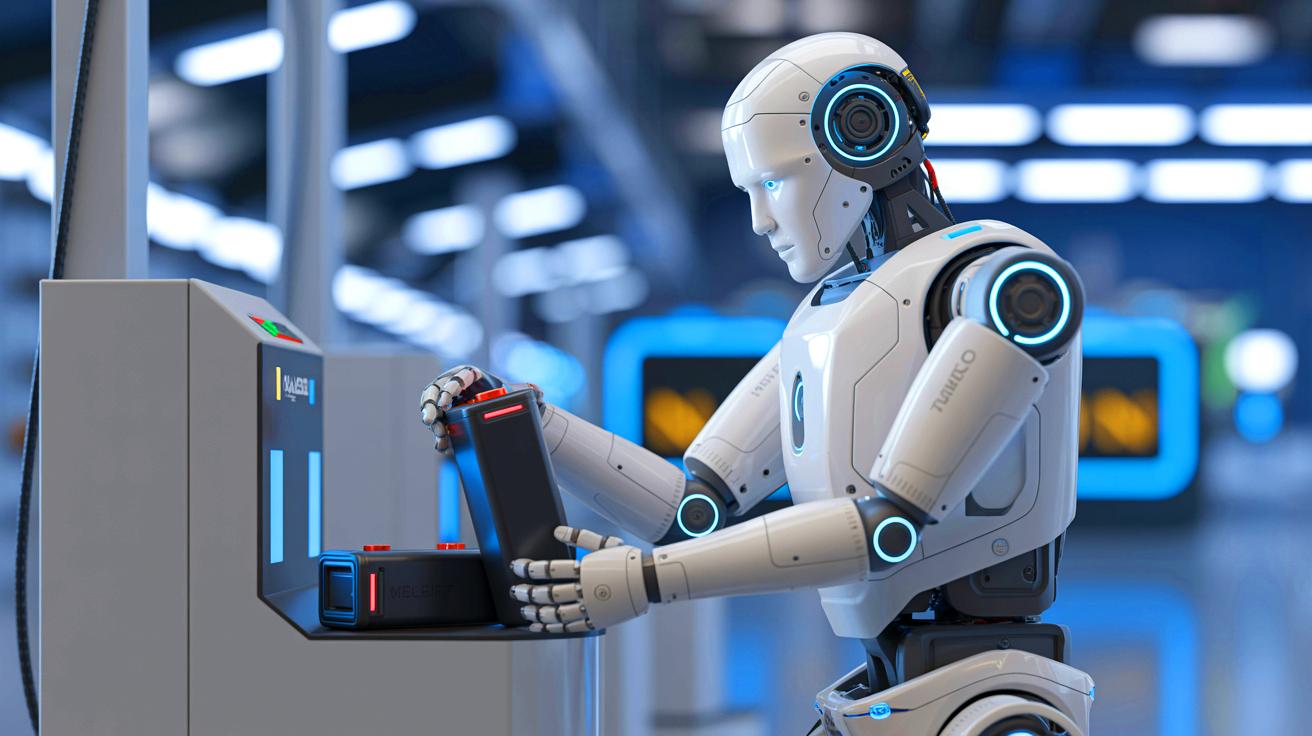
When the time comes, the replacement process is a fascinating display of mechanical precision. The Walker S2 approaches its charging station, positions itself, and uses its articulated arms to gently remove the depleted battery from its dorsal compartment. It then places the old battery in a charging slot before retrieving and installing a fresh one with equal dexterity. This seamless process underscores the advanced engineering and design of the Walker S2, making it a frontrunner in autonomous robotic technology.
Human-Centric Dimensions and Integration
Standing at 5 feet 3 inches tall and weighing 95 pounds, the Walker S2 is designed with human-like proportions, facilitating its integration into environments built for humans, such as industrial spaces and public areas. Its anthropomorphic design not only makes it more relatable but also allows it to navigate and operate in human-centric settings efficiently. With 20 degrees of freedom in movement, the Walker S2 boasts remarkable agility, while its Wi-Fi and Bluetooth connectivity ensure smooth communication with surrounding systems.
This thoughtful design makes the Walker S2 a versatile tool in various settings, from assisting in factories to interacting with the public. Its ability to seamlessly blend into human environments highlights its potential as a valuable asset in enhancing human-robot collaboration.
Total Autonomy: Toward an Industrial Revolution
The potential applications for the Walker S2 are diverse and promising. In manufacturing plants, this robot could provide continuous surveillance without service interruptions, revolutionizing production processes. In public spaces, it could welcome and inform visitors around the clock, redefining customer experiences. This Chinese innovation heralds the dawn of a new robotic era where machines no longer depend on human assistance for basic energy needs.
The Walker S2 demonstrates that complete robotic autonomy is not a science fiction fantasy but an accessible technological reality that will profoundly transform our relationship with intelligent machines. As robotics technology continues to evolve, what further advancements can we expect to see, and how will they shape the future of human-machine interaction?



Wow, a robot that can change its own battery! What’s next, cooking dinner? 🍳
Isn’t it a bit scary to think about robots becoming so independent? 🤔
Finally, a robot that doesn’t need a babysitter. Great job, UBTECH!
Can the Walker S2 dance too? 🤖💃
This is an amazing innovation, but what about the environmental impact of all these batteries? 🔋
Is it just me, or does the Walker S2 sound like the beginning of a sci-fi movie? 🎬
Does the Walker S2 have a self-defense mechanism? Asking for a friend. 👀