




| IN A NUTSHELL |
|
Star Catcher Industries has recently set a groundbreaking record in the field of power beaming technology. By successfully transmitting 1.1 kilowatts of power at NASA’s Kennedy Space Center, the company has demonstrated a significant step forward in energy technology. This achievement was made possible using readily available solar panel components, highlighting the potential for scalable and cost-effective solutions. The concept of beamed solar power has long intrigued scientists and engineers, tracing its origins back to science fiction and evolving into a tangible engineering pursuit. As the space industry continues to grow, Star Catcher’s advancements could redefine how power is distributed both in space and potentially back on Earth.
The Vision of Space-Based Solar Power
The idea of harnessing solar power from space is not entirely new. It was popularized by science fiction author Isaac Asimov in 1941 and later proposed as a viable engineering concept by Peter Glaser in 1968. The fundamental premise is to place solar collectors in orbit, where they can continuously capture sunlight without the interruptions caused by Earth’s atmosphere and weather. By converting this energy into microwaves, it can then be beamed back to Earth, providing a steady and reliable energy source.
Despite its potential, the concept of space-based solar power has seen fluctuating interest over the decades. The challenges are significant, ranging from the technological hurdles of building and maintaining such collectors in space to the economic feasibility of such projects. Nonetheless, recent advancements suggest a renewed interest and a push towards practical applications.
Star Catcher Industries is among the pioneers leading this charge. By focusing on smaller-scale power beaming, not directly to Earth but between spacecraft, they are laying the groundwork for future developments that could eventually lead to the ambitious visions of Asimov and Glaser.
Overcoming Satellite Power Limitations
One of the primary challenges in satellite design is the limited power supply. Currently, satellites rely on solar panels, which have constraints on their size, mass, and the costs associated with launching them. Increasing power generation typically involves enlarging these arrays, which is not always feasible.
Star Catcher’s approach offers a novel solution. Instead of relying solely on the satellite’s own solar panels, their technology beams concentrated solar energy directly to the panels. This method enhances the efficiency of existing systems without the need for expensive modifications or expansions.
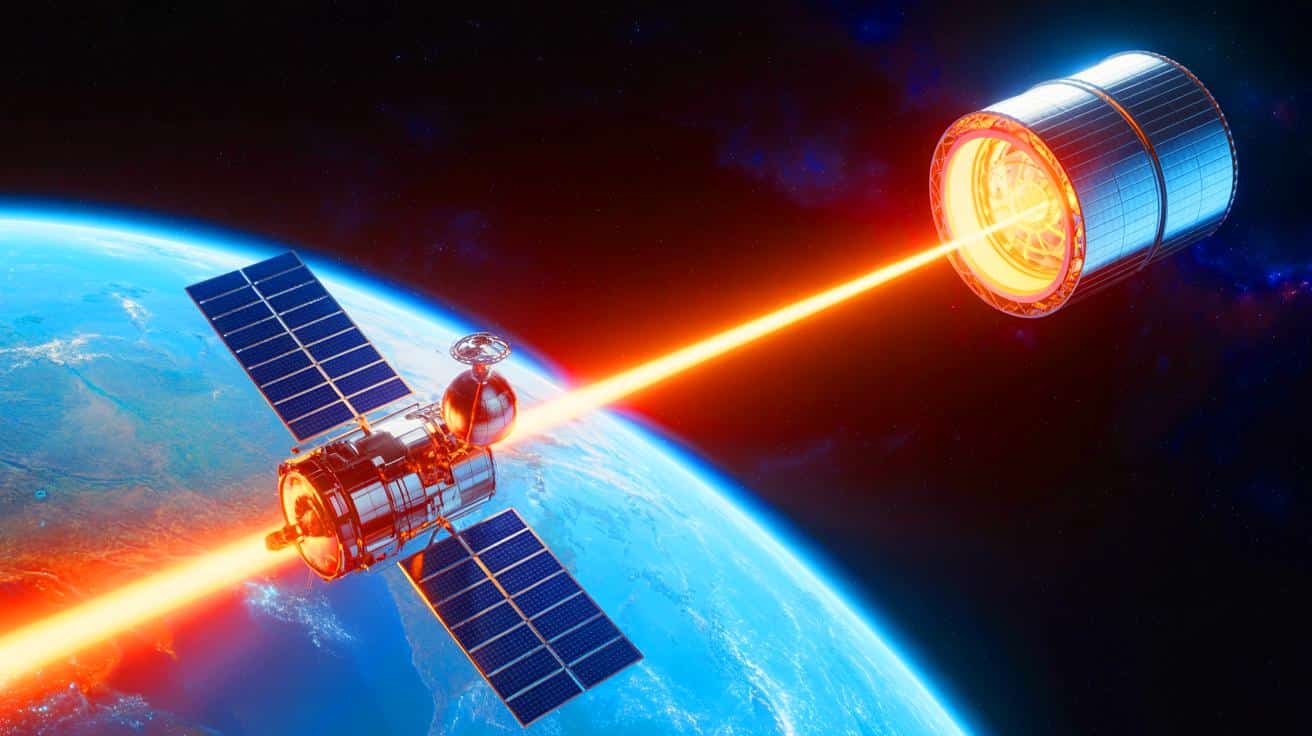
The company’s technology utilizes a grid of solar panels to power an optical multi-spectrum laser. This laser is finely tuned to match the wavelengths that the target solar panels can optimally absorb. The result is akin to using a magnifying glass to intensify the sunlight on a target spacecraft, significantly boosting power generation capabilities.
Record-Breaking Achievements and Future Plans
The recent test at NASA’s Kennedy Space Center marked a significant milestone for Star Catcher. By surpassing the previous beaming record of 800 watts, set by DARPA, with their 1.1-kilowatt achievement, Star Catcher has demonstrated the viability and potential scalability of their technology. This successful demonstration involved various solar panel designs, setting the stage for a planned orbital demonstration in 2026.
According to Andrew Rush, CEO and Co-Founder of Star Catcher, the results are a testament to the soundness and maturity of their approach. With existing Power Purchase Agreements already in place, the market recognizes the value of their technology. As Star Catcher continues to advance, their innovations could play a crucial role in building a resilient orbital power grid.
“Our existing Power Purchase Agreements confirm that the market understands both the value and scalability of our technology to revolutionize power delivery beyond Earth,” said Andrew Rush, CEO and Co-Founder of Star Catcher.
Implications for the Future of Space Exploration
The advancements in power beaming technology have far-reaching implications for the future of space exploration. By overcoming the power limitations of current satellite designs, Star Catcher’s technology could enable more ambitious missions and enhance the capabilities of existing space infrastructure. This could lead to longer mission durations, increased data transmission, and more robust satellite networks.
As the space industry continues to expand, the demand for reliable and scalable power solutions will only grow. Star Catcher’s success in this arena positions them as a key player in shaping the future of space-based energy distribution. Their technology could also pave the way for future endeavors involving large-scale space-based solar power collection and transmission to Earth, potentially transforming the global energy landscape.
The journey towards a fully realized space-based solar power system is still fraught with challenges. However, each step forward brings us closer to a future where energy is abundant and accessible, both in space and on Earth. How will these advancements influence the global pursuit of sustainable energy solutions?



Incredible! How long did it take to achieve this 1.1-kW record? 🤔
This is amazing! How soon can we expect this tech to be used for everyday power needs? ⚡
I’m skeptical. Is beaming power in space safe for nearby satellites?
Could this be the end of traditional energy sources? 🤔
Thank you, Star Catcher, for pushing the boundaries of tech! 🌟
What are the next steps for orbital demonstration in 2026?
I’m a bit skeptical. How safe is it to beam power through space?
How does this compare to other power beaming technologies out there?
Thank you, Star Catcher, for pushing the boundaries of technology! 👏
Can this tech be adapted for use on Earth? Would love to know! 🌍
Wow, 1.1 kilowatts! That’s a lot more than my microwave. 😂
Is there a risk of this technology being used for military purposes?
Not sure I understand how this works. Can someone explain? 🤷♂️
Sounds promising! But what about the costs involved?
What are some of the major challenges still facing power beaming tech?
This sounds like sci-fi coming to life! Amazing work by Star Catcher!