




| IN A NUTSHELL |
|
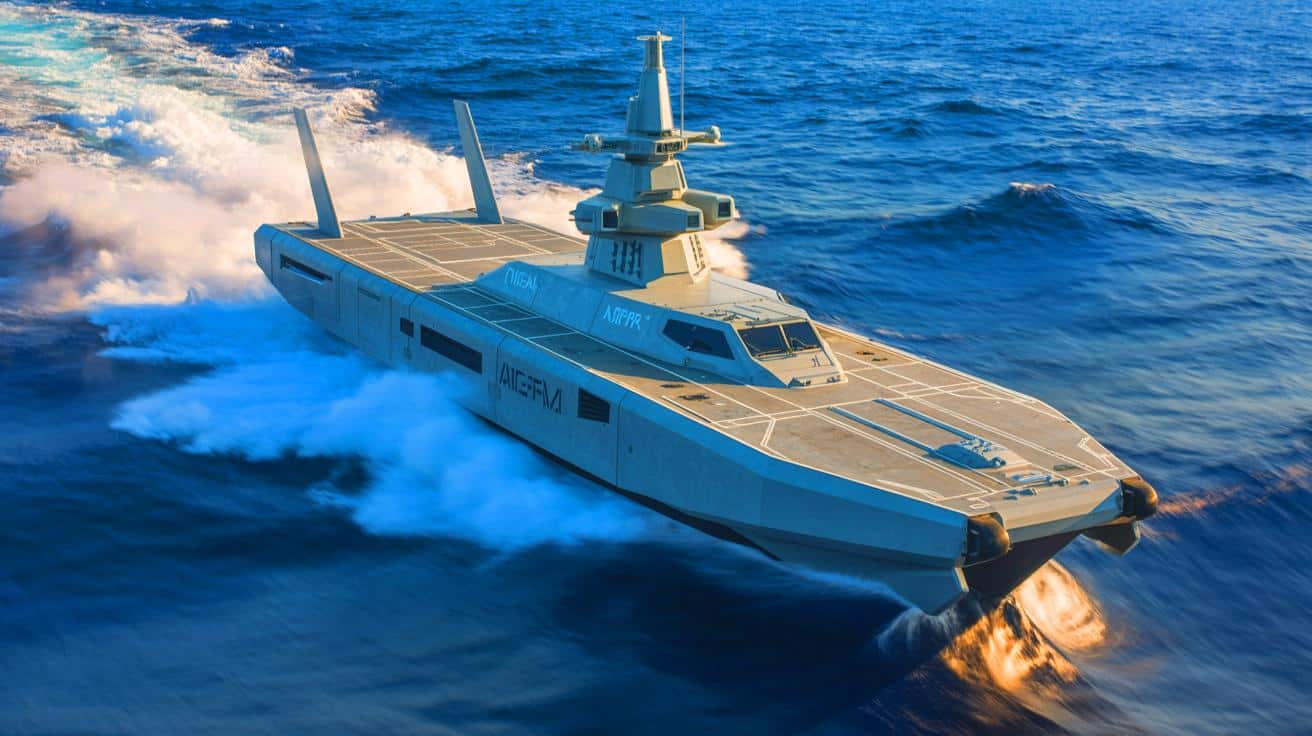
The unveiling of the AIRCAT Bengal MC represents a significant advancement in naval technology. As an autonomous warship, it combines speed, autonomy, and advanced weaponry, marking a new era in maritime warfare. Developed in collaboration between Australian and American experts, this vessel is designed to operate without a crew, carry substantial payloads, and travel long distances without the need for refueling. Its introduction not only showcases the latest advancements in military technology but also raises important questions about the future of naval warfare and the strategic balance of power at sea.
Pushing the Boundaries of Speed and Payload Capacity
The AIRCAT Bengal MC sets unprecedented benchmarks in speed and payload capacity for autonomous maritime vessels. Remarkably, it can carry a 44-ton payload, making it the first of its kind capable of transporting two full-size 40-foot ISO footprint modules. This capability offers significant strategic advantages, allowing the vessel to support a wide array of military operations. The warship can achieve speeds exceeding 57 mph while maintaining a cruising range of 1,150 miles without the need for refueling, which significantly enhances its operational flexibility.
Designed for both crewed and autonomous operations, the vessel provides a level of adaptability that traditional warships lack. This flexibility is viewed as a strategic advantage, allowing naval forces to deploy the AIRCAT Bengal MC in various scenarios without the limitations imposed by traditional crewed ships. Consequently, this vessel represents a paradigm shift in maritime engagements, potentially reducing reliance on larger, more expensive ships while maintaining—if not enhancing—firepower and maneuverability.
Armed for Modern Maritime Conflicts
The AIRCAT Bengal MC is equipped with formidable offensive capabilities, including the ability to launch both Tomahawk cruise missiles and Naval Strike Missiles (NSM). These advanced weapons systems provide significant firepower, positioning the vessel as a powerful tool in contemporary naval conflicts. Bo Jardine, CEO of Eureka Naval Craft, highlights the need for speed and agility in modern warfare, criticizing traditional vessels as outdated and costly. With its blend of speed and firepower, the AIRCAT Bengal MC offers a compelling alternative that enhances both lethality and operational speed.
This combination of capabilities makes the AIRCAT Bengal MC an attractive option for navies aiming to maintain a technological edge in an increasingly competitive maritime environment. Its design prioritizes rapid response and adaptability, qualities essential for modern naval engagements. As the vessel enters service, it raises important questions about the future of naval warfare and how nations will adapt to the evolving landscape of global military power.
A Platform Built for Multiple Missions
Beyond its combat capabilities, the AIRCAT Bengal MC is engineered to perform a wide range of missions. Its modular design allows for customization based on specific operational needs, enabling the vessel to function as a troop transport, landing support craft, electronic warfare platform, drone mothership, and more. This versatility is part of Eureka's broader fleet strategy, which includes other specialized vessels like the Bengal, Lynx, Jaguar, and Panther, each serving distinct roles such as reconnaissance, rescue, and high-speed transport.
The ability to tailor the AIRCAT Bengal MC to various missions makes it a valuable asset for modern navies. Its adaptability aligns with strategic objectives to maximize operational effectiveness while minimizing costs. As naval forces face diverse challenges in different theaters of operation, the AIRCAT Bengal MC's multifunctional capabilities could prove crucial in addressing emerging threats and maintaining maritime security.
Advanced Autonomy Powered by Greenroom Robotics
The technological heart of the AIRCAT Bengal MC lies in its advanced autonomous navigation system, developed by Greenroom Robotics. Known as the Greenroom Advanced Maritime Autonomy (GAMA), this system enhances the vessel's capabilities throughout all phases of operation. Its effectiveness was demonstrated during the Patrol Boat Autonomy Trial (PBAT), where it was validated on a decommissioned patrol boat.
James Keane, CEO of Greenroom, expressed confidence in the collaboration, noting the system's potential to significantly elevate the vessel's autonomous capabilities. Designed to appeal to a wide range of naval forces, including the US Navy, US Marine Corps, AUKUS partners, NATO allies, and regional navies across Asia, the AIRCAT Bengal MC is a formidable addition to the naval landscape, combining lethal capabilities with operational efficiency.
As the AIRCAT Bengal MC enters service, it prompts consideration of the future role of autonomous vessels in naval strategies worldwide. How will this technological advancement influence global naval power dynamics, and what implications will it have for international security and maritime stability?



Does this mean we’ll have robot pirates soon? 🏴☠️🤖
Wow, 57 mph is quite fast for a warship! Is this the new norm for naval tech? 🚀
This sounds like something out of a sci-fi movie. Are we sure it’s not just a Hollywood prop? 🤔
Autonomous ships sound amazing, but what about potential hacking risks?
How will the AIRCAT Bengal MC affect the current naval strategies? Seems like a game-changer!
At 57 mph, it must be one of the fastest ships out there!
I’m skeptical about autonomous tech. What if it malfunctions in the middle of a mission?
Can’t wait to see these ships in action! Thank you for the exciting update! 😃
Is there an emergency crew onboard just in case something goes wrong?
Zero crew? What about maintenance and repairs? 🤨
Thank you for the informative article. The future of warfare certainly looks different now!
Is 44 tons of payload enough for all necessary military equipment?
Hope this doesn’t lead to a new arms race. The world needs less, not more, military tension.
Tomahawk missiles without any crew? That sounds both awesome and terrifying. 😬
Great article! The AIRCAT seems like a leap forward in tech. What are the downsides?
If these ships are autonomous, what happens to sailors’ jobs? 🤔
Could this technology be adapted for commercial use, like in shipping or exploration?
Incredible speed! How does it compare to other warships in the fleet?
Really interesting. How does the AI handle unpredictable situations at sea?
Sounds like the Navy is moving towards a high-tech future. What comes next?
The speed is impressive, but can it evade enemy detection as well? 🤔
How long until other nations develop similar tech? This could spark a new wave of naval innovation.
Is it just me, or does this sound like something from a Terminator movie? 😅
Thanks for keeping us informed! The AIRCAT Bengal MC is truly fascinating. 👍
What’s the environmental impact of these autonomous ships compared to traditional ones?
With no crew onboard, what measures are in place to prevent hacking or cyber attacks?
How do these autonomous systems perform in rough weather conditions? 🌧️
Does anyone else think this will make war more impersonal? 🤔
Amazing tech, but how does it handle ethical decisions during combat?
Why does the Navy need a ship that travels at 57 mph? Are they racing someone? 😂
Really cool stuff! How soon before we see this tech deployed in real operations?
What happens if there’s a hardware failure? Is there a backup system in place? 🔧
Can these ships operate in all sea conditions, or are there limitations?
This is the future of warfare… Should we be excited or worried? 🤷♂️
How does the cost of these autonomous ships compare to traditional crewed vessels?
Is this the beginning of the end for traditional naval warfare? 🤖