

| IN A NUTSHELL |
|
In the realm of space exploration, the quest for efficient propulsion systems is relentless. A breakthrough by chemists at the University of Albany has introduced a compound that promises a 150% increase in energy output compared to traditional aluminum-based fuels. This boron-based compound could revolutionize how space missions are conducted by optimizing fuel storage and enhancing payload capacity. As space agencies and private companies push the boundaries of exploration, innovations like this could redefine the future of interstellar travel.
Exploring the Energy Potential of Boron
Boron-based fuels have long intrigued scientists due to their high energy density. These fuels release more energy per volume than conventional hydrocarbon fuels. Boron’s energy density is approximately 136.4 kJ per cubic centimeter, significantly surpassing the 30.7 to 36.6 kJ per cubic centimeter typical of hydrocarbons. These properties position boron as a compelling candidate for rocket propulsion.
The research team at the University of Albany focused on a particularly promising compound, manganese diboride (MnB2). This compound exhibits unique characteristics that may enhance its energy output. Alan Chen, a professor of chemistry, highlighted that boron compounds often possess unusual properties, setting them apart from other materials. However, synthesizing MnB2 had been a significant hurdle until recent advancements in laboratory techniques.
Joseph Doane, a doctoral student and the study’s lead author, explained that MnB2’s structural asymmetry and instability contribute to its high energy potential. The ability to finally synthesize this compound marks a notable achievement in the field of chemistry and could pave the way for new propulsion technologies.
A Structure With Built-In Tension
The energy potential of MnB2 is inherently linked to its structural makeup. Computer models reveal that the combination of boron and manganese atoms forms a compact, spring-like structure. This configuration allows for energy accumulation, which can be released during combustion. Gregory John, a co-author of the study, likened the structure to a cross-section of an ice cream sandwich, with hexagonal lattice layers acting as the outer “cookies.”
The slightly skewed hexagons in the lattice are key to understanding the energy storage capabilities of MnB2. This asymmetry reflects the tension within the compound, akin to a trampoline storing energy when flexed. When ignited, MnB2 releases energy in a manner similar to a trampoline returning to its flat state.
This innovative approach to fuel design could lead to more efficient propulsion systems, enabling spacecraft to carry heavier payloads or travel greater distances. The implications for space exploration are significant, offering potential solutions to some of the major challenges faced by current propulsion technologies.
Advanced Synthesis Techniques
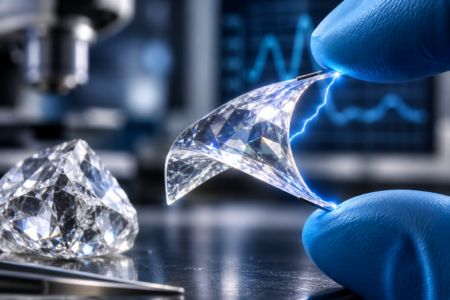
To synthesize MnB2, researchers employed extreme temperatures using an “arc melter.” This process involves compressing manganese and boron powders into a pellet, then subjecting it to a 3,000-degree Celsius electric current. The resulting material is quickly cooled to preserve its unique structure.
The synthesized MnB2 offers 20% more energy than aluminum for the same mass and 150% more energy for the same volume. Despite its high energy density, MnB2 remains safe to handle, requiring an ignition agent like kerosene to combust. This ensures the compound is practical for use in various applications.
Beyond its potential as a rocket fuel, MnB2’s properties could also benefit automotive catalytic converters and serve as a catalyst in plastic decomposition. These additional applications underscore the compound’s versatile nature and potential impact across industries.
Implications for Space Missions
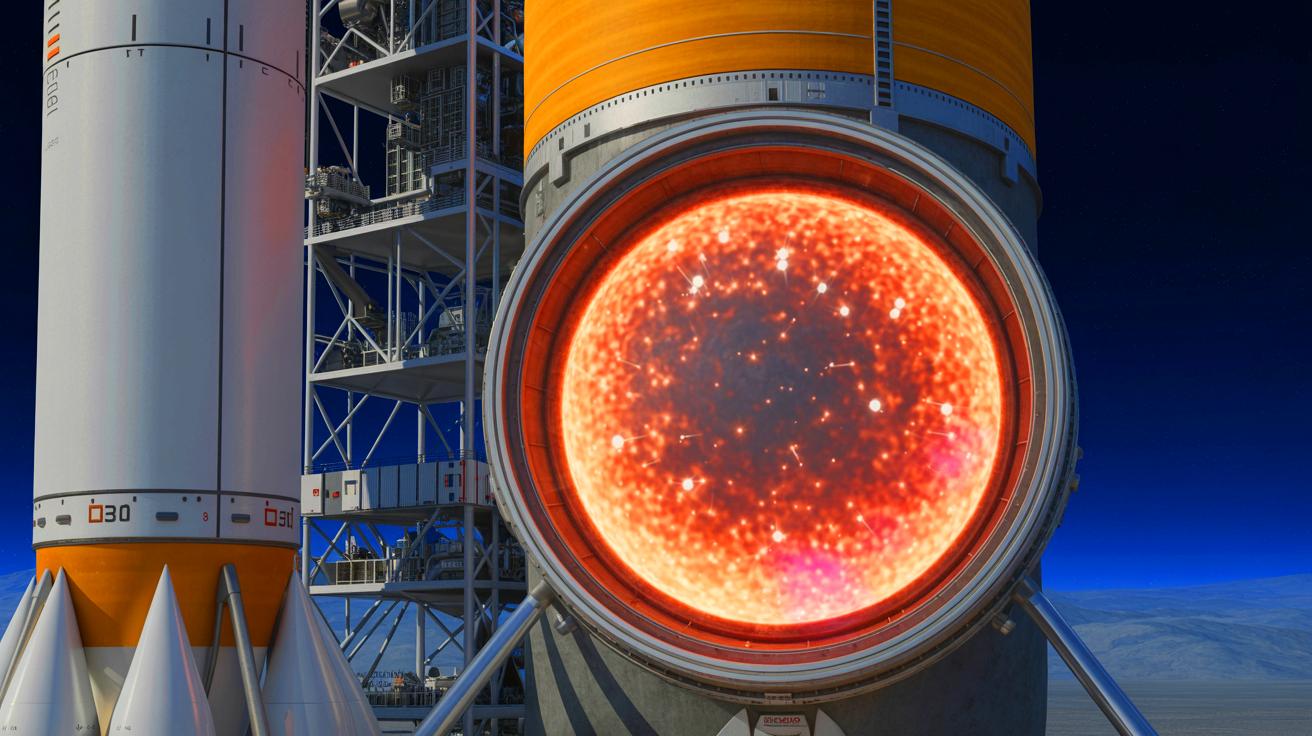
The introduction of a high-energy compound like MnB2 could significantly alter the landscape of space exploration. Currently, fuel occupies a substantial portion of a rocket’s mass, limiting the payload capacity. For instance, SpaceX’s Falcon Heavy allocates nearly 411 tons to propellant, with only about 64 tons available for payload in low Earth orbit.
Michael Yeung, an assistant professor of chemistry leading the research, emphasized the importance of optimizing space within rockets. By reducing the space required for fuel storage, missions could allocate more room for essential equipment, scientific instruments, and even sample retrieval from celestial bodies.
This advancement not only enhances existing missions but also opens possibilities for more ambitious endeavors. As space agencies and private companies look to the future, innovations like MnB2 could be pivotal in achieving long-term goals, such as Mars exploration or establishing lunar bases.
The development of MnB2 as a high-energy rocket fuel is a testament to the potential of chemical innovation in advancing space exploration. By addressing fundamental challenges in propulsion efficiency and payload capacity, this compound could transform the way missions are planned and executed. As researchers continue to explore the possibilities, what other groundbreaking technologies might emerge to shape the future of space travel?



Wow, 150% more powerful than aluminum? That’s insane! 🚀
Wow, 150% more powerful? That’s a game changer for sure! 🚀
Is this new fuel environmentally friendly? 🌍
Can’t wait to see how this affects future space missions. Will it make Mars missions more feasible?
Can this tech be applied to other industries besides space travel?
Is there any environmental impact from this new fuel? 🌍
Sounds like a game-changer for space missions! 👍
This sounds too good to be true. What’s the catch? 🤔
How soon can we expect this fuel to be used in actual rockets?
Thanks for the amazing insight into rocket fuel advancements! Keep it coming!
Does it cost more to produce MnB2 compared to traditional fuels?
Is this boron-based fuel more expensive to produce than traditional fuels?
Hope this doesn’t end up like other “revolutionary” fuels that never took off…
Wow, a fuel that’s more powerful and safe to handle. That’s impressive!
How soon can we expect this technology to be used in actual rocket launches?
I love the idea of a “spring-like” fuel. Science never ceases to amaze! 🧠
How does this compare to other emerging rocket fuels?
Will this fuel work in existing rocket engines, or are new designs needed?
It’s like we’re living in a sci-fi movie! Can’t wait to see where this leads. 🌌
Is the synthesis process scalable for mass production?
I’m skeptical until we see real-world results. Lab tests aren’t everything.
Can this technology be adapted for non-space applications as well?
150% more energy sounds like a pretty big deal. What’s the timeline for deployment?
Thanks for sharing this groundbreaking news! 🙌
How does the energy density of MnB2 compare to lithium-based fuels?
Are there any safety concerns with handling or storing this new compound?
Sounds great, but how about the cost? Will it be affordable for space agencies?
Is it true that this fuel could also benefit automotive industries?
Awesome read! Keep pushing the boundaries of space exploration! 🚀
Why haven’t we heard about boron-based fuels before now?
I’m curious about how this will affect private space companies like SpaceX.
What are the potential drawbacks or limitations of this new fuel?
Would love to see a follow-up article on practical applications for this fuel! 😊
How does the safety of MnB2 compare to traditional rocket fuels?
Thanks to the researchers for their hard work. This could change everything!
I wonder if this will also improve the efficiency of satellite launches.
This is a huge step forward! Can’t wait to see it in action.
Will this technology only be available to government space agencies?
How can they ensure the stability of the fuel in varying conditions?
Could this fuel be a stepping stone to even more powerful compounds?
Such an intriguing development! What will they think of next? 🤯
How does this innovation stack up against the latest in nuclear propulsion?
Thank you for these updates on space tech. Truly fascinating stuff!