



| IN A NUTSHELL |
|
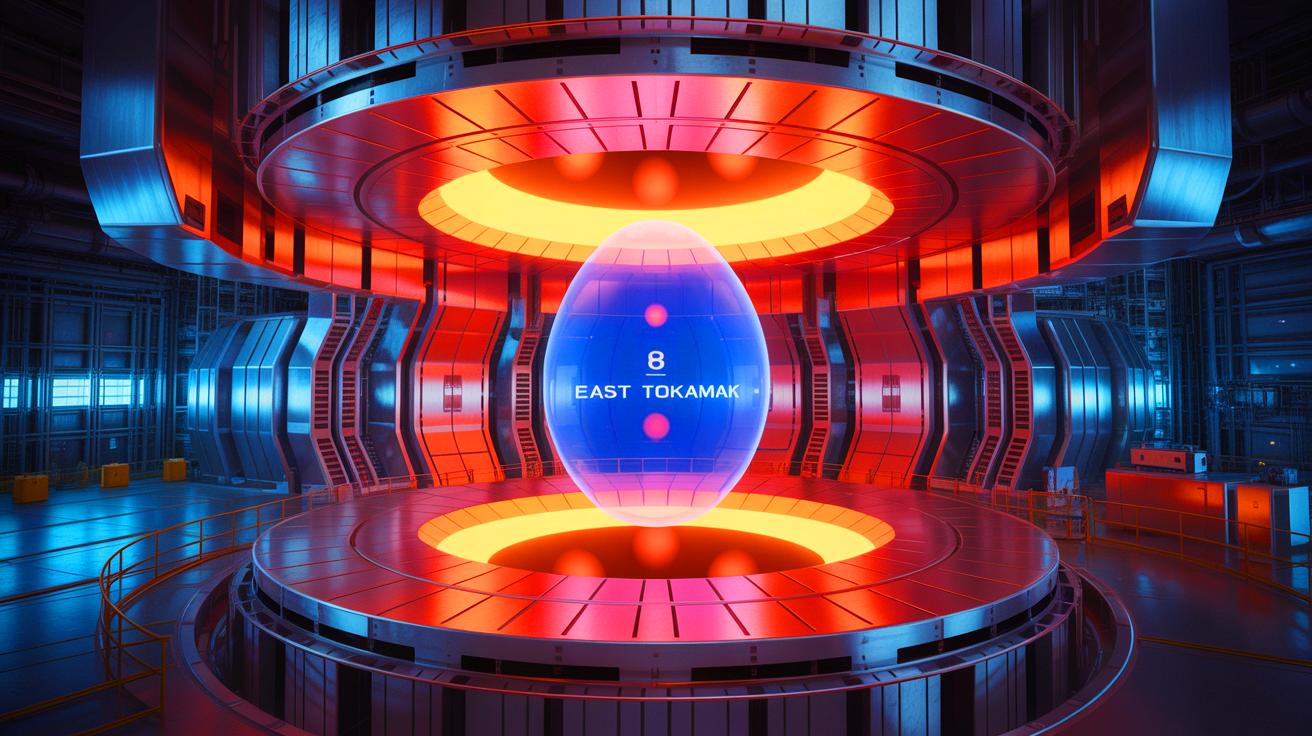
In a significant leap forward for fusion energy research, China’s Experimental Advanced Superconducting Tokamak (EAST), often referred to as the “artificial sun,” has set a new world record. The device maintained a steady-state high-confinement plasma operation for 1,066 seconds. This achievement, realized by the Institute of Plasma Physics at the Hefei Institutes of Physical Science, represents a critical milestone in the quest for sustainable fusion power. The accomplishment not only surpasses EAST’s previous record of 403 seconds but also underscores the potential of fusion energy as a clean and virtually limitless power source.
Breaking New Ground in Fusion Energy
The latest achievement by EAST marks a monumental step in fusion energy research. By maintaining high-confinement plasma operation for over 17 minutes, EAST has demonstrated its ability to sustain the conditions necessary for fusion reactions at unprecedented durations. This advancement is crucial as scientists aim to replicate the sun’s nuclear fusion process on Earth, which could provide a clean, inexhaustible source of energy.
Achieving such a milestone involves overcoming significant challenges. Nuclear fusion requires temperatures exceeding 100 million degrees Celsius, along with stable long-term operation and precise control. As SONG Yuntao, director of ASIPP and vice president of HFIPS, explains, “A fusion device must achieve stable operation at high efficiency for thousands of seconds to enable the self-sustaining circulation of plasma.” The recent record is a critical step toward realizing a functional fusion reactor, highlighting the progress in tackling these challenges.
Technological Upgrades and Innovations
Since its inception in 2006, EAST has undergone numerous upgrades to enhance its capabilities. According to Gong Xianzu, head of EAST’s Physics and Experimental Operations division, significant improvements have been made to various systems, including the heating system. Previously operating at the power equivalent to nearly 70,000 household microwave ovens, this system has now doubled its power output while maintaining stability.
Such advancements are crucial in achieving the sustained operation of fusion reactors. The upgrades not only contribute to EAST’s current achievements but also serve as a foundation for future experiments. These technological innovations are essential for advancing our understanding of fusion processes and for the eventual construction of practical fusion power plants.
The Role of International Collaboration
China’s involvement in the International Thermonuclear Experimental Reactor (ITER) program underscores the collaborative nature of fusion research. As the seventh member of ITER, China is responsible for a significant portion of the project’s construction and operation. ASIPP serves as the primary institution for China’s mission, contributing approximately 9 percent to the effort.
ITER, once completed, will be the world’s largest magnetic confinement plasma physics experiment, and EAST’s achievements provide invaluable insights for its development. International collaboration is seen as vital to overcoming the remaining challenges in fusion research. As SONG Yuntao noted, there is a hope to expand international partnerships through EAST to bring fusion energy into practical use globally.
Future Prospects and Developments
The future of fusion energy research looks promising, with new facilities under construction in Hefei, Anhui Province. These facilities aim to further accelerate the development and application of fusion energy, building on the advancements made by EAST. The insights gained from EAST’s experiments are expected to inform the design and operation of future reactors, such as the China Fusion Engineering Test Reactor (CFETR).
As EAST continues to push the boundaries of fusion research, the potential for achieving practical fusion energy becomes increasingly tangible. This progress not only holds promise for meeting global energy needs but also for reducing reliance on fossil fuels and minimizing environmental impact.
The success of EAST’s recent experiments represents a critical stride toward realizing the dream of limitless fusion energy. As research continues, the question remains: how soon can these breakthroughs be translated into practical, widespread use, and what impact will this have on the global energy landscape?


This is mind-blowing! 🌞 How soon can we expect fusion energy to impact our daily lives?
Wow! 180 million degrees? Guess it’s time to cook marshmallows on China’s fusion reactor! 🔥
The sun’s core is cooler than 180 million degrees. Can someone explain how that’s possible? 🤔
Is this really the future of energy or just another science experiment?
Why isn’t the US investing more in fusion technology like China? 👀
Great article! Thank you for sharing this exciting news.
Thank you for the informative article. It’s fascinating to see the advancements in fusion energy.
I’m skeptical… we’ve been hearing about fusion energy for decades. Is it really happening this time?
How soon can we expect this technology to impact our daily energy consumption?
Imagine no more energy bills. This could change everything!
How does this affect the global energy market? Will oil prices drop?
My electricity bill thanks you, China! 😂
Fusion sounds awesome, but are there any risks involved?
Fusion energy could be the game-changer we’ve been waiting for. Exciting times ahead!
China is really leading the way in clean energy. Impressive!
This is going to make fossil fuels obsolete. Finally, a cleaner future! 🌍
So, when can we have a mini fusion reactor in our backyard? Asking for a friend. 😉
Can someone please simplify what this means for the average person?
Why are American energy giants threatened by this development?
Is this technology safe? What if something goes wrong? 😨
How much time and money are we looking at before fusion power is available for everyone?
China’s doing what?! This is revolutionary! 🚀
How does this compare to other renewable energy sources like wind and solar?
Are there any environmental impacts of using fusion energy?
Wait, did you say 180 million degrees?! That’s insane! 😳
How will this breakthrough affect global politics and energy dominance?
Seems too good to be true. What’s the catch?
Thank you for the detailed explanation. Very informative!
Let’s hope this technology is shared globally. 🌐
How does the temperature of the reactor compare to nuclear fission reactors?
This will revolutionize energy consumption. Can’t wait!
How long before we see a fusion reactor powering a city?
Are there any ethical concerns with using fusion energy?
I’m curious about the costs involved. Is fusion energy expensive?
Sounds like the stuff of sci-fi. Is this really feasible?
All this talk of fusion energy and still no flying cars! 😂
Can fusion energy be decentralized, or will it remain in the hands of big companies?
Is this the end of the oil industry as we know it? 🤯
Will fusion energy be compatible with existing energy infrastructures?
How does this impact climate change efforts? 🌡️
Exciting news! But what are the next steps for EAST and global fusion research?
What are the implications for developing countries? Will they have access to this tech?
Fusion energy, here we come! When can we expect lower bills? 💰