




| IN A NUTSHELL |
|
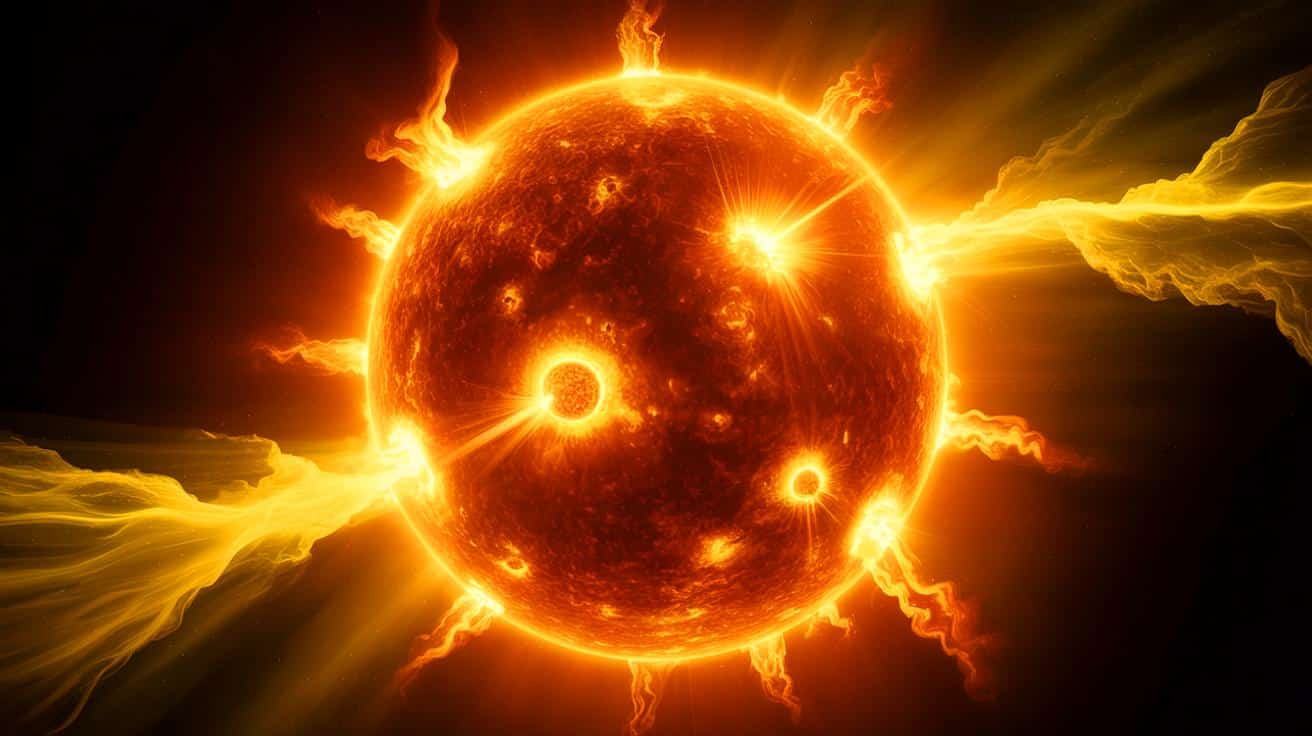
The Sun, our closest star, is a constant source of fascination and concern. Its fiery activity provides the energy that sustains life on Earth, yet it also poses potential threats through solar storms and flares. Scientists have long studied the Sun’s activity, tracing its cycles and attempting to predict its behavior. Recently, a new study has upended previous assumptions about the Sun’s future, suggesting an unexpected uptick in solar activity after years of decline. This revelation has significant implications for our understanding of solar dynamics and the potential impact on Earth’s technological infrastructure.
The Unpredictable Nature of Solar Cycles
The Sun’s activity follows distinct cycles, notably the 11-year solar cycle and the 22-year Hale cycle, named after astrophysicist George Ellery Hale. These cycles have been well-documented and provide some predictability regarding solar behavior. However, the Sun’s activity can also vary across much longer time frames, with periods of high and low activity spanning decades. Notable historical examples include the Maunder Minimum (1645-1715) and the Dalton Minimum (1790-1830), both characterized by significantly reduced solar activity.
Astrophysicists at the turn of the 21st century believed that the Sun was entering another prolonged period of low activity, a “deep solar minimum,” based on declining activity since the 1980s. This expectation was challenged by recent observations indicating a reversal in this trend around 2008. The Sun’s unexpected “awakening” with increased solar storms and flares suggests that our understanding of these longer cycles is still evolving.
New Evidence from Space Missions
NASA's recent study, published in The Astrophysical Journal Letters, sheds light on this unexpected shift in solar activity. Researchers analyzed data from the Advanced Composition Explorer (ACE) and the Wind mission, both launched in the 1990s. These missions provided detailed information on plasma flows and energetic particles emanating from the Sun toward Earth. The findings revealed a significant increase in solar activity, contrary to previous predictions.
Jamie Jasinski, the study's lead author from NASA's Jet Propulsion Laboratory, expressed surprise at the Sun's behavior. He noted that all indicators pointed towards a sustained period of low activity, making the recent uptick particularly intriguing. This new evidence underscores the complexity of predicting long-term solar trends and highlights gaps in our understanding of the Sun's behavior.
Implications for Earth
The increase in solar activity has direct implications for Earth, particularly concerning solar storms and flares. These phenomena can disrupt satellite communications, GPS systems, and even power grids, posing risks to modern infrastructure. The recent surge in sunspots and record numbers of X-flares, the most potent category of solar flares, has heightened concerns about potential disruptions.
Understanding and forecasting solar activity is crucial for mitigating these risks. The unpredictability of long-term solar trends adds an element of uncertainty, emphasizing the need for continued observation and research. The Sun's behavior is not only a matter of scientific curiosity but also a critical factor in safeguarding technological systems that are integral to daily life.
Future Missions and Ongoing Research
NASA is taking proactive steps to enhance our understanding of solar activity with upcoming missions. The Interstellar Mapping and Acceleration Probe (IMAP) will investigate the Sun's solar wind, while the Carruthers Geocorona Observatory will study Earth's exosphere and its interaction with solar weather. Additionally, the National Oceanic and Atmospheric Administration's SWFO-L1 will provide real-time measurements of solar wind, aiding efforts to protect Earth's infrastructure.
These missions represent a significant advancement in solar research, offering unprecedented opportunities to explore the Sun's behavior. As scientists continue to unravel the mysteries of solar dynamics, they aim to develop more accurate models and predictions. The quest to understand the Sun's long-term activity remains an ongoing challenge, but one with profound implications for both science and society.
As we continue to study the Sun's evolving behavior, questions remain about the underlying mechanisms driving its cycles and long-term trends. How will this newfound solar activity influence future scientific research and technological advancements? The answers may redefine our understanding of the Sun and its impact on our world.




Wow, this sounds serious! 🌞🌍 What precautions should we be taking right now?
So, should we start preparing for a solar apocalypse or is this just a phase? 🌞😅
If the Sun is “insane,” does that mean we can expect more beautiful auroras? 😄
Thank you for the article! It’s always fascinating to learn more about the Sun’s behavior.
Is it possible that our understanding of solar cycles is just fundamentally flawed?
How come scientists’ predictions were so off? Aren’t they supposed to be experts? 🤔
Thanks for the update! Could this affect our daily Internet usage? 📡
Why didn’t scientists see this coming? 🤔
Will this increase in solar activity affect climate change in any way?
Great article, but aren’t solar storms a normal part of the Sun’s cycles?
I’m no scientist, but doesn’t this mean we should be worried about our tech infrastructure? 🛰️
Just when I thought 2023 couldn’t get any crazier! 😅