

|
IN A NUTSHELL |
|
Once relegated to spas and local heating, geothermal energy is re-emerging as a strategic contender in the race to decarbonize power systems. Despite supplying under one percent of global energy, the resource already provides a substantial share of electricity and heat in places such as Iceland and Kenya, and long-running sites like California’s The Geysers demonstrate the technology’s baseload reliability. The current surge in interest is not accidental: a convergence of private capital, shifting policy priorities, and rapid technological innovation — from advanced subsurface mapping to novel drilling methods — is lowering barriers that once made geothermal prohibitively expensive. Promising next steps include next-generation geothermal approaches that target deeper, hotter rocks and emerging techniques such as millimeter-wave drilling and research into superhot reservoirs. As investment and R&D intensify, the argument grows that geothermal can move from niche to mainstream, complementing intermittent renewables while addressing grid stability and long-term emissions goals.
historical context and current uptake
Geothermal energy has roots that predate modern industrial society; hot springs and natural steam fields were exploited by the Romans and other early civilizations for bathing and heating. Over the last century the technology evolved into electricity generation, beginning in Italy in the early 1900s and expanding at commercial scale in places such as California’s The Geysers. These historical precedents matter because they show that geothermal is not experimental—what remains experimental is the scale and the places where it will be deployed.
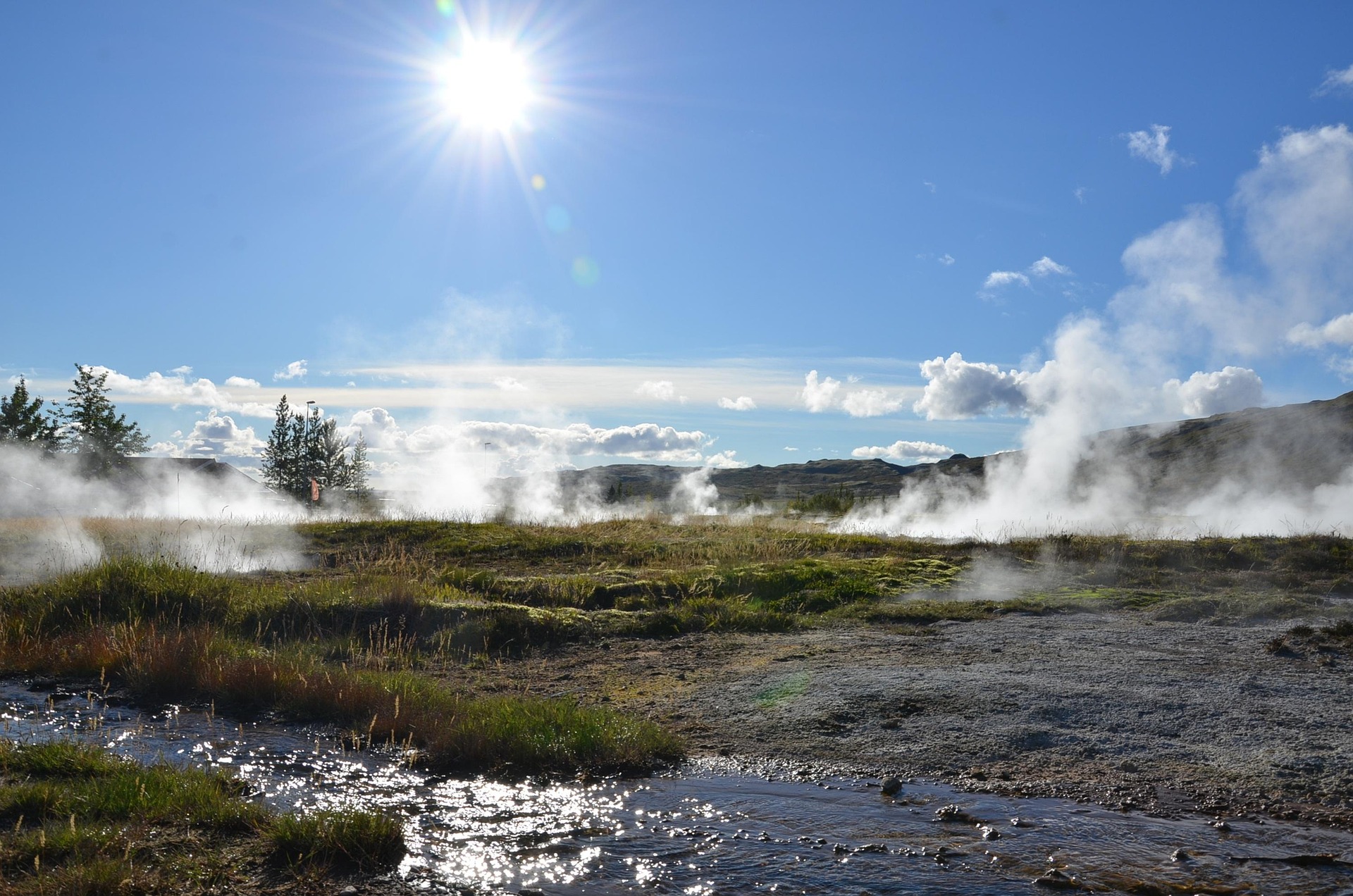
Despite millennia of use and a century of power production, geothermal still supplies under 1% of global energy demand, a gap between demonstrated capability and deployed scale. That gap is visible in national averages: Iceland and Kenya are frequently cited as outliers—Iceland meets nearly 30% of its electricity and roughly 90% of its heating from geothermal, while Kenya gets more than 40% of its electricity from geothermal sources. Facilities such as the Bjarnarflag plant in Mývatn illustrate how geothermal anchors local energy systems and regional economies.
There are compelling data-driven forecasts that justify accelerating deployment. The International Energy Agency’s work on geothermal highlights a clear, evidence-based pathway for growth, and analysts at organizations such as McKinsey argue that geothermal could become a material component of the U.S. power mix if the right cost and permitting conditions occur. If capital, policy signals, and technological improvements align, geothermal can shift from niche to mainstream. That prospect is why industry and governments are rethinking investment strategies now.
Public discourse and popular reporting are converging on geothermal as a strategic option: overview pieces and sectoral analyses have reframed geothermal from a regional curiosity into a potential global contributor, while sector portals track policy movements and project finance that matter for scaling. For readers wanting a concise synthesis, the IEA report and contemporary analyses provide both the technical baseline and the policy context for arguing that geothermal deserves a larger, prioritized role in energy planning.
technical pathways: from shallow heat to superhot rock
Geothermal options are not a single technology but a spectrum of approaches, each with distinct resource requirements and engineering trade-offs. At the shallow end, ground-source heat pumps tap relatively stable subsurface temperatures a few tens of meters below ground to provide efficient heating and cooling for buildings. This approach is well-established and can be deployed almost anywhere with appropriate ground conditions.
Beyond shallow systems lie three pathways that matter for large-scale electricity production: enhanced geothermal systems (EGS), closed-loop advanced geothermal, and superhot rock. EGS increases permeability in hot, dry rock so circulating fluids can harvest heat. Closed-loop systems embed piping into the subsurface and circulate a working fluid without exchanging it with formation waters. Superhot rock aims for temperatures approaching or exceeding 400ºC and—if harnessed—would change the thermodynamic game for power density.
Each pathway imposes distinct engineering requirements: permeability or an engineered fracture network for EGS, robust materials and leak-tight designs for closed-loop systems, and entirely new materials and sensors for superhot environments. That means research is not optional; it is central. MIT and other research centers have been explicit about these distinctions in their analyses of promise, progress, and challenges, and multidisciplinary work is already producing candidate solutions—from high-temperature sensors to novel drilling concepts.
It is also critical to note the geological geography: high temperatures are virtually ubiquitous at depth beneath continental crust, but they are accessible at economically viable depths only where the crust is thin or tectonically active. This is why places like Iceland and parts of the western U.S. are near-term priorities. Properly matching the technical pathway to the geology will determine whether individual projects succeed or fail, and that matching requires rigorous site characterization and cross-disciplinary engineering.
drilling, exploration and the economics of risk
Exploration and drilling are the principal cost and risk drivers for geothermal development. High-quality geophysical surveys can narrow the search, but they do not eliminate uncertainty: an exploratory borehole can cost millions, and even a well-executed program may encounter lower-than-expected temperatures or permeability. Investors and developers must accept a non-trivial chance that an exploratory well—sometimes quoted in the industry at around $10 million—yields disappointing results.
The technical toolbox for exploration includes direct test boreholes plus geophysical techniques such as magnetotelluric and electrical resistivity surveys that infer subsurface conductivity and temperature structures. These methods help prioritize targets, but the real economic squeeze remains drilling to depth: for next-generation systems in crystalline rock the target depth is commonly greater than four kilometers, a regime that is harder, slower, and costlier than typical oil and gas wells in sedimentary basins.
Drilling innovation is therefore a strategic imperative. Millimeter-wave drilling—developed in part at MIT’s Plasma Science and Fusion Center and moving toward commercialization—promises orders-of-magnitude improvements by vaporizing rock rather than mechanically grinding it. Other advances include higher-rate rotary systems, improved drill-bit materials, and sensor suites that allow real-time decisions to steer and optimize expensive wells. Nevertheless, the sector must balance technical breakthroughs against the persistent reality of up-front risk and fiscal conservatism among lenders.
| Exploration method | Primary value | Limitations |
|---|---|---|
| Magnetotelluric (MT) | Maps electrical conductivity and helps locate warm, permeable zones | Interpretation ambiguity; requires calibration with boreholes |
| Electrical resistivity | Identifies contrasts tied to fluids and temperature | Shallow resolution limitations; influenced by surface noise |
| Test boreholes | Direct temperature and permeability data | High cost; single-well risk |
policy, investment and industrial strategies
Policy and investment frameworks currently shape whether geothermal remains niche or scales rapidly. Successful deployment requires coordinated action across permitting, subsidies, risk-sharing instruments, and research funding. Recent bipartisan legislative attention—for example, measures introduced to accelerate research into superhot rock—signals that political appetite exists to de-risk frontier geothermal pathways.
Public incentives and public-private partnerships are not optional if geothermal is to reach its technical and economic potential. Development risk is front-loaded; therefore, instruments that underwrite exploration risk—grant matching, government-backed loan guarantees, or well insurance—will mobilize private capital at scale. International development banks and regional financiers also play a role: commitments to back renewable projects in markets such as Turkey illustrate how finance can unlock projects where sovereign or private balance sheets would otherwise hesitate.
National examples highlight the diversity of strategic responses. Some jurisdictions prioritize district heating and shallow systems for urban emissions reductions, while others concentrate on deep resources for firm power. The uneven performance of renewables across countries—illustrated by market reports and episodes where policy outcomes fell short of targets—underscores why diversified renewable portfolios that include geothermal are prudent. Cities pioneering renewable drives tend to be the same places investing in complementary technologies such as underground heat storage, reinforcing the argument that geothermal must be embedded within broader energy system planning.
Finally, industry clustering and industrial policy matter: research hubs and technology transfer pathways, like those forming around MIT and its industrial partners, accelerate commercialization. If governments and financiers align incentives to underwrite early risk and reward innovation, geothermal can attract the private capital it needs to scale. Absent those moves, promising technologies may remain confined to pilots and demonstration projects.
technology innovation and scaling pathways
Scaling geothermal depends on a cascade of technological innovations across drilling, materials, reservoir engineering, and surface power systems. Breakthroughs are already converging: millimeter-wave drilling could reduce time and cost to reach deep targets; advanced alloys and coatings aim to overcome corrosion and fouling in superhot fluids; and novel sensor systems enable live monitoring of micro-fracturing and reservoir performance.
Technologies must be developed with deployment economics in mind: a lab breakthrough is valuable only if it cuts levelized costs and reduces project risk. That is why applied research programs, industry consortia, and targeted venture activity are crucial. MIT Proto Ventures and MITEI-affiliated projects are examples of how university IP is being translated into startups and commercialization pathways. Research on substituting supercritical carbon dioxide for water as a working fluid is emblematic of the creative thinking required to operate where water chemistry and metal longevity are limiting factors.
| Innovation | Primary benefit | Commercial readiness |
|---|---|---|
| Millimeter-wave drilling | Higher penetration rates; less mechanical wear | Early field trials / commercialization |
| High-temperature sensors | Real-time reservoir management and risk reduction | Emerging; targeted deployments |
| Anti-fouling coatings & alloys | Extended component life in corrosive fluids | Lab-to-field transition |
| Closed-loop heat exchangers | Reduced environmental footprint; broader siting | Pilot and demonstration phases |
Commercial strategies should couple technological advances with pragmatic project designs. Co-locating geothermal plants with high-demand, firm-load customers—data centers are a notable example—creates resilient offtake arrangements that improve project bankability. Research that models co-location economics suggests these pairings can improve returns and reduce revenue volatility. Meanwhile, integrating geothermal with thermal storage, carbon management demonstrations, and district heating increases system value and political palatability.
If developers, investors, and policymakers prioritize the right mix of R&D, de-risking instruments, and strategic partnerships, the technological pathway to routine, cost-competitive next-generation geothermal is achievable. The remaining challenge is aligning incentives so that promising innovations move quickly from labs and demonstrations into the wells and plants that will prove geothermal at scale.
The accelerating interest in geothermal energy is not accidental; it is driven by a convergence of technological progress, policy momentum, and economic opportunity. Unlike intermittent renewables, geothermal offers continuous, firm baseload power with low emissions, making it uniquely suited to stabilize decarbonized grids. Recent innovations — from advanced subsurface imaging to novel drilling methods — reduce the historic risk that exploration and drilling would yield no usable resource. These technical advances make the case that geothermal can move from niche use toward large-scale deployment.
Critically, next-generation approaches such as enhanced geothermal, closed-loop advanced geothermal, and emerging superhot geothermal systems expand the geographic and thermal envelope where heat can be economically extracted. Where classical geothermal depended on fortunate geology near the surface, these methods can tap heat at greater depths and in drier, crystalline rock. That potential shifts geothermal from a regional curiosity to a strategic option for many energy systems — provided the sector solves the twin challenges of drilling costs and reliable high-temperature materials.
Breakthroughs like millimeter-wave drilling, high-temperature alloys, and anti-fouling coatings are tangible examples of how research ecosystems and private capital are lowering barriers. Public policy and targeted R&D can amplify these trends: predictable incentives and funding for demonstration projects reduce early-stage risk, attract investment, and accelerate learning-by-doing. Co-locating geothermal plants with large electricity consumers such as data centers or industrial facilities further strengthens the economic case by matching steady on-site demand with firm clean power.
Argumentatively, ignoring geothermal’s potential is a strategic mistake for any serious decarbonization plan. While practical hurdles remain, the combination of an inherently dispatchable resource, expanding technological toolbox, and growing policy support creates a compelling pathway. If stakeholders prioritize targeted demonstrations and market mechanisms that internalize the value of firm, low-carbon electricity, geothermal can become a cornerstone of resilient, low-emissions energy systems.
Geothermal Energy FAQ
Q: What exactly is geothermal energy?
A: Geothermal energy is heat derived from the Earth’s interior that can be used directly for heating or converted to electricity. It ranges from shallow ground temperatures exploited by heat pumps to very hot rock and fluids deep underground that can drive turbines. The resource is continuous and site-specific, making it a fundamentally different option than intermittent renewables.
Q: If it’s reliable, why does geothermal supply less than 1% of global energy today?
A: The limited market share reflects a history of technical and economic barriers, not a lack of resource. High upfront costs—especially for exploration and deep drilling—and the geological specificity of prime sites have restrained deployment. Additionally, industrial focus and capital flowed more to solar and wind over recent decades. That said, targeted innovations and fresh investment are beginning to address those constraints.
Q: Where has geothermal been successfully scaled?
A: Some countries have leveraged favorable geology to scale geothermal massively. For example, Iceland meets nearly 30% of its electricity needs and about 90% of its heating from geothermal, and Kenya generates more than 40% of its electricity from geothermal fields. In the United States, the The Geysers complex in California routinely supplies over 725 megawatts of baseload power.
Q: What are the categories of geothermal technology I should know?
A: The field is best understood by grouping technologies: conventional geothermal taps naturally hot, permeable reservoirs; enhanced geothermal systems (EGS) create or expand fractures to circulate fluids in hot, dry rock; advanced/closed-loop systems circulate a working fluid through buried pipes without relying on native permeability; and superhot approaches target rock at several hundred degrees Celsius, often near or above the supercritical threshold of water.
Q: What is meant by next-generation geothermal and why does it matter?
A: Next-generation geothermal refers to methods that access much hotter rock at greater depths—often several kilometers—and that use enhanced, advanced, or superhot techniques. These approaches could unlock heat resources beneath most continents, vastly expanding the potential footprint of geothermal electricity while providing firm, low-carbon power that complements intermittent renewables.
Q: What technical hurdles stand between pilot projects and routine deep geothermal power?
A: The core challenges are deep drilling in hard crystalline rock, managing fluids and chemistry at very high temperatures, and developing durable materials and sensors for extreme conditions. Reaching temperatures that support efficient power generation often means drilling beyond four kilometers, which is tougher and costlier than sedimentary oil-and-gas drilling. At above ~374ºC water becomes supercritical, bringing benefits but also severe corrosion and scaling risks.
Q: Are there promising innovations that could cut costs and risks?
A: Yes. Advances include novel drilling methods such as millimeter-wave drilling, which vaporizes rock and promises faster penetration; new high-temperature alloys and anti-fouling coatings to protect wells and piping; and robust sensors to monitor micro-fracturing. Commercialization efforts—for example, a company spun out to develop millimeter-wave drilling—illustrate how lab inventions can move toward field deployment. If these technologies reduce exploration failure rates and drilling time, project economics change dramatically.
Q: How do developers find the best sites before sinking expensive wells?
A: Developers use a mix of geophysical surveys and targeted boreholes. Techniques such as electrical resistivity and magnetotelluric profiling infer subsurface conductivity and help locate warmer, more permeable zones. Despite improved imaging, an exploratory well can still cost many millions—estimates in the field commonly cite figures around $10 million—so reducing geological risk is central to scaling investment.
Q: How does geothermal compare to solar and wind in a decarbonized grid?
A: Geothermal provides continuous baseload or firm power with low lifecycle emissions, unlike solar and wind which are variable. This makes geothermal especially valuable for grid reliability, long-duration energy provision, and coupling with electrification of heating and industry. The tradeoff is that geothermal projects are more site-dependent and capital-intensive up front, so the optimal system mixes technologies according to local needs and resources.
Q: Can geothermal serve heating needs as well as electricity?
A: Absolutely. Shallow geothermal and heat-pump systems deliver efficient, year-round heating and cooling for buildings; institutional projects have achieved near-complete heating/cooling coverage. At larger scales, district heating networks can distribute thermal energy from geothermal reservoirs to whole towns, eliminating combustion-based heating emissions where geology permits.
Q: What are the special challenges of superhot geothermal systems?
A: Superhot systems target rock and fluids at several hundred degrees Celsius, where materials, sensors, and fluids behave very differently. Conventional metals can corrode rapidly, and salts or silica can precipitate and block flow paths. Researchers are exploring alternatives such as using supercritical carbon dioxide instead of water to mitigate some chemical problems, but materials science and field testing remain critical bottlenecks.
Q: Is policy and investment shifting in favor of geothermal?
A: Yes. A mix of government initiatives, private capital, and policy attention is accelerating interest. The IEA has suggested that if costs fall, geothermal could account for a meaningful portion of future electricity growth—figures like meeting 15% of projected growth between 2024 and 2050 have been discussed. Recent bipartisan legislative moves to support research on superhot rock and the flow of venture funding into deep-technology startups indicate a stronger enabling environment than a decade ago.
Q: Are geothermal projects economically attractive for communities and investors?
A: They can be. Geothermal projects create local jobs in drilling, operations, and maintenance and can provide stable energy costs over long lifetimes. The economics hinge on reducing exploration risk and drilling cost; when developers can reliably reach hot rock at reasonable cost, the long operational life and low fuel requirements make the levelized cost of energy competitive. Until then, public support, risk-sharing mechanisms, and continued technological progress will determine the pace of deployment.
