




| IN A NUTSHELL |
|
The United States is pushing the boundaries of space technology with a groundbreaking project that promises to redefine satellite deployment. At the heart of this effort is the development of an orbital aircraft carrier by the innovative startup Gravitics. This venture underscores the U.S.’s strategic focus on space as an essential domain and highlights the growing collaboration between private companies and national defense entities. As global tensions rise, the U.S. is making a decisive move to secure its presence and dominance in the space arena.
The Vision Behind the Orbital Aircraft Carrier
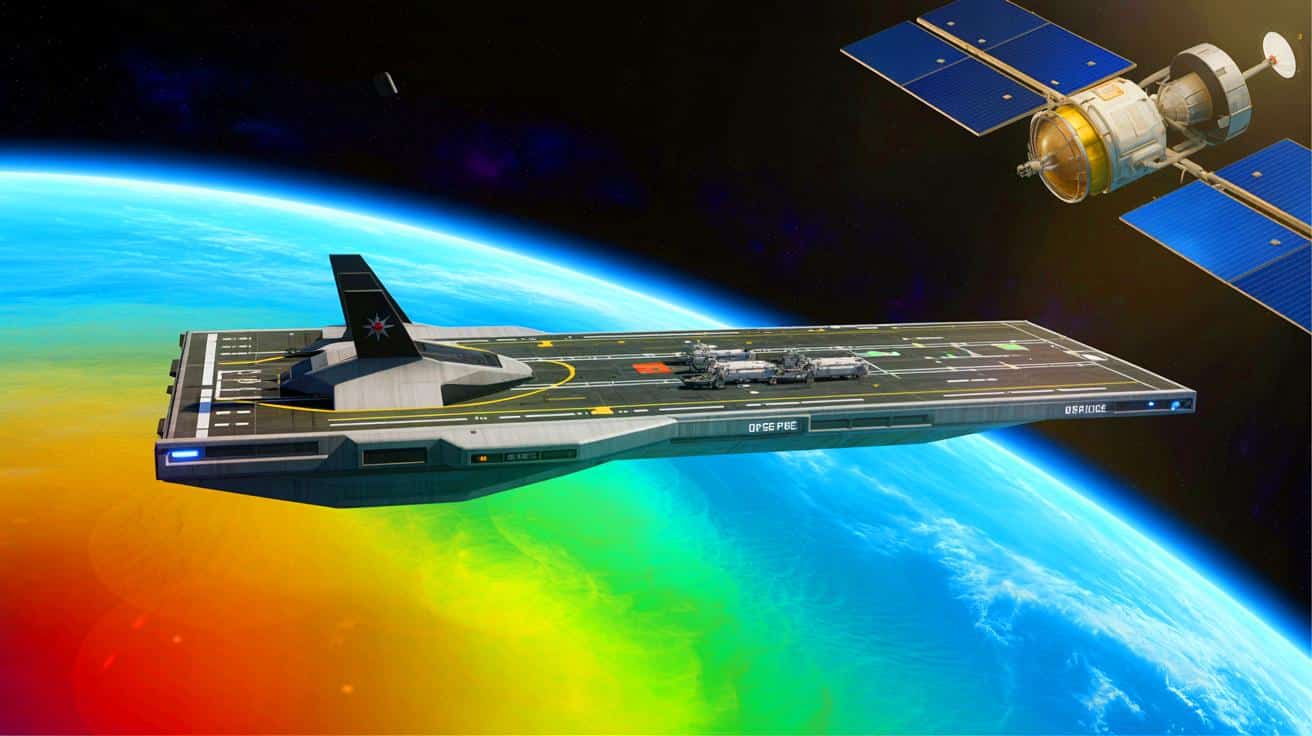
Gravitics has embarked on an ambitious mission to revolutionize satellite deployment with its orbital aircraft carrier. This $60 million project, funded by the U.S. Space Force, aims to enable the direct launch of satellites from Earth’s orbit. Such a platform promises to provide a faster and more agile response to national security threats by eliminating the need for traditional rocket launches. The concept of a space-based carrier represents a significant strategic advantage for the military.
This initiative reflects the U.S. military’s growing interest in maintaining a robust orbital presence, especially with the looming threat of a space arms race. Having a pre-positioned platform in orbit offers the flexibility to deploy satellites as needed, addressing both immediate and future security concerns. This innovation places the United States at the forefront of space technology, showcasing its commitment to maintaining leadership in this critical area.
Enhancing Space Security and Superiority
The orbital aircraft carrier developed by Gravitics offers an unpressurized environment to safely house multiple satellites. This setup ensures that satellites remain protected from the harsh conditions of space, safeguarding their batteries and sensitive electronics. Such protection is crucial in an era dominated by electronic warfare and cyber threats. The ability to isolate and shield satellites provides a strategic edge, enhancing the U.S.’s space security capabilities.
Moreover, the orbital carrier’s potential to conceal satellites from adversaries adds a layer of tactical advantage. Gravitics CEO Colin Doughan describes the carrier as a “game-changer” that aligns perfectly with the Space Force’s mission of orbital dominance. The project not only enhances military capabilities but also sets a precedent for future technological advancements in space exploration.
Public-Private Partnerships and Their Impact
The development of the orbital aircraft carrier is a testament to the growing importance of public-private partnerships in the space sector. Gravitics, in collaboration with Axiom Space, is also working on a pressurized space module, reflecting its commitment to both national defense and commercial solutions. This dual approach underscores Gravitics’s growth trajectory and its alignment with the Department of Defense’s objectives.
Such collaborations are crucial for integrating innovative technologies into national defense strategies. By working together, private companies and government entities can bolster the U.S.’s position in space while fostering the development of technologies with potential civilian applications. The success of these partnerships could pave the way for new market opportunities and further advancements in space technology.
The Future of Space Exploration
As technologies like the orbital aircraft carrier emerge, a new era of space exploration and exploitation is on the horizon. This technological leap has the potential to transform security, surveillance, and communication paradigms, not only for military operations but also for private sector involvement. The implications are vast, signaling a shift in how space is utilized and governed.
As the U.S. Space Force and companies like Gravitics prepare to meet future challenges, questions about international space cooperation arise. How will these innovations influence diplomatic relations between nations? More importantly, how can we ensure that space remains a domain of shared peace and progress, benefiting all of humanity?



How exactly does this orbital aircraft carrier work? Sounds like sci-fi! 🚀
This is a huge leap for mankind. Kudos to the Space Force and Gravitics! 🌌
Is it just me, or does “Warship Hangs Over the Clouds” sound a bit ominous?
What are the potential risks of having such a powerful platform in space?
How will this impact international relations? Will it increase tensions?
Sounds cool, but will this lead to weaponizing space? 😬
Thank you for the detailed article. It’s fascinating to see public-private partnerships in action!
How much of this project is classified? Seems like there’s a lot we don’t know.
Great innovation, but I hope it doesn’t lead to a new space arms race. 🤞
What’s the environmental impact of launching and maintaining such a platform?
Is there any potential for commercial use of this technology?
Thank you for sharing! Always excited to read about advancements in space tech.
Will other countries follow suit and build their own orbital carriers?
How do they plan on dealing with space debris? Seems like a big issue. 😐
I’m skeptical. How feasible is this project really?
Are there any plans for international cooperation on this project?
Absolutely mind-blowing! Can’t wait to see it in action! 🚀
How does this compare to China’s space capabilities?
Can civilians visit the orbital carrier in the future? 😄
Is this the beginning of space becoming a military domain?
Please keep us updated on the project’s progress. Thanks!
What about cybersecurity? Are these platforms protected from hacking?
How are they planning to fund this long-term?
I’m concerned about the potential for conflict over space territory.
Will this project inspire more young people to pursue STEM careers?
This is amazing but sounds like a plot for a sci-fi thriller. 😅
Is there any timeline for when it will be operational?
I waited all my life for aliens 👽 where are they 🤣🤣🤣🤣🤣🤣🤣🤣🤣🤣🤣🤣
Hope this doesn’t increase the militarization of space.
What role does Axiom Space play in this project?
Impressive! But it feels like we’re stepping into unknown territory.
How will this affect global satellite operations?
Thank you for the article. It’s a fascinating read on space innovation!
What measures are in place to ensure space remains peaceful?
Can this technology be used for peaceful purposes too? 🤔
Looking forward to the next steps! Keep the updates coming!
If you already have articles about a space platform, it’s not very secret if we’re trying to win that race and/or they’re just coming up with useless crap click bait articles as usual because the military sure as hell isn’t going to loop in this rag on something so secret as that.
Wow. Every. Single. Word. Including comments and all is a.i. garbage. I’ll set up my a.i. bot to read it for you.