


| IN A NUTSHELL |
|
Deep beneath the icy expanse of Greenland lies a relic of Cold War tensions—a U.S. military base buried within the ice. Originally constructed as a Cold War-era project, Camp Century was intended to serve as a launch site for nuclear missiles. However, this ambitious military plan never materialized, and the base was abandoned. Recently, NASA scientists rediscovered the site, sparking renewed interest and concern about the environmental implications of its hidden nuclear waste. As climate change threatens the stability of the ice, the future of Camp Century’s legacy remains uncertain. What does this discovery mean for the environment and global security?
The Discovery of Camp Century
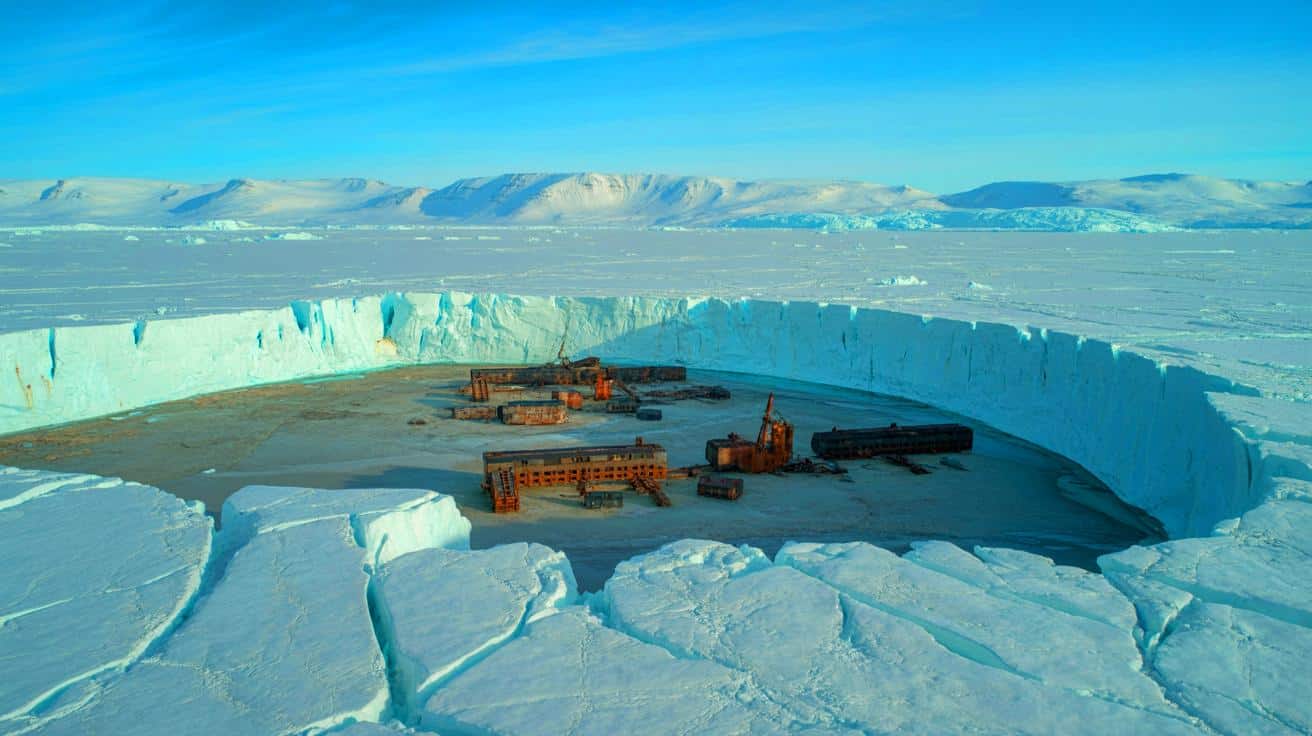
In April 2024, a NASA team conducting research over Greenland stumbled upon an unexpected find. Using radar technology designed to detect hidden structures, they identified what appeared to be an unusual formation beneath the ice. Upon further investigation, the site was confirmed to be Camp Century, a Cold War-era U.S. military base. This base, buried under 100 feet of ice, had been forgotten over the decades. The rediscovery of Camp Century highlights the enduring legacy of Cold War ambitions and the secrets that the ice has preserved.
Camp Century was built between 1959 and 1960 by the U.S. Army Corps of Engineers. It consisted of 21 underground tunnels stretching nearly 9,800 feet. The base was initially established as a scientific research center. However, its true purpose was far more strategic. It was intended as a front for a nuclear weapons program known as “Project Iceworm.” This ambitious plan aimed to house ballistic missiles beneath the ice, with the potential to launch them from this remote location.
Engineering a City Under the Ice
Constructing Camp Century was no small feat. Army engineers faced harsh conditions, including temperatures as low as -70 degrees Fahrenheit and winds reaching 125 miles per hour. The construction materials were transported by heavy bobsleds moving at a mere two miles per hour, taking a grueling 70 hours to reach the site from Thule, another U.S. base in Greenland. Despite these challenges, the engineers managed to build a complex network of tunnels and facilities beneath the ice.
The centerpiece of Camp Century was a PM-2 nuclear reactor, one of the first of its kind. This reactor provided power to the base, enabling scientific research and military operations. However, the reactor also produced a significant amount of nuclear waste. When the base was decommissioned in 1967, the reactor was removed, but the waste was left behind. This oversight has raised concerns about the environmental impact of the base as the ice continues to melt.
The Unfulfilled Ambitions of Project Iceworm
While Camp Century was publicly known, its true purpose as part of Project Iceworm remained a secret for many years. The project aimed to create an extensive network of tunnels spanning 52,000 square miles to house and launch 600 ballistic missiles. This ambitious plan required the construction of 60 launch centers and the deployment of 11,000 soldiers. However, the logistical challenges and harsh environmental conditions made the project impractical.
By 1967, the U.S. military abandoned Camp Century, and the base was left to be buried by the ice. The full extent of Project Iceworm was only revealed in 1997 by the Danish Institute of International Affairs. The revelation of the project’s true purpose raised questions about the transparency of U.S. military operations during the Cold War. Today, Camp Century stands as a testament to the ambitious and often secretive nature of Cold War-era military strategies.
The Environmental Concerns of Buried Nuclear Waste
One of the most pressing concerns surrounding Camp Century is the presence of nuclear waste left behind after the base was abandoned. This waste, estimated at over 47,000 gallons, remains trapped beneath the ice. As the climate warms and the ice begins to melt, there is a growing risk that this waste could be exposed, posing a potential environmental hazard.
Experts have warned that the ice covering Camp Century could start to melt by 2090, potentially releasing the nuclear waste into the environment. The original planners of the base never anticipated such a scenario, as the concept of global warming was not widely understood at the time. The situation raises important questions about the legacy of Cold War-era military projects and the responsibility to address the environmental impacts of past actions.
The rediscovery of Camp Century is a stark reminder of the hidden legacies of the Cold War. As climate change continues to alter the landscape, the potential release of nuclear waste poses a significant environmental challenge. This situation calls for international cooperation and innovative solutions to address the risks posed by buried military projects. As we confront the consequences of past actions, what steps should be taken to ensure the protection of our environment and the safety of future generations?



Wow, this is like something out of a spy novel! 🌍🕵️♂️
Wow, a secret base under Greenland? Sounds like something out of a James Bond movie! 😲
How could something this significant be forgotten for so long? It’s a bit concerning.
Why wasn’t this base taken care of earlier? Seems like a big oversight.
Are there any other secret bases we should know about? 😅
Is NASA taking any steps to mitigate the environmental risks posed by the melting ice?
Thanks for the informative article. It’s a bit scary to think about what’s under the ice.
Thank you for bringing this to light! It’s crucial to discuss the environmental impacts of past military projects.
What’s gonna happen to all that nuclear waste now? 😬
Does anyone know what steps are being taken to prevent the nuclear waste from leaking?
This is why climate change is such a big deal. We have no idea what it might uncover.
Project Iceworm? More like Project Ice-cream with all that melting going on! 🍦