




| IN A NUTSHELL |
|
In the realm of advanced manufacturing, 3D printing has emerged as a transformative technology, reshaping industries with its versatility and innovation. Among the various methods under the 3D printing umbrella, vat photopolymerization (VP) stands out for its ability to create intricate structures. Traditionally, VP has been limited by its reliance on resin, which can lead to weaker, porous structures. However, a groundbreaking study from scientists at the Ecole Polytechnique Fédérale de Lausanne (EPFL) in Switzerland has introduced a novel approach that leverages VP to produce metal structures 20 times stronger than those made with conventional 3D printing techniques. This advancement holds significant promise for various industries, from aerospace to electronics.
Understanding Vat Photopolymerization
Vat photopolymerization, a key player in the realm of additive manufacturing, operates by using light-reactive resin that hardens under specific light sources like lasers or ultraviolet light. Unlike more basic 3D printing methods like fuse deposition modeling (FDM), which primarily uses plastic, VP enables the creation of highly detailed and complex structures. This capability makes it particularly valuable for producing components that require precision, such as those used in electrical batteries and storage technologies.
Despite its advantages, VP has faced significant limitations when it comes to producing metallic structures. The traditional approach often results in porous outputs that are susceptible to shrinkage and warping, compromising the strength of the final product. This has historically made VP less suitable for applications where metal is essential.
The Breakthrough: Stronger Metal Structures
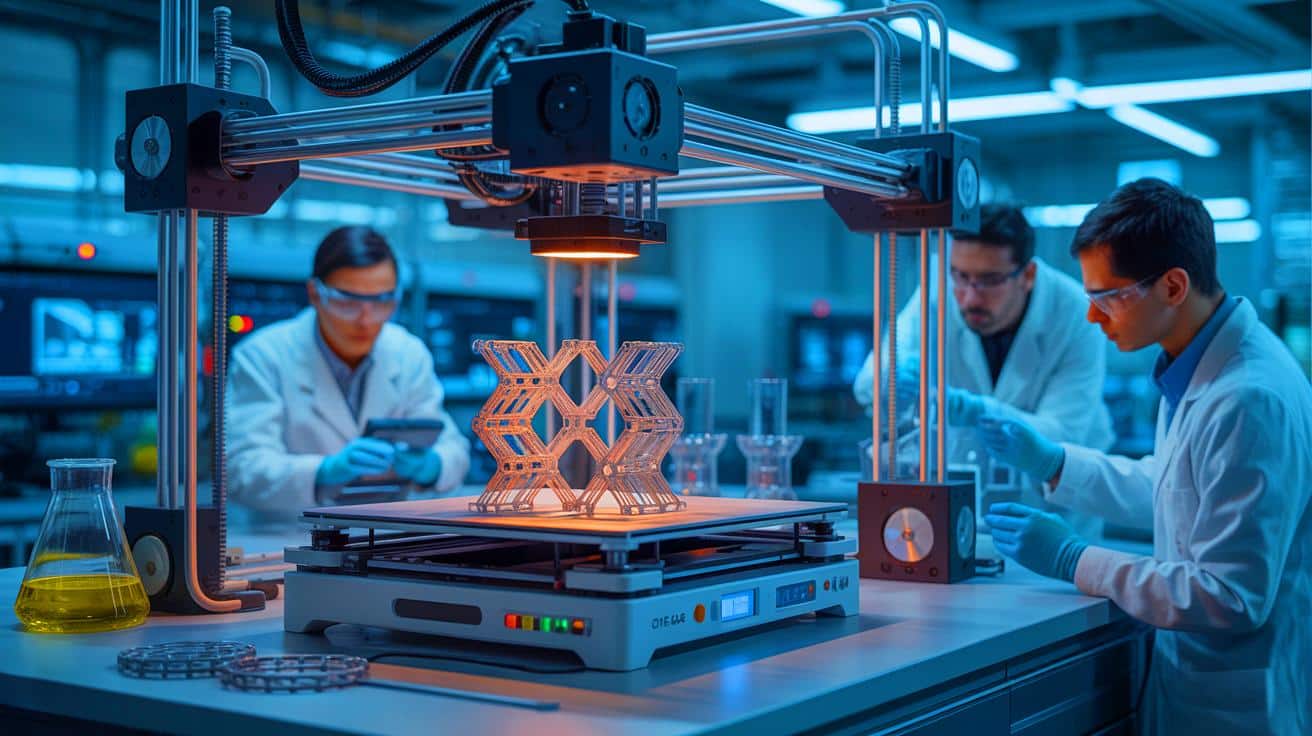
The research conducted by the team at EPFL marks a significant leap forward in overcoming the limitations of VP. By employing a sophisticated process involving hydrogels and metal salts, the researchers have developed a method to create robust metal structures. Initially, a lattice structure is 3D-printed using hydrogel. This lattice is then repeatedly infused with metal salts, allowing nanoparticles to distribute evenly throughout the structure. After several cycles of this process, the hydrogel is removed through heating, leaving behind a dense metallic framework.
This innovative technique not only enhances the strength of the metal structures but also reduces the shrinkage commonly associated with VP. The outcome is a metal that is 20 times stronger than those produced through traditional 3D printing methods. Such improvements could revolutionize sectors that demand high durability and precision, including aerospace engineering and medical device manufacturing.
Potential Applications and Industry Impact
The implications of this new VP method are vast. Industries that rely on intricate metal components could see significant benefits from adopting this technology. For instance, in the aerospace sector, the ability to produce stronger, lighter components could lead to more efficient aircraft designs. Similarly, in the field of electronics, this method could enable the production of more durable and compact devices.
The technology also aligns with the growing demand for sustainable manufacturing practices. By allowing material selection post-3D printing, this method reduces waste and enhances material efficiency. Moreover, as a low-cost process, it could democratize access to high-quality metal manufacturing, fostering innovation in smaller enterprises and research institutions.
“Our work not only enables the fabrication of high-quality metals and ceramics with an accessible, low-cost 3D printing process; it also highlights a new paradigm in additive manufacturing where material selection occurs after 3D printing, rather than before,” said Daryl Yee, a senior author of the study.
Challenges and Future Prospects
Despite the promising advancements, challenges remain in the implementation of this new VP method. One of the primary hurdles is the time-intensive nature of the process. The repeated infusion steps required to achieve the desired metal density and strength make the technique slower compared to traditional methods. This time factor poses a significant barrier to widespread industrial adoption.
However, the research team is optimistic about overcoming this obstacle. Efforts are underway to automate the process using robotic systems, which could significantly reduce the processing time and enhance scalability. The potential for automation opens new avenues for industrial efficiency and productivity, making the technology more appealing to a broader range of industries.
The advancements in 3D printing technology, particularly in metal manufacturing, showcase the relentless pursuit of innovation in the field of additive manufacturing. As researchers continue to refine these processes, the question remains: How will industries adapt to and integrate these groundbreaking technologies to redefine the future of manufacturing?


Wow, 20 times stronger? That’s mind-blowing! 🚀
Wow, 20 times stronger? That’s incredible! How soon can we expect to see this tech in action? 🚀
Can this technology be used in the automotive industry as well?
So you’re telling me we just leveled up metal like it’s a video game? 😂 #EpicLoot
I’m skeptical about the “20 times stronger” claim. What’s the catch?
Can this technology be applied to consumer electronics? Imagine the durability boost! 🔋
Thanks for the great article! This tech sounds like a game-changer for aerospace.
This sounds promising, but how cost-effective is it compared to traditional methods?
Wait, so are we talking about metal stronger than titanium? 🤔
Impressive work by the EPFL team! Thanks for pushing the boundaries of what’s possible. 💪