

Close Menu
  • Featured
    • News
    • Consumption
    • Environment
    • Industry
    • Opinion
    • Policy
    • Production
    • Storage
    • Transmission
  • About Us
  • Advertise
  • Contact Us

Subscribe to Our Newsletter

News, investigations, and analysis — our top stories every morning to start your day right.

Trending
learn effective methods to assess the carbon footprint of your energy consumption and discover practical tips to reduce your environmental impact.
How to evaluate the carbon footprint of your energy use
explore the ultimate guide to different types of renewable energy sources, including solar, wind, hydro, and more, to understand their benefits and applications for a sustainable future.
Guide to different types of renewable energy sources
explore the vital link between energy consumption and water resources, highlighting how energy use impacts water availability and sustainability.
The connection between energy use and water resources
Facebook X (Twitter) LinkedIn YouTube TikTok
Energy Reporters
Facebook X (Twitter) RSS
Subscribe
  • Featured
  • News
    Illustration of Abu Dhabi National Oil Company's $11 billion financing deal for future gas production projects.

    ADNOC Secures $11 Billion for Gas Expansion, Transforming Energy Future and Boosting Local Economies

    12/19/2025
    Illustration of Energy Transfer LP's Lake Charles LNG project suspension and strategic shift to pipeline infrastructure.

    Energy Transfer Suspends Lake Charles LNG Project, Sparking Concerns Over Job Losses and Future Energy Solutions

    12/19/2025
    Illustration of a U.S. judge blocking Michigan's attempt to shut down Enbridge's Line 5 pipeline.

    Judge Blocks Michigan’s Effort to Shut Down Enbridge’s Line 5 Pipeline, Sparking Environmental and Economic Debate

    12/18/2025
    Illustration of a Venezuelan oil tanker under U.S. sanctions and its impact on the oil industry.

    Venezuela’s Oil Industry Faces Turmoil as Tanker Seizure Prompts Calls for Contract Revisions and Discounts

    12/17/2025
    Illustration of a woman standing in a snow-covered street in Manhattan during a cold snap.

    US Energy Emergency Declared as Northeast Cold Snap Threatens Homes, Businesses, and Critical Infrastructure

    12/16/2025
  • Use
    discover effective steps to make your business more energy efficient and reduce operational costs while promoting sustainability.

    Steps to make your business more energy efficient

    06/16/2026
    learn step-by-step how to conduct an energy audit for your home to identify energy-saving opportunities and reduce utility bills effectively.

    How to conduct an energy audit for your home

    05/19/2026
    explore how energy consumption contributes to climate change and discover strategies to reduce its environmental impact for a sustainable future.

    The impact of energy consumption on climate change

    05/12/2026
    discover essential tips for choosing the best energy provider to save money, ensure reliable service, and find the right plan for your needs.

    Tips for choosing the best energy provider

    05/05/2026
    discover why energy efficiency is crucial for businesses in 2026, helping reduce costs, improve sustainability, and boost competitive advantage.

    Why energy efficiency matters for businesses in 2026

    03/24/2026
  • Climate
    learn effective methods to assess the carbon footprint of your energy consumption and discover practical tips to reduce your environmental impact.

    How to evaluate the carbon footprint of your energy use

    07/21/2026
    explore the vital link between energy consumption and water resources, highlighting how energy use impacts water availability and sustainability.

    The connection between energy use and water resources

    07/07/2026
    discover what green energy is and understand its importance for a sustainable future. learn how renewable sources can reduce environmental impact and promote clean living.

    What is green energy and why it’s important

    06/09/2026
    discover the environmental benefits of switching to clean energy, including reduced carbon emissions, improved air quality, and a sustainable future for our planet.

    The environmental benefits of switching to clean energy

    04/21/2026
    Illustration of a radiative engine harnessing energy from the night sky using a Stirling engine.

    Night Sky Radiative Engine Sparks New Era of Clean Energy, Transforming How We Harness Power After Dark

    11/25/2025
  • Industry
    A bunch of black and white objects with a green arrow above them

    The Ongoing Bribery Case Against Hithium’s Chairman Wu Zuyu Highlights the Stakes for Battery Investors

    02/22/2026
    Illustration of Ford's strategic shift from electric vehicles to gas and hybrid models.

    Ford Reveals $19.5 Billion Charge as EV Strategy Unravels, Impacting Jobs and Future Mobility Choices

    12/17/2025
    Illustration of U.S. energy firms reducing operational oil and gas rigs amidst fluctuating market conditions.

    US Drillers Cut Oil and Gas Rigs Again, Exposing Potential Economic and Environmental Impacts on Local Communities

    12/13/2025
    Illustration of Nador West Med port in Morocco.

    Morocco Moves Closer to $1 Billion LNG Hub, Promising Major Energy Shift and Economic Growth

    12/10/2025
    Illustration of Chevron's Gorgon Stage 3 development project off Western Australia's northwest coast.

    Chevron’s Gorgon LNG Project Secures $2 Billion Investment, Reshaping Energy Landscape and Boosting Local Economy

    12/07/2025
  • Opinion
    lighted city skyline at night

    Korean Companies Are Losing Ground to China: Why Governance Failures at Conglomerates Like Young Poong Group Matter More Than Ever

    03/22/2026

    Pulling back the curtain on Turkey’s natural gas strategy

    09/01/2020

    How West Africa can expand power supply and meet climate goals

    06/15/2020

    Review: Oil and the Great Powers: Britain and Germany, 1914 to 1945

    06/09/2020

    Eastern Mediterranean gas: testing the field

    05/27/2020
  • Policy
    explore the concept of dynamic pricing in electricity markets, including how it works, its benefits, and its impact on consumers and suppliers.

    Understanding dynamic pricing in electricity markets

    06/23/2026
    explore how artificial intelligence is transforming energy management by optimizing efficiency, reducing costs, and promoting sustainable solutions.

    The influence of artificial intelligence on energy management

    06/02/2026
    explore how government policies are influencing the energy sector, driving innovation, sustainability, and market dynamics for a cleaner future.

    How government policies are shaping the energy sector

    04/14/2026
    discover the essentials of smart energy management, including how innovative technologies optimize energy use, reduce costs, and promote sustainability for homes and businesses.

    What you need to know about smart energy management

    02/24/2026
    Illustration of the Trump administration's delay in finalizing 2026 biofuel quotas amid oil and agricultural sector tensions.

    Trump Administration Faces Delays in Finalizing 2026 Biofuel Quotas, Raising Questions About Future Energy Policies

    12/14/2025
  • Output
    explore the ultimate guide to different types of renewable energy sources, including solar, wind, hydro, and more, to understand their benefits and applications for a sustainable future.

    Guide to different types of renewable energy sources

    07/14/2026
    discover the advantages and disadvantages of hydroelectric power, exploring its impact on the environment, energy efficiency, and sustainability.

    Exploring the pros and cons of hydroelectric power

    05/26/2026
    explore the rise of geothermal energy, its growing importance in sustainable power, and the potential it holds for a cleaner energy future.

    The rise of geothermal energy and its potential

    03/31/2026
    explore the role of nuclear energy in the global power mix, its benefits, challenges, and impact on sustainable energy development worldwide.

    The role of nuclear energy in the global power mix

    03/03/2026
    explore the future of wind energy and discover upcoming trends, innovations, and what to expect in this rapidly evolving renewable energy sector.

    The future of wind energy: what to expect

    02/03/2026
  • Storage
    discover how energy storage solutions can stabilize renewable energy sources by managing supply fluctuations and ensuring a reliable power grid.

    How energy storage can stabilize renewable sources

    06/30/2026
    explore the latest innovations in battery technology transforming energy storage solutions, enhancing efficiency, capacity, and sustainability for a cleaner future.

    Innovations in battery technology for energy storage

    03/17/2026
    Illustration of Venezuela's oil storage facilities nearing maximum capacity amid U.S. sanctions.

    Venezuela Faces Oil Storage Crisis as Tanker Restrictions Expose Vulnerabilities in Energy Infrastructure and Economy

    12/18/2025
    time lapse photography of square containers at night

    ‘Mega Batteries’ are Powering the Future of Energy Consumption

    10/23/2025
    Illustration of a gravity-based energy storage system integrated into a skyscraper, utilizing renewable energy sources.

    Gravity Battery Innovation Transforms Skyscrapers into Renewable Energy Storage, Revealing New Possibilities for Urban Sustainability

    10/18/2025
  • Grid
    explore the fundamentals of energy grids and their modernization, including innovations, smart technologies, and the future of efficient power distribution.

    Understanding energy grids and their modernization

    04/28/2026
    Illustration of Ovintiv and Pembina's collaboration on LNG export from the Cedar LNG facility.

    Ovintiv Agreement for Cedar LNG Capacity Sparks New Era in North American Energy Collaboration and Innovation

    12/16/2025
    Illustration of Star Catcher Industries' power beaming technology at NASA's Kennedy Space Center.

    Star Catcher Achieves Breakthrough, Sets New 1.1-kW Power Beaming Record, Transforming Future Energy Solutions

    11/25/2025
    Illustration of U.S. LNG exports navigating global market challenges and expanding into Asian regions amidst rising competition.

    US LNG Export Dominance Faces Challenge as Sellers Explore New Markets Beyond Europe’s Energy Demand

    11/23/2025
    Illustration of the race to develop new pipelines in response to California refinery closures and rising fuel prices.

    California Refinery Closures Drive Urgent Pipeline Race, Transforming Energy Supply Dynamics on the West Coast

    11/19/2025
Energy Reporters

Earth Day at 50: A look to the past offers hope for the planet’s future

Eirwen WilliamsEirwen Williams04/21/20200
Share Twitter Facebook LinkedIn Telegram WhatsApp Email Copy Link
Follow Us
Google News
Share
Twitter Facebook LinkedIn WhatsApp Email Copy Link

Fifty years ago, on April 22, 1970, millions of people took to the streets in cities and towns across the United States, giving voice to an emerging consciousness of humanity’s impact on Earth. Protesters shut down 5th Avenue in New York City, students in Boston staged a “die-in” at Logan airport and demonstrators in Chicago called for an end to the internal combustion engine.

CBS News anchor Walter Cronkite hosted a half-hour Earth Day special, calling for the public to heed “the unanimous voice of the scientists warning that halfway measures and business as usual cannot possibly pull us back from the edge of the precipice.”

Today, Cronkite’s words are eerily familiar. Warnings of impending ecological crises are now commonplace. But are we prepared to heed the warnings? In 1970, the answer was yes. The same might just be true, once again, in 2020.

CBS News Earth Day special report, part 1, from April 22, 1970.

The road to Earth Day

In 1970, the world was reaching the end of a post-war economic boom, associated with a rapid expansion of industry and manufacturing. “Better living through chemistry,” was radically changing the daily lives of many of the world’s inhabitants. Pesticides like DDT had saved thousands from malaria and other insect-borne diseases, while chlorofluorocarbons (CFCs) had expanded safe and reliable refrigeration around the world.

But dark clouds loomed on the horizon. As the air, water and land became increasingly choked with industrial wastes, Rachel Carson’s 1962 book Silent Spring sounded a clear warning about the poisonous effects of DDT and other synthetic compounds across the food chain.

Increasing ecological awareness was fuelled by the social unrest of the civil rights and anti-war movements. The youth of the day created a counter-culture that openly questioned their parents’ notions of progress.

Demonstrators hold a mock funeral at Logan International Airport in Boston to protest the airport’s pollution, expansion and the coming of supersonic jets, on April 22, 1970.
(AP Photo)

First steps

The first Earth Day helped catalyze more than two decades of sweeping legislative changes, first at national levels, and then through multilateral institutions seeking to tackle global environmental problems.

The 1987 Montreal Protocol and 1992 Rio Earth Summit produced framework agreements to limit the accumulation of ozone-destroying CFCs, protect global biodiversity and mitigate human impacts on the climate system. These agreements sought to balance economic growth with ecological and social justice.

Within a few years of the Rio Earth Summit, other powerful forces of globalization began to emerge. In 1995, the World Trade Organization was created, ushering in a new economic order that has exerted a profound impact on planet Earth and its inhabitants.
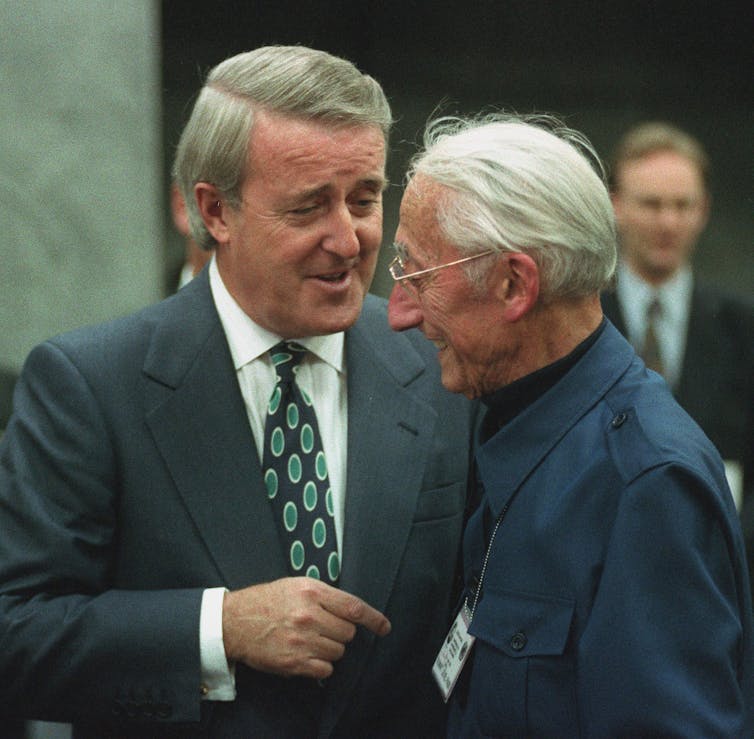
Oceanographer Jacques Cousteau chats with former prime minister Brian Mulroney following Mulroney’s speech at the Rio Earth Summit in June 1992.
THE CANADIAN PRESS/Ron Poling

Since the mid-1990s, rapid expansion of trade in the new digital economy has stimulated development in some of the world’s poorest countries, lifting millions out of poverty, but also greatly increasing income inequality. At the same time, globalization has expanded the ecological footprint of the world’s wealthiest countries over supply chains stretching across the planet.

Today, 25 years into our new globalized era, we must reckon with the unintended consequences of progress, much as we did in 1970. Between 1945 and 1970, and again from 1995 to 2020, our societies have transformed through geopolitical shifts, economic expansion and technological developments.

While the specifics are different, there can be no doubt that both periods left a strong imprint on planet Earth. But are we ready to tackle profound challenge of redefining our relationship with Earth?

The ties that bind us

Ignorance is no longer an excuse for inaction; a half century of science has provided clear evidence of the ongoing deterioration of Earth’s biophysical systems. What we lack is determination and courage in the face of powerful oppositional forces.

Rachel Carson stands in her library in Silver Spring, MD., holding her book ‘Silent Spring.’ She wanted to bring to public attention information that pesticides were destroying wildlife and endangering mankind.
(AP Photo)


Much as Carson did in the 1960s, we still struggle against vested economic and political interests intent on maintaining the status quo. We must also recognize that the problems are now embedded deeply into the fabric of societies; tackling climate change, for example, requires nothing short of re-imagining the global energy sector.


Read more:
A year of resistance: How youth protests shaped the discussion on climate change


We face a daunting task, but there are signs of hope, particularly as we see a resurgence of youth movements willing to challenge our notions of progress. The first Earth Day protesters were overwhelmingly young; they didn’t have a Greta Thunberg, but they did strike from school. And just as their message caught the attention of Walter Cronkite, at least some adults are listening now.

Disruption and new opportunities

What will it take to move us from listening to action?

Perhaps the current COVID-19 pandemic could provide a trigger. Our relentless drive to move goods and people across the planet has been hijacked by a microscopic bundle of protein and RNA, inflicting significant human suffering and damage on the global economy.

The pandemic is, no doubt, a global health catastrophe. But the disruption of the status quo also presents an opportunity to question our core values and to re-examine our relationships with each other and with Earth’s natural systems. For COVID-19, as with our most complex environmental challenges, any viable solutions will require co-operation rather than isolation across borders.

The pandemic also demonstrates how societies can mobilize rapidly in the face of existential threats. While our current emergency response to COVID-19 has been reactive, rather than proactive, perhaps it need not have been entirely so — why did we not learn from SARS, MERS, H1N1 and other global respiratory virus outbreaks?

People gather before participating in a student-led Climate March in Vancouver in October 2019.
THE CANADIAN PRESS/Darryl Dyck

Must we also wait for more dire impacts of climate change before taking action? Now is the time to mitigate environmental threats through proactive measures, developing the societal tools to maximize human well-being in a rapidly changing world.

The economic pain inflicted by COVID-19 should not limit our ability to take bold action. The environmental triumphs of the 1970s and 1980s occurred against a backdrop of significant economic uncertainty after the post-war boom.

When the current crisis passes, as it surely will, we must seize the opportunity to re-imagine, and to create, a different kind of future, much as the original Earth Day protesters did on April 22, 1970.The Conversation

Philippe Tortell, Professor and Head, Dept. of Earth, Ocean & Atmospheric Sciences, University of British Columbia

Photo credit: A crowd observes the world’s first Earth Day on April 23, 1970, in Fairmount Park in Philadelphia.(AP Photo)

This article is republished from The Conversation under a Creative Commons license. Read the original article.

Subscribe to Our Newsletter

News, investigations, and analysis — our top stories every morning to start your day right.

Earth Day global energy sector Greta Thunberg Rachel Carson Walter Cronkite
Follow on Google News Follow on X (Twitter)
Share. Facebook Twitter LinkedIn Telegram WhatsApp Email Copy Link
Previous ArticleExclusive interview: Barbara Freese on coal and how industry denies climate change
Next Article Energy geopolitics will hinge on the nationalism-globalism swinging door
Eirwen Williams
  • X (Twitter)

Eirwen Williams is a Brussels-based journalist at Energy Reporters, specializing in European energy policy, market trends, technological innovation, and energy security. Trained in journalism through a renowned program in New York, he examines how nations and industries are navigating the continent’s energy transition. With a focus on the forces driving change, his reporting highlights the interplay between regulation, infrastructure, and new technologies shaping Europe’s energy future. Contact: [email protected]

Keep Reading
learn effective methods to assess the carbon footprint of your energy consumption and discover practical tips to reduce your environmental impact.

How to evaluate the carbon footprint of your energy use

explore the vital link between energy consumption and water resources, highlighting how energy use impacts water availability and sustainability.

The connection between energy use and water resources

discover what green energy is and understand its importance for a sustainable future. learn how renewable sources can reduce environmental impact and promote clean living.

What is green energy and why it’s important

Add A Comment
Leave A Reply Cancel Reply

Subscribe to Our Newsletter

News, investigations, and analysis — our top stories every morning to start your day right.

Trending
learn effective methods to assess the carbon footprint of your energy consumption and discover practical tips to reduce your environmental impact.
How to evaluate the carbon footprint of your energy use
explore the ultimate guide to different types of renewable energy sources, including solar, wind, hydro, and more, to understand their benefits and applications for a sustainable future.
Guide to different types of renewable energy sources
explore the vital link between energy consumption and water resources, highlighting how energy use impacts water availability and sustainability.
The connection between energy use and water resources
News by category
  • Featured
  • News
  • Use
  • Climate
  • Industry
  • Opinion
  • Policy
  • Output
  • Storage
  • Grid
Information
  • About Us
  • Advertise
  • Meet the Team
  • Contact Us
  • Legal Notice
  • Privacy Policy

Subscribe to Our Newsletter

News, investigations, and analysis — our top stories every morning to start your day right.

Facebook X (Twitter) RSS
© Energy-Reporters.com. All rights reserved.

Type above and press Enter to search. Press Esc to cancel.