



| IN A NUTSHELL |
|
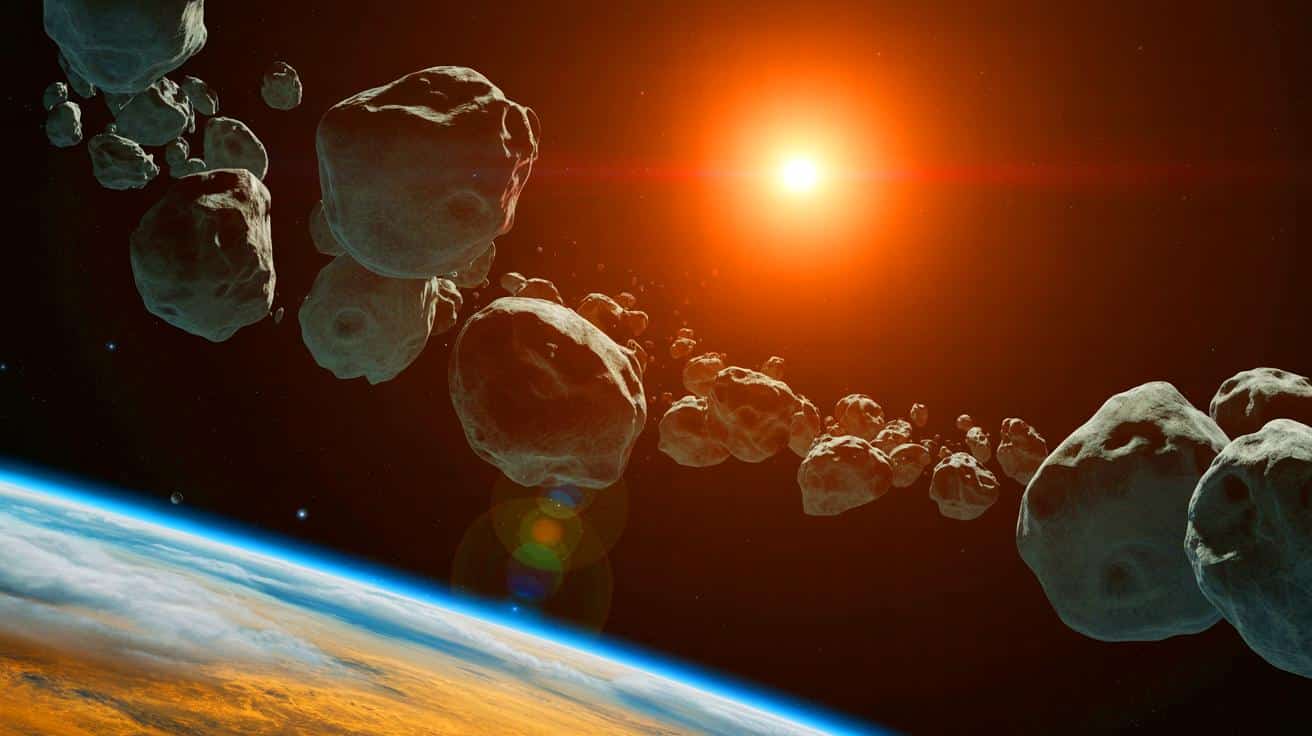
Asteroids have long been a subject of fascination and fear. Their unpredictable nature and potential for destruction make them a unique focus of scientific study. Recent research has unveiled a hidden threat lurking near Venus—asteroids that could cross paths with Earth. These celestial bodies, dubbed co-orbital asteroids, evade detection due to their proximity to the Sun. This newfound awareness has sparked concern among researchers about the limitations of current space monitoring systems and the potential implications for Earth.
The Elusive Nature of Co-Orbital Asteroids
Despite significant investments in space technology, certain asteroids still manage to slip through the cracks of our detection systems. Advanced radars, telescopes, and satellites are employed to protect Earth, yet some celestial bodies remain undetected. A new class of threats, known as co-orbital asteroids of Venus, poses a unique challenge. Their proximity to the Sun makes them invisible to Earth-based instruments, and they orbit in resonance with Venus. This positioning places them in a blind spot for even the most sophisticated satellites.
The co-orbital asteroids are not merely elusive due to their size or speed. Their orbital positions place them in regions where terrestrial telescopes cannot reach. Even space-based instruments struggle to monitor these areas effectively. This raises questions about our ability to fully understand and predict the behavior of these hidden objects. As these asteroids orbit in tandem with Venus, they could potentially drift towards Earth, raising the stakes of potential impact.
Periodic Risks of Collision Every 12,000 Years
An insightful study conducted by the State University of São Paulo sheds light on this "ghost" population of asteroids. Led by Professor Valerio Carruba, the research suggests that these asteroids could occasionally intersect with Earth's orbit. Although many will remain harmless, gravitational disturbances could potentially redirect one towards a collision course with our planet once every 12,000 years.
The study involved modeling various scenarios using supercomputers, some of which predict a direct encounter with Earth. While such events are rare, their potential impact cannot be underestimated. One significant collision could have catastrophic consequences. The findings underscore the importance of understanding these asteroids' trajectories and preparing for scenarios that could disrupt life as we know it.
Sudden and Devastating Impact Potential
One of the most chilling aspects of these asteroids is their ability to approach Earth without warning. In some scenarios, we might only detect them days before impact. Carruba's research indicates that some could measure up to 1,000 feet and create craters nearly 2.5 miles wide, releasing energy equivalent to hundreds of megatons.
Such an impact on an urban area would have devastating effects. Yet, there would be no early warning signs—these celestial threats could remain "silent" until it is too late. The prospect of a sudden asteroid appearance, too late to mount a deflection mission, transforms science fiction into a plausible reality. This emphasizes the need for enhanced detection capabilities and strategies to address the threat of co-orbital asteroids.
Rethinking Planetary Defense Strategies
Given the shadowy nature of this threat, scientists advocate for an evolution in space strategy. Current monitoring focuses on visible threats, but it is crucial to anticipate the undetectable. Future solutions may include probes positioned closer to the Sun, enabling the scrutiny of the Venusian environment. Alternatively, space telescopes placed in inner orbits could expand our observational reach.
This new reality calls for a reassessment of planetary defense priorities. International collaboration, increased funding, and awareness of invisible risks are now essential. The ability to protect life on Earth depends on our preparedness to tackle these hidden dangers. By expanding our detection capabilities, we can better shield our planet from unforeseen threats.
A Persistent Threat for Future Generations
While these potential collisions may not occur immediately, the warning has been issued. Proactive contemplation today is preferable to reactive measures tomorrow. These asteroids could emerge above our heads—or those of future generations—at any moment.
Planetary defense is not confined to cinematic depictions. It begins with data, modeling, and increased vigilance. What we do not know today may become our greatest danger tomorrow. Preparing for the unpredictable is a necessity. If humanity wishes to avoid a fate similar to the dinosaurs, monitoring the shadows behind Venus is crucial. Are we ready to confront this invisible threat to ensure the safety of future generations?

Is this really something we need to worry about right now? 🤔
Is this a real threat or just theoretical? I’m genuinely concerned! 😟
Thanks for the article! But how can we prepare for something we can’t even see?
Thank you for bringing this to light! I had no idea asteroids near Venus could be such a threat.
Why is it always Venus? Can’t these asteroids take a break? 😂
So, are we basically sitting ducks for the next 12,000 years?
Every 12,000 years? That’s not too bad, right? Or am I missing something? 🤔
Why haven’t we developed better detection systems yet? Seems like a no-brainer.
Interesting piece, but I feel like we’re always discovering something new to worry about.
Great article, but I’m skeptical. How reliable are these predictions?
Wouldn’t it make more sense to focus on more immediate threats to Earth? 🤷♂️
This is like a Hollywood movie plot! 🎥😅
Wow, this is terrifying! Are there any plans in place to improve detection systems?