




| IN A NUTSHELL |
|
For centuries, Mars has captivated the imagination of people across the globe, often referred to as the “Red Planet” due to its distinct hue. This alluring characteristic has led to numerous mythological and scientific interpretations, fueling curiosity about its true nature. The reddish appearance of Mars is not merely a visual trick but a feature deeply rooted in its composition. As scientific explorations intensify, our understanding of Mars’ color, as well as its other fascinating features, continues to evolve.
Why Mars Appears Red
Mars owes its signature red appearance to the presence of iron oxide, commonly known as rust, which covers its surface. This iron oxide is abundant in the rocks and dust, creating a reddish tint that is visible even from Earth. The Romans, inspired by this color, named the planet after their god of war. Interestingly, this color connection to warfare is not entirely unfounded; blood contains iron, which also contributes to its red color.
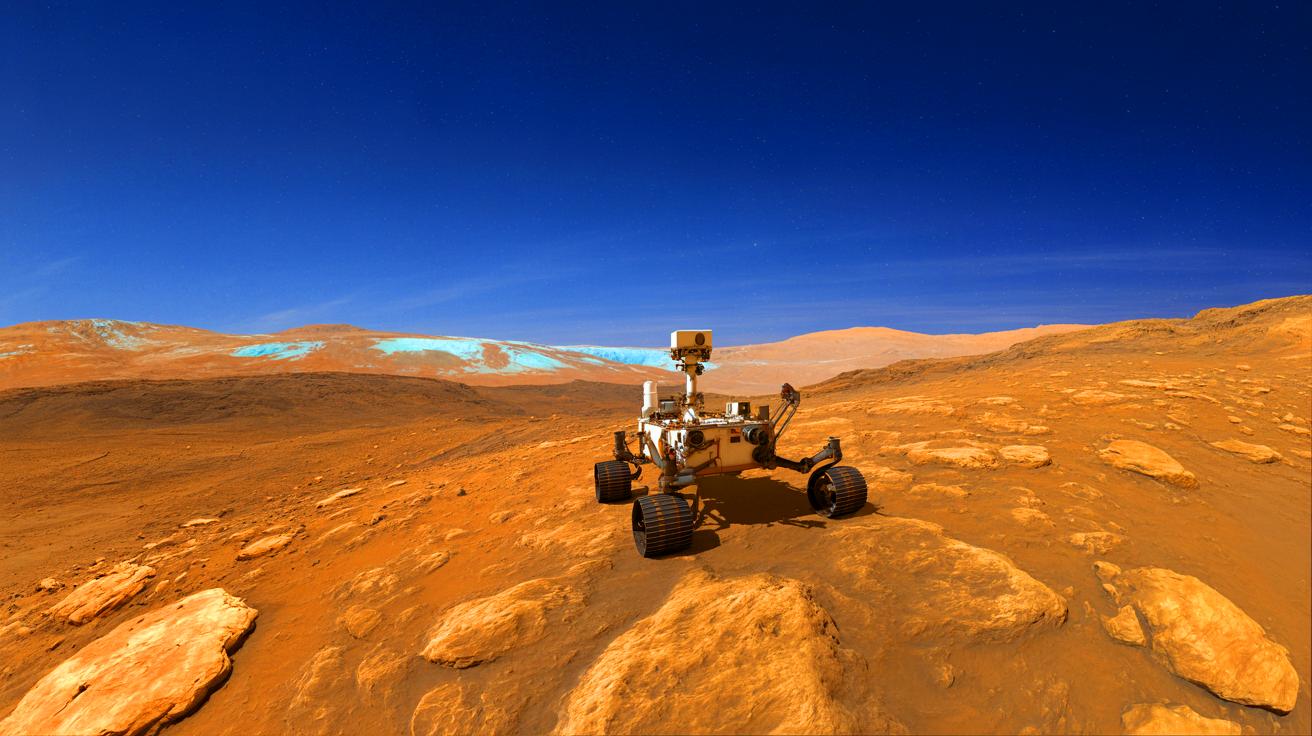
However, if you look closely at images captured by rovers and landers, Mars is not uniformly red. The surface varies from rusty brown to tan, with areas like the poles displaying white ice caps. These caps consist of frozen water and a layer of frozen carbon dioxide, or dry ice, which changes with the Martian seasons. Understanding the color variations on Mars is crucial as it provides insights into the planet’s composition and atmospheric conditions.
Probing Mars with Technology
Our knowledge of Mars has been significantly enriched through the deployment of rovers and landers. These missions have provided comprehensive images of the Martian surface, revealing the planet’s true colors. For instance, the Viking lander in 1976 delivered the first close-up images, showing a landscape covered in rusty orange dust.
The data collected by these probes have shown that Mars’ surface is diverse and complex. The white ice caps at the poles, for example, grow and shrink based on sunlight exposure, offering clues about the planet’s climate. This dynamic aspect of Mars is constantly monitored, aiding our understanding of Martian weather patterns and potential habitability.
Exploring Beyond Visible Light
While visible light images provide valuable information, exploring Mars through other parts of the electromagnetic spectrum unveils even more details. Mars emits light in various wavelengths, some of which are invisible to the naked eye but detectable with specialized equipment. For instance, infrared imaging allows scientists to observe heat emissions from the planet’s surface, while ultraviolet light helps study its atmospheric composition.
These advanced imaging techniques reveal features not visible in standard photographs. For example, infrared images can display thermal properties, and ultraviolet photography can highlight atmospheric phenomena. This multi-spectral approach provides a comprehensive view of Mars, enabling researchers to piece together its geological and atmospheric history.
The Ongoing Quest for Martian Knowledge
Despite centuries of observation, Mars still holds many mysteries. Modern telescopes and spacecraft continue to explore the planet, aiming to answer fundamental questions about its formation, volcanic activity, and the potential for past or present life. Missions like NASA’s MAVEN spacecraft have broadened our understanding by analyzing atmospheric loss and surface interactions.
Each new discovery builds upon previous research, creating a more detailed picture of Mars. Astronomers employ various methods, including radio waves and X-rays, to gain insights into the planet’s past and present. As technology advances, so does our ability to study Mars, bringing us closer to unraveling the secrets of our celestial neighbor.
The exploration of Mars is far from over, with each mission uncovering new aspects of this enigmatic planet. As we continue to delve deeper into its mysteries, one question remains: What will the next generation of explorers discover on the surface of the Red Planet?


Wow, I always thought Mars was just red! Thanks for the enlightenment. 🌟
Great article, but what about the blue sunsets on Mars? 🤔
Isn’t this just another way to say Mars is still pretty red? 😂
I find it fascinating that mythology ties into the scientific explanation of Mars’ color.
What implications does this have for future Mars missions?