



| IN A NUTSHELL |
|
Recent archaeological discoveries in Egypt have unveiled a groundbreaking perspective on ancient engineering capabilities. Central to these revelations is a water management system surrounding the Pyramid of Djoser, which challenges traditional narratives about ancient Egyptian construction techniques. By harnessing seasonal floodwaters, the ancient Egyptians demonstrated a level of engineering sophistication previously underestimated. These findings have the potential to revolutionize our understanding of ancient construction methods and highlight the technical prowess of the Egyptians. As researchers continue to explore these advancements, the implications for historical site evaluation are both profound and far-reaching.
Ingenious Stone Dam Capturing Desert Floodwaters
The enigmatic structure known as Gisr el-Mudir at Saqqara has long intrigued archaeologists with its sheer size and enigmatic purpose. Recent investigations led by Xavier Landreau have revealed that this ancient stone structure functioned as a stone dam. Its primary purpose was to capture and store seasonal floodwaters from nearby wadis, creating a sustainable water source for construction endeavors.
By analyzing the surrounding terrain, researchers have reconstructed the hydrological patterns of ancient Saqqara. The stone dam could retain up to 14 million cubic feet of water, offering a vital resource for large-scale construction projects. This water not only supported building activities but also enriched the soil with nutrient-rich sediments, boosting agricultural potential.
The strategic placement of Saqqara was likely influenced by both religious and hydrological factors. The discovery of this dam underscores the importance of water management in ancient Egyptian society, highlighting their ability to adapt to environmental challenges and leverage natural resources for monumental achievements.
How Hydraulic Construction of Pyramids Worked
While securing a stable water supply was crucial, the real innovation at the Djoser complex lay in its hydraulic infrastructure. Beneath the pyramid, an intricate network of basins and shafts, known as the “Deep Trench,” facilitated water purification and transportation.
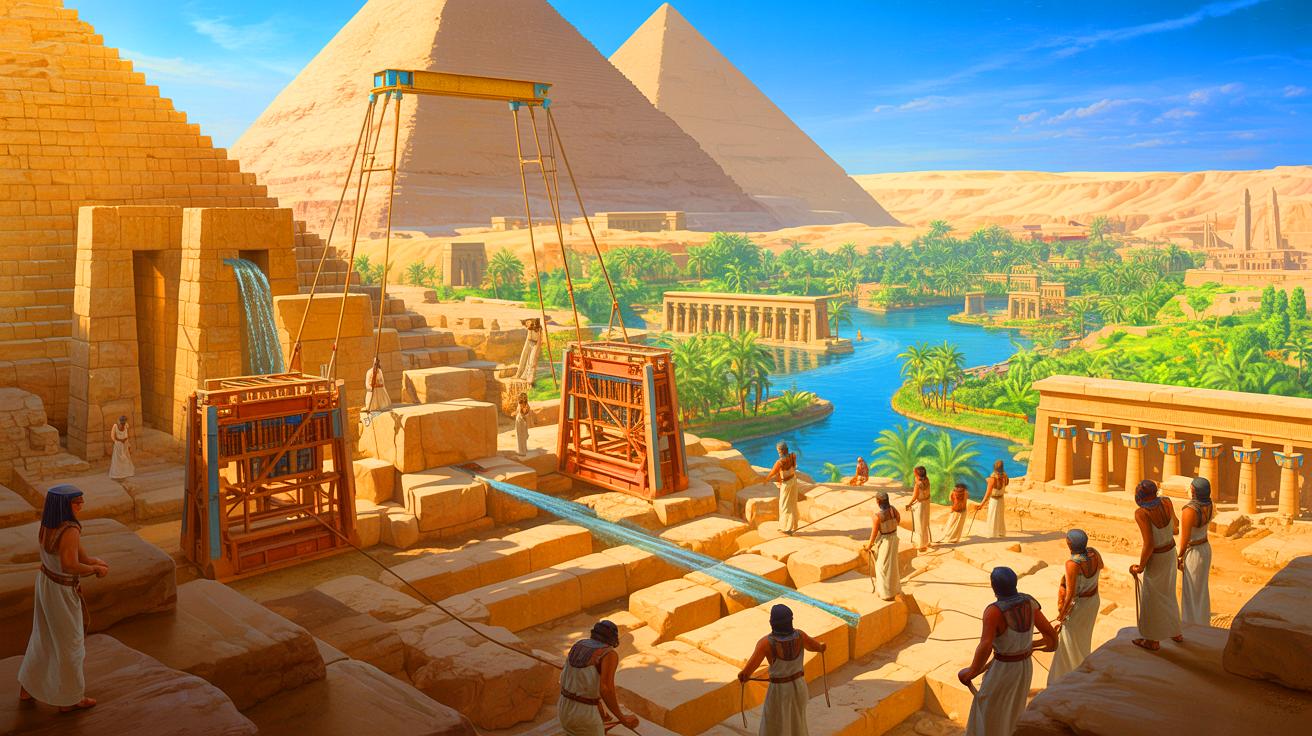
This setup likely powered a hydraulic elevator mechanism. By harnessing water pressure in vertical shafts, the Egyptians could float heavy limestone blocks on platforms, easing the lifting process. This ingenious method reduced the mechanical effort needed for construction, providing a practical solution to the challenge of moving massive stones.
The structural remnants found in the galleries and underground compartments support the hypothesis of hydraulic engineering, suggesting that the Egyptians possessed an advanced understanding of hydraulic principles. This discovery challenges the traditional view of pyramid construction, emphasizing the technical acumen of ancient builders.
Sophisticated Technology Matching Pharaohs’ Ambitions
The notion of hydraulic construction may appear bold, but it is substantiated by concrete evidence. The interconnected system of dams, basins, galleries, and shafts reflects a sophisticated engineering approach. The ancient Egyptians were no strangers to hydraulic technology, as their expertise in irrigation and water management is well-documented.
This study posits that advanced techniques like these could have minimized reliance on labor-intensive methods such as massive ramps, enhancing construction efficiency and precision. The Pyramid of Djoser, often regarded as a prototype, exemplifies this sophisticated engineering, showcasing the technical prowess of the Old Kingdom.
This revelation challenges long-held beliefs and highlights the Egyptians’ ability to innovate and adapt to their environment. By leveraging hydraulic technology, they achieved remarkable feats of construction, leaving a legacy that continues to inspire modern engineers and archaeologists alike.
How Saqqara’s Hydraulic Remains Alter Our Historical Perspective
Traditionally, pyramids have been studied for their architectural and symbolic importance. However, the discovery of a comprehensive hydraulic system at Saqqara shifts this narrative. It reveals that the ancient builders were not only architects of religious monuments but also pioneers of sustainable technical systems.
This interdisciplinary approach, which combines archaeology, hydrology, and geotechnics, enriches our understanding of ancient Egypt. It highlights a sophisticated work organization and resource management strategy, suggesting that the construction of pyramids was as much an engineering feat as it was a testament to manpower.
These insights invite a reevaluation of other historical sites, encouraging the search for overlooked hydraulic systems that may have played a crucial role in ancient construction. As researchers continue to explore, the potential for new discoveries remains vast.
The recent findings at Saqqara have significantly altered our perception of ancient Egyptian capabilities. The integration of hydraulic systems into monumental construction demonstrates a level of technical ingenuity previously underestimated. As we continue to uncover these engineering marvels, the question remains: What other technological innovations of the ancient world await discovery, poised to redefine our understanding of history?



Wow! Ancient Egypt never ceases to amaze. 🚀
Wow, this is mind-blowing! 🧠 Who would have thought the Egyptians were so advanced? 🤯
Isn’t it amazing how they figured out hydraulic systems so early? Truly groundbreaking!
This is fascinating. How do researchers know the exact volume of water the dam held?
Could the same techniques be used on other pyramids? Curious to know more!
Water elevators? Sounds like something out of a sci-fi movie! 🚀
Is there any evidence of other pyramids using similar hydraulic systems?
So they had a dam system back then—what a way to manage resources! 🏞️
Water elevators? Sounds like ancient Egyptians were way ahead of their time. 😄
I wonder if this discovery will change how we think about other ancient civilizations too.
I wonder how they maintained such a complex system. Any ideas?
Were there any hieroglyphics that hinted at this water system before? 🤔
This article makes me want to visit Egypt even more! 🏜️
Thank you for shedding light on this incredible discovery!
Okay, but how did they figure all this out? Fascinating research!
Was this technology unique to the Djoser complex, or was it widespread?
Can we get more details on the role of the Gisr el-Mudir?
In order to use water to raise stone blocks on floating platforms, “water elevators” would need to raise the water in the elevators themselves. I have read a dozen articles like this one that contain no explanation of how this might have been done, nor of how the water pressure might have been contained without bursting the walls of the “elevator”. An Archimedes screw might raise the water, but it would be slow, and it would have taken much longer to complete the pyramid than it actually did.