

| IN A NUTSHELL |
|
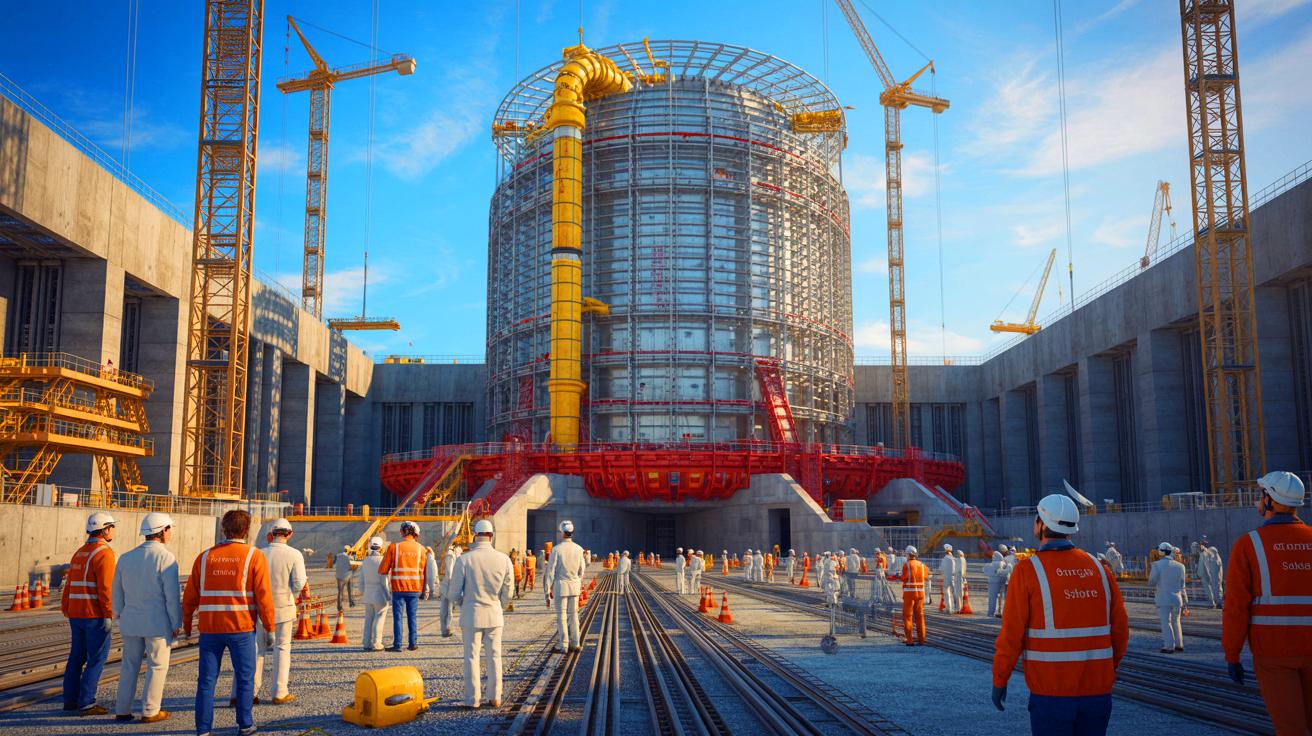
In the heart of Provence, France, a groundbreaking scientific endeavor is unfolding. The International Thermonuclear Experimental Reactor (ITER) project is set to become the world’s largest and most ambitious science experiment. This colossal undertaking aims to demonstrate the feasibility of nuclear fusion at an industrial scale, tapping into the same reaction that powers the Sun and stars. With contributions from over 30 countries, the project is a testament to international collaboration and scientific innovation. However, the path to achieving fusion energy is fraught with challenges, from technical difficulties to geopolitical tensions.
Understanding Nuclear Fusion
Nuclear fusion is a process where two light atomic nuclei combine to form a heavier nucleus, releasing a substantial amount of energy. This is the same process that fuels the Sun, where hydrogen atoms fuse under immense gravitational pressure. Here on Earth, the challenge is to replicate this process in a controlled environment. Two primary methods are being explored: laser-induced fusion and magnetic confinement.
The ITER project focuses on magnetic confinement fusion, utilizing a massive tokamak—a magnetic confinement chamber. Within this chamber, a small amount of deuterium and tritium is heated to extraordinarily high temperatures, reaching up to 150 million degrees Celsius. At such temperatures, atomic nuclei overcome their natural repulsion and fuse, releasing energy in the form of alpha particles and neutrons. The highly energetic neutrons transfer their heat to the chamber walls, which is then used to generate steam and drive turbines, producing electricity.
The complexity of this process is daunting, with numerous first-of-a-kind materials and components involved. As Laban Coblentz, ITER’s head of communications, notes, “We’ve run into challenges before just simply due to the complexity and the multitude of first-of-a-kind materials, first-of-a-kind components in a first-of-a-kind machine.”
Advantages of Fusion Energy
Nuclear fusion offers several advantages over traditional nuclear fission. Unlike fission, which relies on splitting heavy atomic nuclei, fusion uses lighter elements like hydrogen, resulting in significantly less radioactive waste. Furthermore, the fuel for fusion—deuterium and tritium—is abundant and can be sourced from seawater and lithium, respectively.
The safety profile of fusion is also more favorable. In fusion reactors, only small amounts of fuel are used, minimizing the risk of catastrophic failure. As Coblentz points out, “The safety effects are not even comparable. You’ve only got 2 to 3 g of material. Moreover, the material in a fusion plant, deuterium and tritium, and the material coming out, non-radioactive helium and a neutron, are all harnessed.”
Despite these benefits, the path to practical fusion energy is long and arduous. The technology is still in its experimental stage, and commercial viability remains a distant goal.
Challenges and Setbacks
ITER’s ambitious timeline has faced numerous setbacks. Originally, the project aimed for its first plasma by 2025, with full commissioning by 2035. However, technical challenges and delays, exacerbated by the COVID-19 pandemic, have pushed these targets back. The project’s budget has ballooned from an initial estimate of €5 billion to over €25 billion.
One major hurdle involved misalignments in the welding surfaces of the vacuum chamber segments, which necessitated complex remedial work. This challenge highlighted the project’s reliance on precision engineering and the difficulties inherent in managing a global supply chain. Coblentz explains, “It’s not rocket science in that particular case. It’s not even nuclear physics. It’s just machining and getting things to an incredible degree of precision, which has been difficult.”
Despite these challenges, the project continues to push forward, with efforts to resequence tasks and maintain progress towards the 2035 fusion operations target.
Global Collaboration Amid Geopolitical Tensions
The ITER project is a remarkable example of international cooperation, with countries like the U.S., EU, Russia, China, and India working together despite geopolitical tensions. This collaboration is driven by a shared vision of harnessing fusion energy to meet the world’s growing energy demands.
Coblentz underscores the importance of this collaboration: “For those countries to make a 40-year commitment to work together, there was no certainty. There will never be a certainty that there were not going to be some conflicts.” However, the common goal of achieving fusion energy helps to transcend these challenges, providing hope for future energy security.
The project’s resilience amid global tensions is a testament to the enduring appeal of a clean and virtually limitless energy source.
Fusion Energy and Climate Change
As the world grapples with the urgent challenge of climate change, nuclear fusion presents a potential long-term solution. Fusion energy is inherently carbon-free, offering a sustainable alternative to fossil fuels. However, the timeline for achieving practical fusion energy remains uncertain.
While ITER represents a significant step forward, commercial fusion power is unlikely to be realized in time to address the immediate climate crisis. Nonetheless, the potential impact of fusion energy on future energy systems cannot be overstated. As Coblentz states, “The longer that we wait for fusion to arrive, the more we need it. So the smart money is: get it here as fast as possible.”
As the world continues to seek solutions to climate change, will nuclear fusion emerge as the cornerstone of a sustainable energy future?


Isn’t this project just another expensive gamble? 🤔
Thank you for the insightful article. It’s nice to see countries coming together for a common goal!
The timeline seems ambitious, do you really think they’ll meet the 2035 target?
I’ve always thought nuclear fusion was science fiction, but this makes it sound so real!
How does this compare to renewable energy sources like solar and wind?
I’m excited to see clean energy on the horizon. Let’s hope they succeed! 🌟
What are the potential dangers of nuclear fusion? Is it truly safe?
With so many countries involved, how do they manage the project without conflicts?
Why is this taking so long? Can’t we speed up the process?
The cost is insane! Could that money be better spent elsewhere?
I’m skeptical. We’ve heard promises of fusion for decades. What’s different this time?
What happens if the project fails? Is there a plan B?
It’s amazing to think we could harness the power of the stars. 🌌
This article gives me hope for a sustainable future. Thank you!
Will this actually help with climate change, or is it too little too late?
Why is it called a “star” on Earth? Sounds a bit dramatic! 😂
What kind of jobs will this project create in the future?
I’m concerned about the environmental impact. Is it really carbon-free?
Why are there so many delays? Is this project just too complex?
It’s incredible to see global collaboration at this level. Truly inspiring!
Is nuclear fusion the only way forward, or are there other options?
How do they ensure the security of such a massive project? 🚨
The science behind this is mind-blowing! Thanks for breaking it down.
Is this technology going to be affordable for everyone once it’s developed?
I’m all for clean energy, but this sounds too good to be true.
How did they decide on France as the location for ITER?
What are the biggest technical challenges they face right now?
How does this project impact the local community in Provence?
Can’t we just stick to solar and wind energy? 🌞💨
The cost overruns are worrying. Who is footing the bill for this? 💸
Thanks for highlighting the importance of international cooperation in science!
Will this project eventually lead to the end of fossil fuels? 🤞
What role do private companies play in the ITER project?