

| IN A NUTSHELL |
|
The Dead Sea, renowned for its extreme salinity and unique geological features, has recently become the focal point of groundbreaking research into “salt giants.” These colossal salt deposits, hidden beneath its surface, offer a rare opportunity to study the conditions and processes that lead to their formation. Scientists from the University of California, Santa Barbara, and the Geological Survey of Israel have been investigating these phenomena to gain insights that could be pivotal in understanding the future of arid coastlines in the face of climate change. This research not only sheds light on the Dead Sea’s own geological evolution but also draws intriguing parallels with historical events in the Mediterranean region.
The Phenomenon of Salt Giants
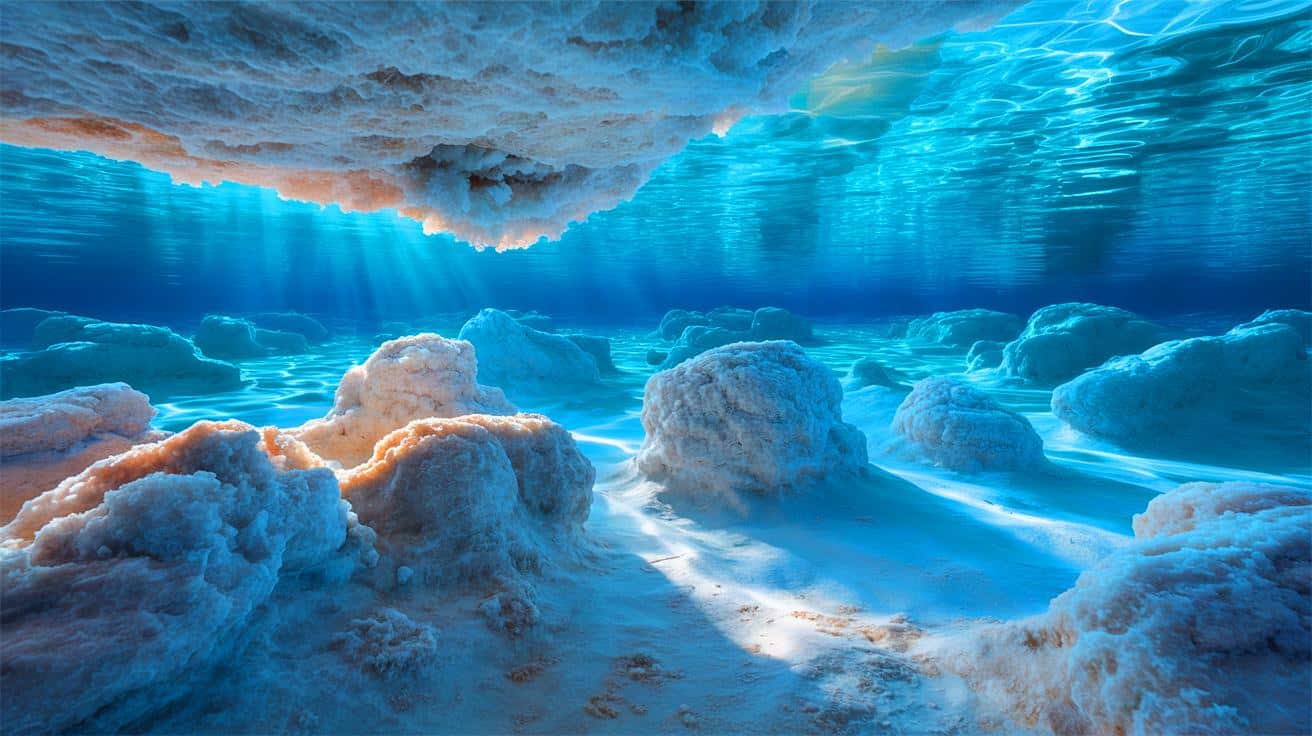
The term “salt giant” might conjure images of mythical creatures, but in the realm of geology, it refers to vast salt deposits found within the Earth’s crust. These formations can span several miles horizontally and reach over a mile in thickness. The Dead Sea, with its unparalleled salinity, presents a unique laboratory to study these formations in real time. Professor Eckart Meiburg from UC Santa Barbara has been at the forefront of this research, focusing on the fluid dynamics within this hypersaline terminal lake.
In 2019, Meiburg’s team uncovered the mechanism of “salt snow,” an underwater process that steadily deposits salt onto the lakebed. This discovery paved the way for further exploration into the formation of salt giants. Six years later, in collaboration with Nadav G. Lensky from the Geological Survey of Israel, the team has detailed the conditions that foster the growth of these salt structures. Their findings, published in the Annual Review of Fluid Dynamics, highlight the Dead Sea’s status as an unparalleled site for studying such geological phenomena.
The Impact of Water Dynamics
As a terminal lake, the Dead Sea's water dynamics are primarily governed by evaporation. With no outlets, water escapes solely through this process, leaving behind substantial salt deposits. The Jordan River's damming has exacerbated the decline in water levels, altering the lake's chemistry and accelerating the formation of salt giants. In the 1980s, the lake was meromictic, characterized by a stable stratification of water layers. However, the diversion of the Jordan River upset the delicate balance between evaporation and freshwater inflow, leading to a rise in surface salinity.
This shift has transformed the Dead Sea into a holomictic body of water, where annual overturns occur among water layers, primarily during winter months. This interplay of internal currents and surface waves continues to shape the evolving landscape beneath the Dead Sea, creating conditions reminiscent of those that once prevailed in the Mediterranean during a significant geological event known as the Messinian Salinity Crisis.
Historical Parallels: The Messinian Salinity Crisis
The Messinian Salinity Crisis, which occurred approximately 5.96 to 5.33 million years ago, serves as a historical parallel to the conditions now observed in the Dead Sea. During this period, the Mediterranean Sea was cut off from the North Atlantic due to tectonic shifts that closed the Strait of Gibraltar. This isolation led to the Mediterranean drying up and the formation of extensive salt deposits. Eventually, the Strait of Gibraltar reopened, allowing water to flood back into the basin during the Zanclean flood.
Understanding the formation and dynamics of salt giants in the Dead Sea offers invaluable insights into similar processes that shaped the Mediterranean's geological history. By studying these formations, scientists aim to better comprehend the impact of tectonic and climatic changes on arid coastlines, which are increasingly vulnerable to rising sea levels as a result of global climate change.
The Broader Implications for Climate Change
The research into salt giants extends beyond unraveling past geological mysteries. It has significant implications for the future of coastal regions facing the threat of sea level rise. As climate change accelerates, understanding how salt deposits form and influence the erosion of arid coastlines becomes crucial. The Dead Sea's unique environment serves as a natural laboratory where scientists can observe and analyze these processes in action.
The insights gained from this research may inform strategies for managing and mitigating the impact of rising sea levels on vulnerable regions worldwide. By drawing lessons from the past and applying them to contemporary challenges, researchers hope to develop more effective approaches to safeguarding coastal communities from the encroaching effects of climate change.
The Dead Sea, often perceived as a barren landscape, is proving to be a treasure trove of scientific insights. As researchers continue to uncover its secrets, the implications for understanding geological processes and addressing climate change become increasingly significant. What other hidden phenomena might this saline marvel reveal, and how can they inform our efforts to adapt to a rapidly changing world?

Fascinating article! 🌟 How does the Dead Sea’s unique conditions affect local wildlife? 🐟
So, the Dead Sea is a real-life salt factory? That’s salty! 🧂
I never knew salt could be so interesting! 😅
Can these findings help prevent future environmental disasters?
Are there any similar salt formations elsewhere in the world?
What exactly is a “salt giant”? Sounds like something from a fantasy novel!
How does this research impact our understanding of current climate change issues?
Maybe we should all start investing in salt now! 🤔
Interesting read, but how does this really affect us today?
Great read, but I’m curious how the “salt snow” process works. Can anyone explain?
The connection to the Mediterranean is fascinating! 🏖️
Is there a risk that the Dead Sea might ‘dry up’ completely like the Mediterranean once did?
I’m always amazed by how much history is hidden beneath the Earth’s surface. Thanks for sharing.
Thank you for this enlightening piece! It’s amazing what we can learn from history.
What are the possible consequences if these salt formations continue to grow?
Wait, are they saying the Dead Sea could “kill” the Mediterranean again? 😱
How do the findings inform modern-day environmental policies?