



| IN A NUTSHELL |
|
In a significant stride towards energy independence, Global Laser Enrichment (GLE) has successfully completed its large-scale uranium enrichment demonstration in the United States. This milestone marks a pivotal advancement in nuclear fuel production, leveraging the innovative SILEX laser enrichment process developed by Silex Systems of Australia. Conducted at GLE’s Test Loop facility in Wilmington, North Carolina, this testing campaign sets the stage for the future of domestic nuclear fuel supply. As the U.S. seeks to reduce its reliance on foreign sources, this development promises a brighter horizon for the nation’s energy landscape.
GLE’s Uranium Enrichment Demonstration Testing
Global Laser Enrichment (GLE) was founded in 2007 with the mission of developing a cutting-edge, laser-based uranium enrichment technology. In collaboration with Silex Systems of Australia, GLE aims to commercialize the SILEX laser enrichment technology for uranium enrichment. GLE is co-owned by Silex Systems Limited, which holds a 51 percent stake, and Cameco Corporation, which owns the remaining 49 percent.
The recent testing program is a crucial step in validating the performance of large-scale enrichment under conditions that mimic real-world operations. Insights gained from these test runs are expected to significantly advance the scaling and manufacturing of full-scale plant systems and equipment.
The nuclear energy sector is evolving, with new reactor technologies such as small modular and advanced reactors on the horizon. This evolution necessitates a diverse array of fuel designs and enrichment levels. Therefore, the ability to cater to a wide range of enrichment needs is essential for the future growth and diversification of domestic nuclear fuel supply chains.
Uranium, a naturally occurring element, is found in deposits worldwide and primarily consists of two isotopes: U-235 and U-238. The U-235 isotope is crucial for nuclear reactors, as it undergoes fission to release energy. Enrichment is the process of increasing the concentration of U-235 to make uranium more suitable for nuclear fuel.
Uranium Enrichment Using Lasers for Nuclear Fuel Production
Historically, uranium enrichment relied on the gaseous diffusion process, which is now considered outdated. Today, the gas centrifuge method, which uses molecular weight differences to separate isotopes, is predominantly employed. However, laser technology offers an alternative approach to enrichment.
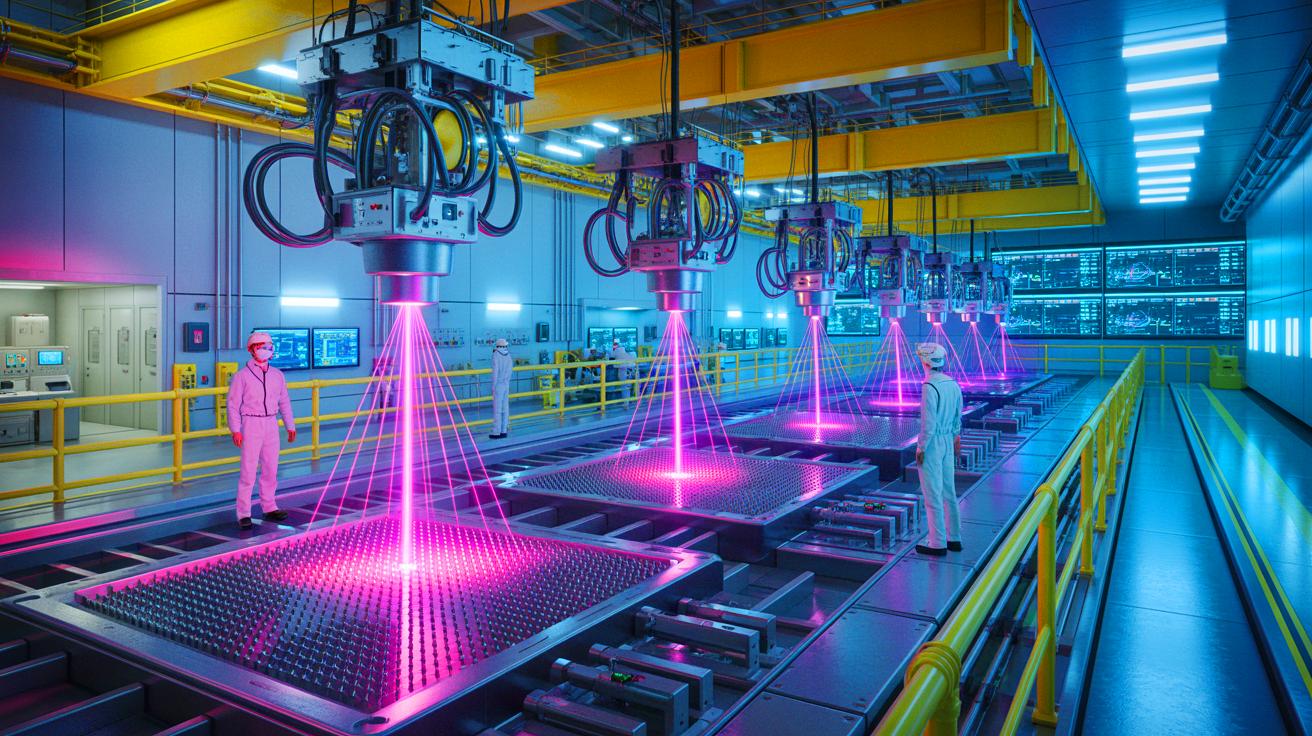
The SILEX process, short for Separation of Isotopes by Laser EXcitation, uses lasers to selectively excite and separate U-235 isotopes from the more prevalent U-238 isotopes. This results in a higher concentration of U-235 in the processed uranium. The SILEX process promises greater efficiency compared to existing enrichment methods and is the most advanced third-generation enrichment technology nearing commercialization.
“We believe the enrichment activities conducted over the past five months position GLE to be the next American uranium enrichment solution,” stated GLE CEO Stephen Long.
Long emphasizes that 20 percent of the U.S. electricity supply is generated from nuclear energy. GLE’s advancements are expected to reduce America’s dependency on foreign government-controlled uranium fuel supplies, thereby enhancing energy security.
Future Prospects for GLE and the U.S. Nuclear Industry
GLE’s planned Paducah Laser Enrichment Facility in Kentucky is currently under review by the Nuclear Regulatory Commission for a licensing application. Once approved, this facility will offer significant capabilities. It is projected to re-enrich over 200,000 metric tons of high-assay depleted uranium tails obtained from the U.S. Department of Energy. Additionally, it is anticipated to produce up to 6 million separative work units of low-enriched uranium (LEU) annually.
This development holds promise not only for GLE but also for the broader U.S. nuclear industry. By establishing a domestic source of enriched uranium, the U.S. can strengthen its energy independence and security. The diversification of fuel sources and the adoption of advanced reactor technologies further underscore the potential for growth in this sector.
As the global landscape shifts towards more efficient and sustainable energy solutions, laser-based enrichment technologies like the SILEX process could play a critical role. By reducing costs and increasing efficiency, these technologies offer the potential to transform the nuclear fuel supply chain.
The Broader Implications of Laser Enrichment
The completion of the large-scale uranium enrichment demonstration by GLE is a testament to the potential of laser enrichment technologies. This advancement could revolutionize the nuclear fuel industry by providing a more efficient and economical method of producing enriched uranium.
Beyond its immediate applications, the success of the SILEX process could have implications for international energy markets. As more countries seek to diversify their energy sources and reduce reliance on fossil fuels, the demand for nuclear energy is likely to rise.
The ability to efficiently enrich uranium could position the U.S. as a leader in the global nuclear fuel market. Moreover, it could encourage other nations to explore similar technologies, potentially leading to greater collaboration and innovation in the field.
As the world grapples with the challenges of climate change and energy security, advancements in nuclear technology offer a promising path forward. The ongoing development and commercialization of laser enrichment methods could prove pivotal in shaping a sustainable energy future.
The progress made by Global Laser Enrichment highlights the potential of laser-based technologies in transforming the nuclear fuel industry. As the U.S. moves towards greater energy independence, what further innovations will emerge in the quest for a sustainable energy future?


Wow, this sounds like a game-changer for the nuclear industry! Does this mean cheaper energy prices in the future? 🌍
Wow, this sounds like a game-changer for US energy independence! How soon can we expect this technology to be fully operational? 🚀
Finally! We’ve been too dependent on foreign uranium for too long. About time we took charge. 🇺🇸
Does this mean the cost of nuclear energy will go down for consumers? 🤔
How does the SILEX process compare in terms of safety to other enrichment methods?
This is amazing! But how soon can we see the benefits of this tech? 🚀
Finally, no more relying on foreign uranium! What’s the next step after the Kentucky facility is built?
Can this technology be applied to other elements, or is it just for uranium?
I’m curious, how will this affect uranium mining jobs in the U.S.?
Are there any environmental concerns with the SILEX process? Seems too good to be true! 🌍
Should we be worried about laser technology in nuclear enrichment? Sounds a bit sci-fi! 🤖
Great achievement! Thanks to everyone involved for pushing the boundaries of nuclear technology. 🙌
Great news! But what are the environmental impacts of this new enrichment process?
What took so long? Let’s get this up and running ASAP!
This is big news, but how will it affect our relationships with countries like Russia?
Can we expect any international partnerships to emerge from this development? 🤝
Does the SILEX process use less energy than traditional enrichment methods?
Sounds like the U.S. is stepping up its game in the nuclear sector! 🎉
I hope this means more jobs in the nuclear industry. We need that boost!
Call me skeptical, but how realistic is it to say we “don’t need” Russia anymore?
This is revolutionary! Will it be implemented globally or just in the U.S.?
How does laser enrichment actually work? Can someone explain in layman’s terms?
Wishing them success, but I hope the nuclear waste management is also considered.
Is it just me, or does “laser enrichment” sound like something from a James Bond movie? 🔫
When will the new facility in Kentucky be operational?
Interesting article, but what does this mean for renewable energy sources?
This definitely puts America on the map for nuclear innovation!
I wonder how this will impact the price of uranium globally. 📉
Will this new tech lower our electricity bills in the long run?
This is a huge leap forward, but are there any risks involved?
Hopefully, this leads to more sustainable nuclear energy solutions. 🌿
What are the security measures in place for this new facility?
Any chance this technology can be adapted for space travel? 🚀
As always, the devil is in the details. Let’s see how this pans out.
Are there any other countries working on similar tech, or is the U.S. leading the pack?
Is this going to be a secretive project, or will there be transparency? 🤔
This sounds promising, but has it been tested under real-world conditions?