




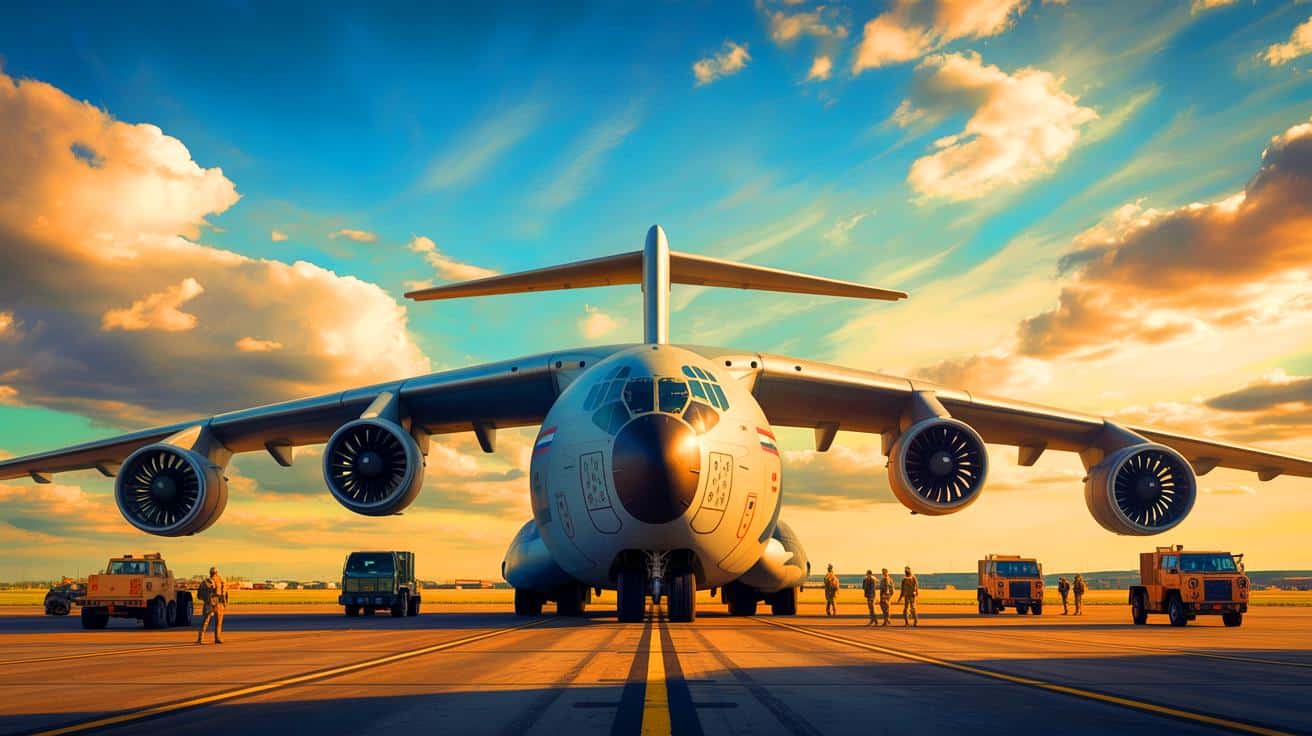
| IN A NUTSHELL |
|
In the ever-evolving landscape of military aviation, the development of large transport aircraft stands as a testament to technological advancements and strategic necessities. These behemoths of the sky play a crucial role in global military operations, enabling the rapid deployment of troops, equipment, and humanitarian aid across vast distances. As geopolitical tensions rise and the need for swift responses becomes paramount, understanding the capabilities and significance of these aircraft is more important than ever. In this article, we delve into the world of the largest military aircraft, exploring their design, capacity, and strategic impact.
The Antonov An-124: A Soviet-Era Marvel
The Antonov An-124, developed by Ukraine’s Antonov Design Bureau during the Soviet era, remains a hallmark of heavy-lift military aviation. Introduced in 1986, this aircraft holds the title of the world’s largest military transport by payload capacity. With the ability to carry up to 150 tons, the An-124 is a logistical powerhouse. Its design includes a fuselage length of almost 227 feet and a wingspan of 240 feet, making it capable of transporting tanks, helicopters, and even other aircraft fuselages.
Primarily used by the Russian Air Force and Volga-Dnepr Airlines, the An-124 is equipped with a nose-loading ramp and multiple wheels to handle unprepared runways. This versatility allows it to participate in both military operations and international relief missions. The aircraft’s design and operational history highlight its importance in strategic military logistics and humanitarian efforts.
Lockheed Martin C-5M Super Galaxy: The U.S. Heavyweight
In the United States, the Lockheed Martin C-5M Super Galaxy stands as the largest strategic airlifter in the U.S. Air Force. Originally introduced in 1969 as the C-5A, it underwent significant upgrades to become the C-5M, featuring new engines and avionics. With a payload capacity of approximately 130 tons, the Super Galaxy is designed for transporting outsize and oversize cargo across intercontinental distances without refueling.
The aircraft measures 248 feet in length, with a wingspan of 223 feet. Its unique nose-tilt and rear-loading capabilities facilitate simultaneous loading and unloading, enhancing its operational efficiency. The C-5M’s role in the U.S. military’s global rapid mobility strategy underscores its significance in national defense and international operations.
Boeing C-17 Globemaster III: Versatility in Action
The Boeing C-17 Globemaster III, introduced in 1995, represents a blend of tactical and strategic capabilities. With a payload capacity of 77.5 tons, this high-wing, four-engine aircraft is a cornerstone of U.S. military logistics. Its dimensions include a length of 174 feet and a wingspan of 170 feet, allowing it to perform airdrop missions and land on short or semi-prepared runways.
The C-17 has been extensively used in military operations in Iraq and Afghanistan, as well as in disaster relief efforts. Its ability to transport vehicles, troops, and medical evacuation units makes it an indispensable asset in diverse operational scenarios. Its versatility and reliability have solidified its reputation as a critical component of military and humanitarian missions.
The Xian Y-20: China’s Strategic Leap
China’s foray into large military aircraft is epitomized by the Xian Y-20, developed by Xi’an Aircraft Industrial Corporation. As the largest military aircraft produced in China, the Y-20 was inducted into service in 2016. With a payload capacity of 66 tons and a maximum takeoff weight of around 220,000 kg, it measures 154 feet in length and has a wingspan of 147 feet.
The Y-20 enhances the People’s Liberation Army Air Force’s ability to deploy forces and materials over long distances. It is utilized for military logistics and international humanitarian aid, with future variants expected to feature indigenous WS-20 engines. The Y-20 highlights China’s growing capabilities and ambitions in military aviation, representing a strategic leap forward for the nation.
The development and deployment of large military aircraft are driven by the need for strategic and tactical mobility across global forces. These aircraft are designed not only for heavy cargo transport but also for speed, flexibility, and efficiency in deployment. As the world faces increasing geopolitical challenges, the role of these aircraft in military logistics and humanitarian efforts continues to grow. What innovations will shape the next generation of military airlifters, and how will they redefine global strategic mobility?



Wow, the An-124 is a beast! 150 tons is mind-blowing. 🛫
Does anyone know how the An-124 compares to the Airbus A400M in terms of capacity?
So, which of these planes is the most fuel efficient?
Can the C-5M really load and unload at the same time? That’s impressive!
The Y-20 may be a strategic leap for China, but does it have the same global reach as the C-17?
Why isn’t the A380 used for military purposes? 🤔
I had no idea Ukraine was still producing these giants. Thanks for the info!
How do these planes handle in rough weather? Are they as durable as they seem?
Is the C-17 still being produced, or has it been phased out?
The C-5M can transport outsized cargo without refueling—just wow!
Is there any chance for a civilian version of these military aircraft?
What’s the maintenance cost like for these massive planes? 💸
Do you think the Y-20 will eventually surpass the C-17 in technology?
The C-17 being used for disaster relief is a great example of military tech serving peaceful purposes.
How do the noise levels of these aircraft compare? Are they all equally loud?
The An-124 seems like it could be a real game-changer in rapid deployment scenarios.
I’ve read somewhere that the C-5M is nicknamed “FRED” by the USAF. Can anyone confirm?
Are any of these aircraft used by other countries besides their country of origin?
Incredible article! I learned so much about these flying giants. Thank you! 😊
Which one of these aircraft has the longest operational range? 🌍
Is there a future for electrically-powered military airlifters?
The nose-loading ramp of the An-124 sounds like a unique feature. How does it work exactly?
How does the Y-20 stack up against the An-124 in terms of payload capacity?
The C-17’s ability to land on short runways is probably its best feature for quick deployments.
Has there been any recent innovation in reducing the environmental impact of these aircraft?
How secure are these aircraft from electronic warfare attacks?
Does the C-5M’s loading capability make it more versatile than the others?
Are there any plans to upgrade the An-124 with modern avionics?
The versatility of these planes is amazing, especially in crisis situations. 🙌
What are the training requirements for pilots of these massive aircraft?
Does the An-124 have any civilian applications, or is it strictly military?
Interesting read, but I wish it included more technical specifications.
Can these aircraft participate in mid-air refueling operations? 🤯