




| IN A NUTSHELL |
|
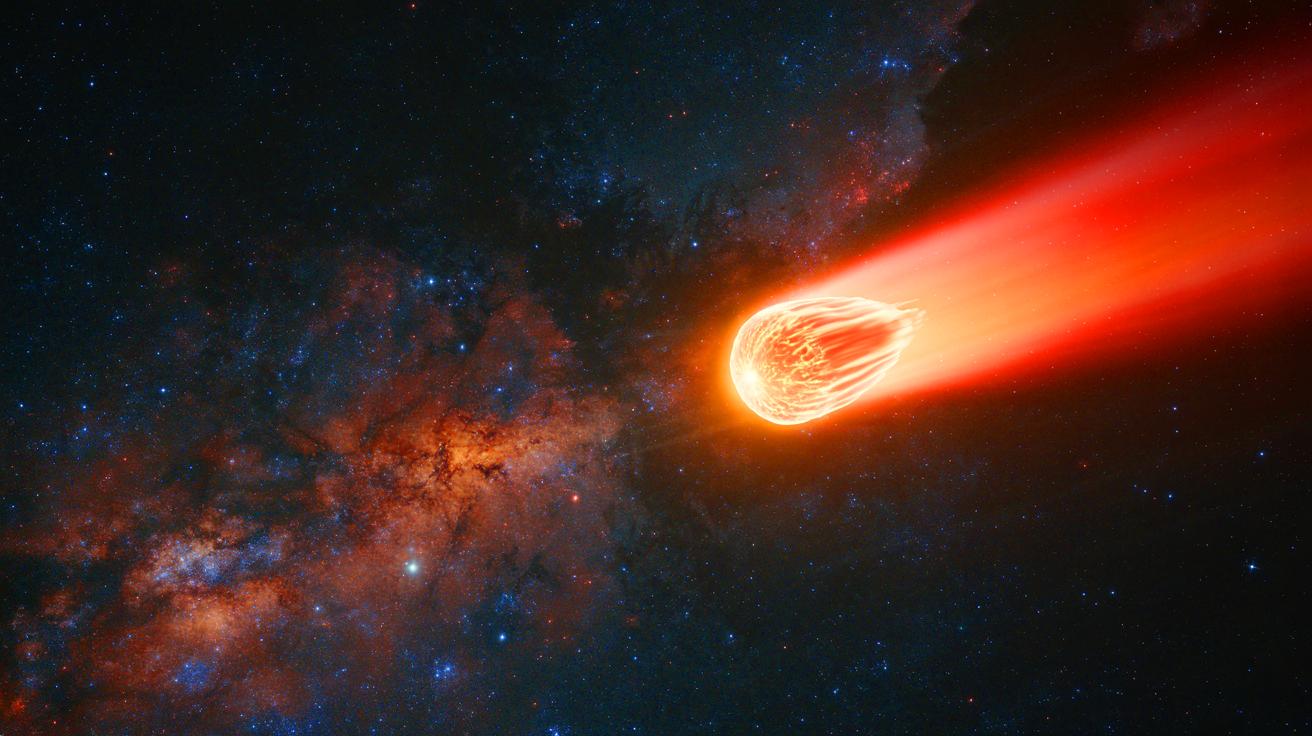
A recent discovery has reignited the age-old debate about extraterrestrial life, with a new interstellar comet known as 3I/ATLAS captivating astronomers worldwide. This comet, only the third of its kind to be identified, is an interstellar visitor passing through our solar system. First observed in July 2025, its arrival has sparked speculation and controversy, particularly due to the claims made by Harvard scientist Avi Loeb. Loeb suggests that this comet might not be just a natural phenomenon but possibly an artifact of alien technology. His provocative theory has stimulated discussions about the comet’s nature and the potential for advanced extraterrestrial civilizations.
The Unique Characteristics of 3I/ATLAS
The discovery of 3I/ATLAS, an interstellar comet, has intrigued scientists due to its unique features. The comet, which originated from outside our solar system, is the latest in a rare category of celestial objects. Unlike most comets, which are native to our solar system, 3I/ATLAS has traveled from the far reaches of space, bringing with it numerous unanswered questions.
Avi Loeb has focused on the comet’s distinct properties, which include a mysterious light glow that seems to emanate from its core. While some scientists attribute this glow to evaporating dust, Loeb proposes that it might be evidence of a central light source, possibly suggesting that the comet is not entirely natural.
He speculates that this glow could either be from a radioactive fragment of a supernova or, more intriguingly, from a nuclear-powered spacecraft. These bold claims are not without controversy, but they have certainly captured the attention of the scientific community and the public.
Loeb’s Controversial Propositions
Avi Loeb is no stranger to controversy, having previously suggested that other interstellar objects might be technological artifacts. He famously claimed that 1I/ʻOumuamua, the first known interstellar object, could have been an alien probe. His propositions have often been met with skepticism but continue to provoke important discussions about the possibilities of life beyond Earth.
In the case of 3I/ATLAS, Loeb’s theory hinges on the comet’s trajectory and size, which he believes could indicate a technological origin. He argues that the comet’s path is too precise to be entirely natural, suggesting instead that it might be guided by an intelligent force. While these ideas are speculative, they underscore the need for more data and investigation.
“3I/ATLAS could be a spacecraft powered by nuclear energy, and the dust emitted from its frontal surface might be from dirt that accumulated on its surface during its interstellar travel.” – Avi Loeb
Opportunities for Further Investigation
As 3I/ATLAS approaches Mars, it presents a unique opportunity for closer observation. Loeb has suggested that NASA utilize the Mars Reconnaissance Orbiter (MRO) to observe the comet as it makes its close approach. The MRO’s HiRISE camera could capture high-resolution images, providing valuable data that might help confirm or refute Loeb’s theories.
The timing of the comet’s approach is critical, as its proximity to the Sun will soon make it difficult to observe from Earth. The scientific community is eager to learn more about its composition, trajectory, and origin. If Loeb’s hypothesis holds any truth, the implications could be profound, potentially changing our understanding of the universe and our place within it.
“I encouraged the HiRISE team to use their camera during the first week of October 2025 in order to gather new data on 3I/ATLAS. They responded favorably.” – Avi Loeb
The Broader Implications
The debate surrounding 3I/ATLAS extends beyond the realm of astronomy and into questions about the existence of extraterrestrial life. If Loeb’s theories are proven correct, it would be a groundbreaking discovery, suggesting that we are not alone in the universe. Such a revelation would have far-reaching implications for science, philosophy, and even religion.
However, the scientific community remains cautious. Extraordinary claims require extraordinary evidence, and many scientists are calling for more rigorous data before drawing any conclusions. The exploration of 3I/ATLAS is a reminder of how much we still have to learn about the cosmos. As we continue to search for answers, the question remains: what else might be out there, waiting to be discovered?
The mystery of 3I/ATLAS challenges us to think beyond our current understanding and to keep exploring the unknown. As scientists prepare to gather more data, the question remains: could this comet reveal secrets about intelligent life beyond Earth, or is it merely another fascinating natural phenomenon?