



| IN A NUTSHELL |
|
The recent study conducted by South Korean researchers marks a significant advancement in the understanding of plasma physics, particularly in the context of nuclear fusion technology. By providing experimental proof of ‘multi-scale coupling’ in plasma, the researchers have managed to demonstrate how turbulence at the particle level can influence the equilibrium of an entire plasma system. This breakthrough has the potential to impact not only the development of nuclear fusion reactors but also our understanding of astrophysical phenomena. The findings, which were published amidst growing interest in sustainable energy solutions, underscore the intricate relationship between microscopic and macroscopic processes in plasma dynamics.
Understanding Multi-Scale Coupling in Plasma
Plasma, often referred to as the fourth state of matter, consists of highly charged particles resulting from electrons separating from atomic nuclei at elevated temperatures. The study aimed to explore the concept of multi-scale coupling, where turbulence at the particle level scales up to affect the entire system. This phenomenon poses a challenge to existing magnetohydrodynamics (MHD) theories, which primarily treat plasma as a single conductive fluid.
Researchers focused on demonstrating a direct causal link between microscopic activity and macroscopic structural changes. By doing so, they sought to address a gap in the current understanding of plasma behavior. Such insights are crucial for the development of nuclear fusion technology, as controlling plasma dynamics is essential for maintaining a stable fusion reaction.
Experimentation with the Versatile Experiment Spherical Torus (VEST)
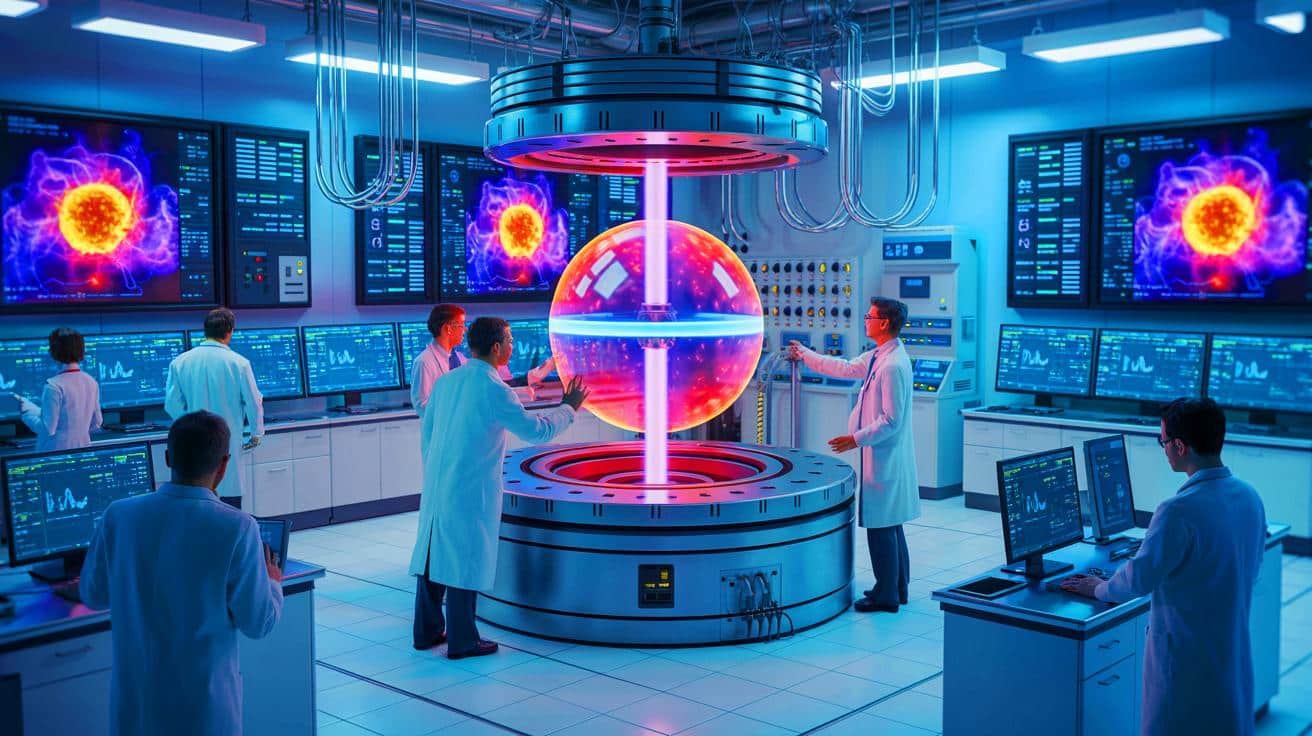
The experimental study was conducted using the spherical toroidal nuclear fusion device known as VEST, located at Seoul National University. This device allowed researchers to simulate the conditions necessary for observing the effects of particle-level turbulence on plasma equilibrium. The experiment utilized a 3D helical magnetic field configuration to examine the behavior of flux ropes, which are structures of charged particles.
Two electron beams were launched along magnetic field lines, forming individual flux ropes that moved at drift velocities exceeding the ambient Alfvén velocity. This setup effectively induced magnetic turbulence through beam-driven instabilities, providing a unique opportunity to observe the cross-scale coupling in action. The results of the experiment offered valuable insights into the complex interactions within plasma systems.
Significant Findings and Their Implications
The experiment revealed that micro-turbulence could lead to a sequence of events culminating in magnetic reconnection. This process involves the reconfiguration of magnetic field lines, converting magnetic energy into thermal energy. The reconnection event observed in the experiment caused the merging of two separate flux ropes into a larger structure, demonstrating how small-scale turbulence can directly impact large-scale plasma stability.
These findings have far-reaching implications for both nuclear fusion development and astrophysics research. Understanding how turbulence affects plasma stability can inform strategies for sustaining fusion reactions, a key challenge in achieving practical nuclear fusion energy. Additionally, the laboratory findings offer a model for understanding cosmic plasma phenomena, providing insights into events such as solar flares.
Broader Impact on Energy and Astrophysics
The implications of this research extend beyond the confines of laboratory experiments. In the realm of nuclear fusion, the ability to control plasma dynamics is pivotal for developing reactors capable of providing a sustainable energy source. The insights gained from this study could inform the design and operation of future fusion reactors, potentially accelerating the timeline for achieving practical fusion energy.
In the field of astrophysics, the study’s findings offer a valuable framework for interpreting observational data from cosmic events. The energy spectra measured during the experiment’s magnetic reconnection resembled those seen in natural plasma environments, such as solar flares. By serving as a model for these phenomena, the research bridges the gap between laboratory experiments and astronomical observations, enhancing our understanding of the universe.
As the world grapples with the challenges of energy sustainability and climate change, advancements in nuclear fusion technology hold significant promise. The South Korean researchers’ contributions to plasma physics not only advance the scientific community’s understanding but also pave the way for practical applications in energy production and space exploration. What new breakthroughs in plasma research will emerge as scientists continue to unravel the complexities of this fascinating state of matter?




This is mind-blowing! Are we finally on the brink of harnessing fusion energy? 🙌
Can someone explain what “multi-scale coupling” means in layman’s terms?
Great work, scientists! This could be a huge step towards sustainable energy. 🌍
If this works out, does it mean cheaper electricity bills in the future?
I’m skeptical. We’ve heard about fusion breakthroughs before. What’s different this time? 🤔
Can this technology be scaled up for commercial use, or is it still just a lab experiment?
How soon can we expect to see this technology in actual power plants?
The advancements in nuclear fusion are impressive! Thanks to all the researchers involved.
This seems too good to be true. What’s the catch?