


Close Menu
  • Featured
    • News
    • Consumption
    • Environment
    • Industry
    • Opinion
    • Policy
    • Production
    • Storage
    • Transmission
  • About Us
  • Advertise
  • Contact Us

Subscribe to Our Newsletter

News, investigations, and analysis — our top stories every morning to start your day right.

Trending
learn effective methods to assess the carbon footprint of your energy consumption and discover practical tips to reduce your environmental impact.
How to evaluate the carbon footprint of your energy use
explore the ultimate guide to different types of renewable energy sources, including solar, wind, hydro, and more, to understand their benefits and applications for a sustainable future.
Guide to different types of renewable energy sources
explore the vital link between energy consumption and water resources, highlighting how energy use impacts water availability and sustainability.
The connection between energy use and water resources
Facebook X (Twitter) LinkedIn YouTube TikTok
Energy Reporters
Facebook X (Twitter) RSS
Subscribe
  • Featured
  • News
    Illustration of Abu Dhabi National Oil Company's $11 billion financing deal for future gas production projects.

    ADNOC Secures $11 Billion for Gas Expansion, Transforming Energy Future and Boosting Local Economies

    12/19/2025
    Illustration of Energy Transfer LP's Lake Charles LNG project suspension and strategic shift to pipeline infrastructure.

    Energy Transfer Suspends Lake Charles LNG Project, Sparking Concerns Over Job Losses and Future Energy Solutions

    12/19/2025
    Illustration of a U.S. judge blocking Michigan's attempt to shut down Enbridge's Line 5 pipeline.

    Judge Blocks Michigan’s Effort to Shut Down Enbridge’s Line 5 Pipeline, Sparking Environmental and Economic Debate

    12/18/2025
    Illustration of a Venezuelan oil tanker under U.S. sanctions and its impact on the oil industry.

    Venezuela’s Oil Industry Faces Turmoil as Tanker Seizure Prompts Calls for Contract Revisions and Discounts

    12/17/2025
    Illustration of a woman standing in a snow-covered street in Manhattan during a cold snap.

    US Energy Emergency Declared as Northeast Cold Snap Threatens Homes, Businesses, and Critical Infrastructure

    12/16/2025
  • Use
    discover effective steps to make your business more energy efficient and reduce operational costs while promoting sustainability.

    Steps to make your business more energy efficient

    06/16/2026
    learn step-by-step how to conduct an energy audit for your home to identify energy-saving opportunities and reduce utility bills effectively.

    How to conduct an energy audit for your home

    05/19/2026
    explore how energy consumption contributes to climate change and discover strategies to reduce its environmental impact for a sustainable future.

    The impact of energy consumption on climate change

    05/12/2026
    discover essential tips for choosing the best energy provider to save money, ensure reliable service, and find the right plan for your needs.

    Tips for choosing the best energy provider

    05/05/2026
    discover why energy efficiency is crucial for businesses in 2026, helping reduce costs, improve sustainability, and boost competitive advantage.

    Why energy efficiency matters for businesses in 2026

    03/24/2026
  • Climate
    learn effective methods to assess the carbon footprint of your energy consumption and discover practical tips to reduce your environmental impact.

    How to evaluate the carbon footprint of your energy use

    07/21/2026
    explore the vital link between energy consumption and water resources, highlighting how energy use impacts water availability and sustainability.

    The connection between energy use and water resources

    07/07/2026
    discover what green energy is and understand its importance for a sustainable future. learn how renewable sources can reduce environmental impact and promote clean living.

    What is green energy and why it’s important

    06/09/2026
    discover the environmental benefits of switching to clean energy, including reduced carbon emissions, improved air quality, and a sustainable future for our planet.

    The environmental benefits of switching to clean energy

    04/21/2026
    Illustration of a radiative engine harnessing energy from the night sky using a Stirling engine.

    Night Sky Radiative Engine Sparks New Era of Clean Energy, Transforming How We Harness Power After Dark

    11/25/2025
  • Industry
    A bunch of black and white objects with a green arrow above them

    The Ongoing Bribery Case Against Hithium’s Chairman Wu Zuyu Highlights the Stakes for Battery Investors

    02/22/2026
    Illustration of Ford's strategic shift from electric vehicles to gas and hybrid models.

    Ford Reveals $19.5 Billion Charge as EV Strategy Unravels, Impacting Jobs and Future Mobility Choices

    12/17/2025
    Illustration of U.S. energy firms reducing operational oil and gas rigs amidst fluctuating market conditions.

    US Drillers Cut Oil and Gas Rigs Again, Exposing Potential Economic and Environmental Impacts on Local Communities

    12/13/2025
    Illustration of Nador West Med port in Morocco.

    Morocco Moves Closer to $1 Billion LNG Hub, Promising Major Energy Shift and Economic Growth

    12/10/2025
    Illustration of Chevron's Gorgon Stage 3 development project off Western Australia's northwest coast.

    Chevron’s Gorgon LNG Project Secures $2 Billion Investment, Reshaping Energy Landscape and Boosting Local Economy

    12/07/2025
  • Opinion
    lighted city skyline at night

    Korean Companies Are Losing Ground to China: Why Governance Failures at Conglomerates Like Young Poong Group Matter More Than Ever

    03/22/2026

    Pulling back the curtain on Turkey’s natural gas strategy

    09/01/2020

    How West Africa can expand power supply and meet climate goals

    06/15/2020

    Review: Oil and the Great Powers: Britain and Germany, 1914 to 1945

    06/09/2020

    Eastern Mediterranean gas: testing the field

    05/27/2020
  • Policy
    explore the concept of dynamic pricing in electricity markets, including how it works, its benefits, and its impact on consumers and suppliers.

    Understanding dynamic pricing in electricity markets

    06/23/2026
    explore how artificial intelligence is transforming energy management by optimizing efficiency, reducing costs, and promoting sustainable solutions.

    The influence of artificial intelligence on energy management

    06/02/2026
    explore how government policies are influencing the energy sector, driving innovation, sustainability, and market dynamics for a cleaner future.

    How government policies are shaping the energy sector

    04/14/2026
    discover the essentials of smart energy management, including how innovative technologies optimize energy use, reduce costs, and promote sustainability for homes and businesses.

    What you need to know about smart energy management

    02/24/2026
    Illustration of the Trump administration's delay in finalizing 2026 biofuel quotas amid oil and agricultural sector tensions.

    Trump Administration Faces Delays in Finalizing 2026 Biofuel Quotas, Raising Questions About Future Energy Policies

    12/14/2025
  • Output
    explore the ultimate guide to different types of renewable energy sources, including solar, wind, hydro, and more, to understand their benefits and applications for a sustainable future.

    Guide to different types of renewable energy sources

    07/14/2026
    discover the advantages and disadvantages of hydroelectric power, exploring its impact on the environment, energy efficiency, and sustainability.

    Exploring the pros and cons of hydroelectric power

    05/26/2026
    explore the rise of geothermal energy, its growing importance in sustainable power, and the potential it holds for a cleaner energy future.

    The rise of geothermal energy and its potential

    03/31/2026
    explore the role of nuclear energy in the global power mix, its benefits, challenges, and impact on sustainable energy development worldwide.

    The role of nuclear energy in the global power mix

    03/03/2026
    explore the future of wind energy and discover upcoming trends, innovations, and what to expect in this rapidly evolving renewable energy sector.

    The future of wind energy: what to expect

    02/03/2026
  • Storage
    discover how energy storage solutions can stabilize renewable energy sources by managing supply fluctuations and ensuring a reliable power grid.

    How energy storage can stabilize renewable sources

    06/30/2026
    explore the latest innovations in battery technology transforming energy storage solutions, enhancing efficiency, capacity, and sustainability for a cleaner future.

    Innovations in battery technology for energy storage

    03/17/2026
    Illustration of Venezuela's oil storage facilities nearing maximum capacity amid U.S. sanctions.

    Venezuela Faces Oil Storage Crisis as Tanker Restrictions Expose Vulnerabilities in Energy Infrastructure and Economy

    12/18/2025
    time lapse photography of square containers at night

    ‘Mega Batteries’ are Powering the Future of Energy Consumption

    10/23/2025
    Illustration of a gravity-based energy storage system integrated into a skyscraper, utilizing renewable energy sources.

    Gravity Battery Innovation Transforms Skyscrapers into Renewable Energy Storage, Revealing New Possibilities for Urban Sustainability

    10/18/2025
  • Grid
    explore the fundamentals of energy grids and their modernization, including innovations, smart technologies, and the future of efficient power distribution.

    Understanding energy grids and their modernization

    04/28/2026
    Illustration of Ovintiv and Pembina's collaboration on LNG export from the Cedar LNG facility.

    Ovintiv Agreement for Cedar LNG Capacity Sparks New Era in North American Energy Collaboration and Innovation

    12/16/2025
    Illustration of Star Catcher Industries' power beaming technology at NASA's Kennedy Space Center.

    Star Catcher Achieves Breakthrough, Sets New 1.1-kW Power Beaming Record, Transforming Future Energy Solutions

    11/25/2025
    Illustration of U.S. LNG exports navigating global market challenges and expanding into Asian regions amidst rising competition.

    US LNG Export Dominance Faces Challenge as Sellers Explore New Markets Beyond Europe’s Energy Demand

    11/23/2025
    Illustration of the race to develop new pipelines in response to California refinery closures and rising fuel prices.

    California Refinery Closures Drive Urgent Pipeline Race, Transforming Energy Supply Dynamics on the West Coast

    11/19/2025
Energy Reporters

In Persian Gulf, it’s back to the future

Rosemary PotterRosemary Potter06/19/20190
Share Twitter Facebook LinkedIn Telegram WhatsApp Email Copy Link
Follow Us
Google News
Share
Twitter Facebook LinkedIn WhatsApp Email Copy Link

Is Robert Zemeckis a seer? The celebrated American director of the Back to the Future trilogy seems to have uncanny prognostication powers when it comes to oil, the Persian Gulf, and his own Baby Boomer generation.

The attacks on two Arab oil tankers last week in the Gulf of Oman has reminded many of the 1984-88 Tanker War in the Persian Gulf, when Iran and the United States engaged in limited but sustained naval and aerial engagements. The geopolitical and market dynamics today are also quite reminiscent of the 1951-54 period. At the time, Washington (and London) embargoed Iranian oil and pushed for regime change after Tehran nationalized its oil industry.

In the Back to the Future trilogy, Zemeckis sets the story across three years: 1955, 1985, and 2015. The main character, played by Michael J. Fox, time-travels between them—in a flying DeLorean sports car, powered by a fuel concocted by a crazy scientist—to stop the machinations of Biff Tannen, a character based on, believe it or not, Donald Trump. Zemeckis is not, of course, a seer. But he knows his culture, and builds meaningful and eerily realistic narratives out of its historical imaginings. Forrest Gump was another such masterpiece.

We are certainly going back to the future now with tankers attacked in the Gulf. Fortunately, market dynamic, geopolitics, Iranian strategy, American public opinion, and Trump’s character will hopefully contain the second Tanker War to naval and aerial engagements.

Non-OPEC spare capacity

The key to understanding oil prices is global spare capacity. When there is plenty of it, markets will ignore even the most patent threat to oil-supply security.

OPEC first gained market power in the early 1970s as the repository of global spare capacity. When the Arab members of OPEC embargoed supplies in 1973-4, they unleashed the first oil-price shock and redefined the geopolitics of oil. The Iranian Revolution brought the second price shock. Even with Iran fighting Iraq, OPEC managed to collaborate somewhat and keep upward pressure on price until 1982.

Thereafter, prices fell, bottoming out in 1986, all despite the ongoing Tanker War, which featured an Iranian blockade of Iraq’s tankers and an American blockade of Iran’s, with a secondary goal of safeguarding of Arab tankers. The reason was that high prices from 1973-82 ushered in massive supplies of non-OPEC production from the North Sea, Mexico, and the U.S. state of Alaska .

The 1950s also had plentiful supplies of non-OPEC oil, since the organization was still unborn. Arab oilfields were just coming online, and the United States was still the world’s largest producer. It is little wonder, then, that shutting in Iran’s oil from 1951-54 had little effect on the market. There was plenty of Arab and American oil to replace it.

The same is true today, with surging U.S. supplies bringing global spare capacity. OPEC’s production cuts since 2016, aided by its historic alliance with Russia, have failed to rebalance the market and arrest the softening of oil prices since 2014. The U.S.-Chinese trade war is also denting global demand, creating more spare capacity.
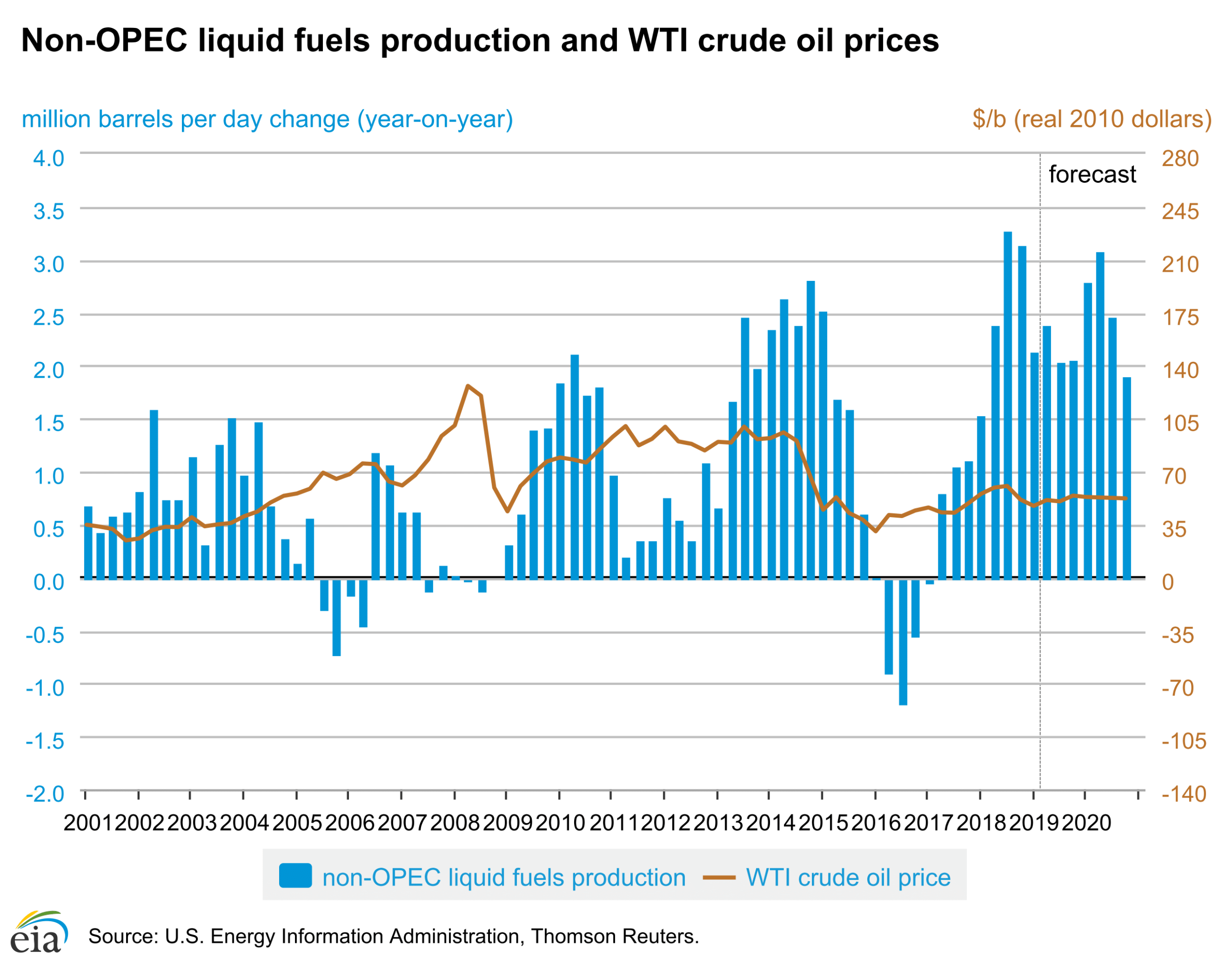
Lest I sound too flippant, an actual outage in Hormuz would obliterate the above assumptions, to be sure. Yet non-OPEC spare capacity will make this Tanker War much like the 1950s and 1980s.

Hormuz haze

It remains unclear whether Iran was responsible for last week’s attacks, as the United States and Saudi Arabia claim. Others raise the specter that this was a false flag operation. A crew member of one tanker said “the ship was attacked by a flying object,” a story backed the tanker’s owner. Japan is demanding clearer evidence of Iran’s culpability; the Europeans are urging restraint.

My guess is that this could have been indeed a false flag attempt to provoke the Second Tanker War. Recent events are simply too hazy and inconclusive to declare Iran culpable. On May 5, the United States deployed additional forces to the Gulf. Then, on May 12, two Saudi oil tankers were targeted. Then, on May 14, a drone purportedly from the Iranian-backed Houthis in Yemen attacked a Saudi oil pipeline.

Last August, I argued that Washington might be baiting Iran to close Hormuz. It had scrapped the Iranian nuclear deal and begun to sanction Iranian oil once again. The best way to eliminate Iranian oil exports altogether would be to seal off Hormuz, making a tanker war a better solution. Why? Because it allows Arab oil to continue to flow, while applying U.S. force to keep Iranian exports off the market. Last month, I outlined the potential for a false flag closure.

It is clear why the United States and its Arab allies would benefit from a second Tanker War in the Persian Gulf. As such, it is getting to the point where Iran’s culpability no longer matters.

Life imitates art

At the same time, it would also be possible for Iran to initiate these actions as a way to push and test the United States. It knows from decades of experience that America is unwilling to tolerate human casualties. Past Republican presidents who have military service have mostly favored offshore strategies to avoid land wars in the Persian Gulf. (The Bush presidencies being the exceptions.)

Ronald Reagan entered office full of bravado, but quickly retreated after U.S. forces suffered massive casualties at the hands of Iranian-backed Hezbollah in Lebanon. He thereafter relied on offshore strategies such as the Tanker War. Dwight Eisenhower was similarly reluctant to commit American troops abroad during the 1950s, instead preferring brinkmanship, covert operations, and economic pressure to enact foreign policy goals. Enter the Vietnam draft-dodging Trump, who has even less stomach for foreign adventures and adores coercive economic and oil policies. Much like the bluffing bully Biff Tannen, Trump retreats when faced with real opposition.

But an all-out war is unlikely. The second Tanker War is likely to bear deep, albeit imperfect, similarities to America’s offshore approaches to Iran in the 1950s and 1980s. It will be restricted to aerial and naval engagements – à la the climactic dogfighting scene of the 1986 blockbuster Top Gun – in an attempt to limit Iranian oil exports and destroy its nuclear facilities. Still, incidental calamities are not to be ruled out. During the first Tanker War, a U.S. missile killed nearly 300 innocent people aboard Iran Air Flight 655, and Iraqi missiles killed 37 sailors aboard the USS Stark. Both were purported accidents.

If only it were all a movie.

Subscribe to Our Newsletter

News, investigations, and analysis — our top stories every morning to start your day right.

Donald Trump oil tankers Opec Strait of Hormuz Tanker War
Follow on Google News Follow on X (Twitter)
Share. Facebook Twitter LinkedIn Telegram WhatsApp Email Copy Link
Previous ArticleRussia admits power grid vulnerabilities 
Next Article Project aims to create energy production
Rosemary Potter
  • X (Twitter)

Rosemary Potter is a Berlin-based journalist for Energy Reporters, covering European energy markets, cross-border policy, industry innovation, and the challenges of energy transition. With journalism training in the U.S., she combines investigative depth with a continental outlook. Her reporting amplifies the perspectives shaping Europe’s energy future across sectors, borders, and technologies. Contact: [email protected]

Keep Reading
explore the concept of dynamic pricing in electricity markets, including how it works, its benefits, and its impact on consumers and suppliers.

Understanding dynamic pricing in electricity markets

explore how artificial intelligence is transforming energy management by optimizing efficiency, reducing costs, and promoting sustainable solutions.

The influence of artificial intelligence on energy management

explore how government policies are influencing the energy sector, driving innovation, sustainability, and market dynamics for a cleaner future.

How government policies are shaping the energy sector

Add A Comment
Leave A Reply Cancel Reply

Subscribe to Our Newsletter

News, investigations, and analysis — our top stories every morning to start your day right.

Trending
learn effective methods to assess the carbon footprint of your energy consumption and discover practical tips to reduce your environmental impact.
How to evaluate the carbon footprint of your energy use
explore the ultimate guide to different types of renewable energy sources, including solar, wind, hydro, and more, to understand their benefits and applications for a sustainable future.
Guide to different types of renewable energy sources
explore the vital link between energy consumption and water resources, highlighting how energy use impacts water availability and sustainability.
The connection between energy use and water resources
News by category
  • Featured
  • News
  • Use
  • Climate
  • Industry
  • Opinion
  • Policy
  • Output
  • Storage
  • Grid
Information
  • About Us
  • Advertise
  • Meet the Team
  • Contact Us
  • Legal Notice
  • Privacy Policy

Subscribe to Our Newsletter

News, investigations, and analysis — our top stories every morning to start your day right.

Facebook X (Twitter) RSS
© Energy-Reporters.com. All rights reserved.

Type above and press Enter to search. Press Esc to cancel.