




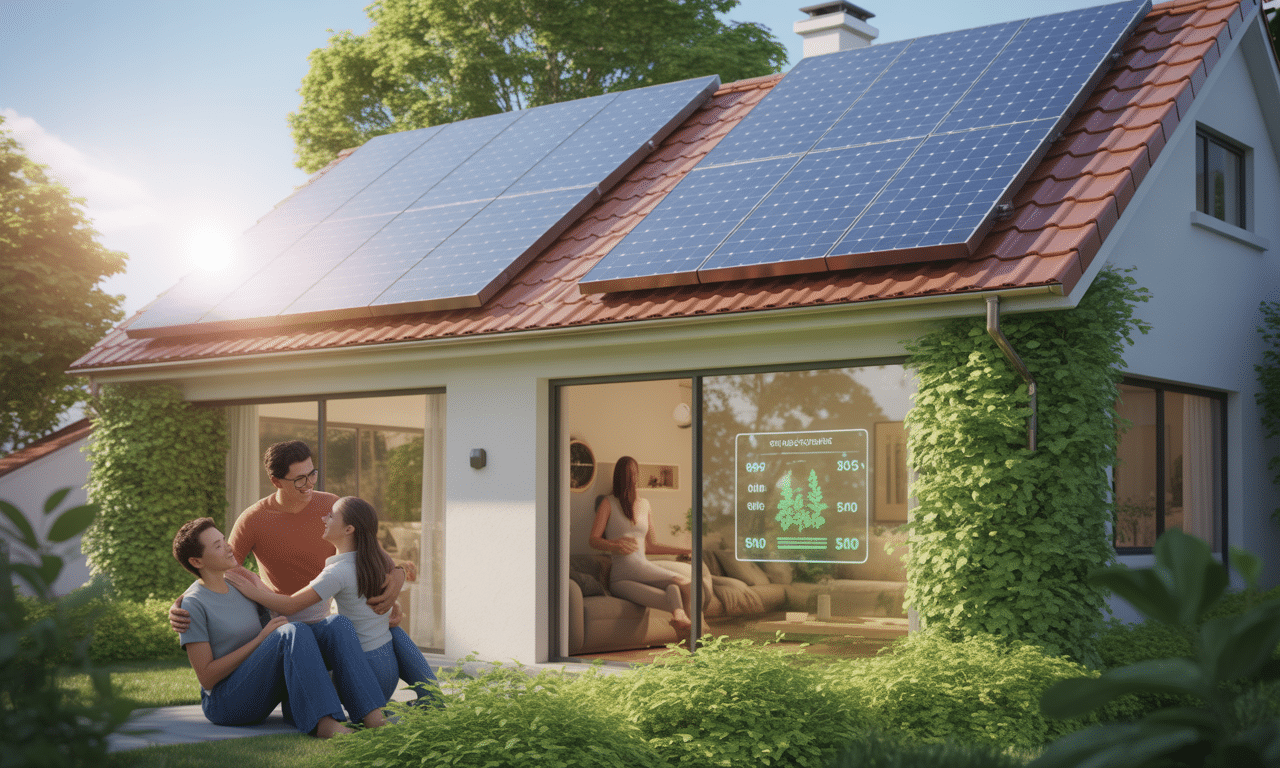
IN A NUTSHELL
As Americans install more rooftop systems—now numbering over a million—homeowners increasingly cite financial savings and resilience as reasons to go solar. Solar electricity converts a renewable and abundant resource into tangible monthly bill reductions, with outcomes depending on consumption, system size, sun exposure and local rates. Policy incentives, including a federal tax credit that can cover roughly 30% of installation costs, accelerate payback and improve returns. Research also ties solar to higher resale prices; studies suggest buyers pay a premium for PV-equipped homes, with average uplifts in the low five figures. Beyond dollars, solar delivers energy independence during grid disruptions and a lower-carbon alternative that produces power without greenhouse-gas emissions. Technological advances and scale economies have driven panel costs down, while simple upkeep keeps maintenance demands low. For homeowners weighing upgrades, solar increasingly reads as a pragmatic, long-term investment: it cuts utility exposure, boosts property value and leverages a domestic energy resource so plentiful that a single hour of peak summer sun could theoretically match the nation’s annual electricity demand.
Financial returns and lower monthly utility bills
Solar investment is often judged first by its effect on household cash flow. Homeowners consistently report that the most compelling reason to adopt rooftop photovoltaic systems is the promise of lower monthly utility bills and an attractive rate of return compared with traditional home improvements. Variables such as electricity consumption, system size, whether the system is bought or leased, and the local price of electricity all shape the actual savings you will realize.
Careful analysis shows that a properly sized system can drastically reduce or even eliminate your electric bill. Net metering policies amplify these savings by allowing surplus production to offset consumption over billing cycles. For specifics about how residential solar translates to household uses and savings, see the practical breakdown of applications at GoBeSolar.
The financial case is strengthened by the fact that solar installation costs have been steadily declining due to technological advances and economies of scale. While sources like Forbes outline both pros and cons, the overall trend favors lower upfront costs and improved panel efficiency. That decline changes the payback calculus every year, making early adoption less risky and more profitable. Government resources such as the Department of Energy provide authoritative guidance on the concrete benefits of residential solar: Energy Saver: Benefits.
| Factor | Effect on savings | Action to optimize |
|---|---|---|
| Electricity consumption | High consumption increases potential savings | Reduce demand, size system appropriately |
| System size | Oversizing raises production; undersizing limits offset | Model production vs. load |
| Net metering | Improves financial return | Verify local policies |
| Sunlight hours & roof angle | Directly impacts generation | Optimize orientation, consider trackers |
That combination of falling costs, supportive policies, and clear operational levers makes solar one of the most defensible home investments available today. The table above highlights actionable factors to maximize your returns.
Increase in home value
Solar panels do more than cut utility bills; they represent a tangible upgrade that prospective buyers increasingly value. Real estate research has repeatedly shown that homes with installed solar systems sell at a premium compared to comparable homes without PV. The upgrade is often equated with other sought-after renovations—buyers perceive lower ongoing expenses and a modern, efficient dwelling.
Empirical studies indicate that solar-equipped homes command higher sale prices and often sell faster. One influential analysis found an average uplift in home value tied to presence of solar panels. While premiums vary by market conditions—such as local electricity rates and the size of the solar system—the presence of owned panels typically reads as an asset rather than a liability. Buyers evaluate the reduced operating cost as an immediate financial benefit, much like a lower tax or utility bill stitched into the mortgage calculation.
There are practical considerations: leased systems sometimes complicate transactions if transfer clauses are not clearly handled, so ownership is generally preferable for resale value. Homeowners considering solar should also weigh aesthetic and structural factors; well-integrated systems that maintain roof integrity and visual appeal perform best in resale scenarios. Resources like United Better Homes and market analyses provide buyers and sellers with data supporting the value uplift.
Investing in solar is an investment in asset quality. When arguing for solar as a wealth-preserving home improvement, emphasize the dual benefit: ongoing operational cost reduction plus a likely increase in sale price. That combination turns solar from an expense into a strategic financial move.
Environmental impact and resource abundance
The environmental case for residential solar is straightforward: photovoltaic systems generate electricity without emitting greenhouse gases during operation, removing a key source of household carbon footprint. Solar power replaces fossil-fuel generation and lowers emissions from the grid, which is critical for climate goals. For homeowners concerned about the long-term environmental legacy of their household, installing solar is a direct and measurable step.
Yet environmental assessment must include trade-offs. Not all large-scale solar projects are without controversy; some concentrated solar installations have raised ecological concerns. For example, investigative reporting on certain utility-scale plants has documented unintended impacts on wildlife and questioned overall efficiency, a reminder that scale and design matter—residential arrays avoid many of these problems by limiting land use and focusing on rooftop deployment. See reporting on contentious large projects at Energy Reporters: Ivanpah.
In terms of raw resource, the United States has enormous solar potential—one hour of clear summer sunlight can theoretically meet the country’s annual electricity needs. That abundance means most regions can benefit from solar; even areas with lower insolation can see positive returns because of modern panel efficiency. Reports and primers like those at Greenwave Solar and mainstream coverage highlight how wide applicability supports national decarbonization.
Installing rooftop solar is an effective way to claim a share of an abundant, renewable resource while avoiding the larger environmental pitfalls associated with some utility-scale projects. Homeowners thereby contribute to reduced emissions while reaping private benefits.
Energy independence and reliability
Household solar is fundamentally about control: generating your own electricity reduces dependency on centralized utilities and volatile fuel markets. That energy independence is particularly persuasive in regions prone to outages or where grid reliability is inconsistent. Adding battery storage alongside solar further enhances resilience, enabling households to ride through blackouts and avoid peak pricing by discharging stored energy when the grid is expensive or unavailable.
Owning the means of production—your rooftop—changes the relationship between household and utility from passive consumer to active producer. This shift has practical value beyond finances: it offers predictable energy costs, local reliability, and the psychological benefit of self-sufficiency. Policy shifts and geopolitics also intersect with this point; national trade and industrial dynamics influence component availability and prices, as debates around international manufacturing show. For example, reporting on political stances toward foreign solar manufacturing illustrates how policy affects supply chains and domestic energy strategy: Energy Reporters: policy.
Decisions by countries and regions to shift from coal to solar further emphasize the strategic nature of decentralized generation. Poland’s efforts to increase solar while reducing coal dependency demonstrate how distributed generation supports broader energy transitions: Poland and solar. For homeowners, distributed solar converts a macro-level policy trend into household-level reliability and risk mitigation.
Emerging technologies—like solar-integrated devices and solar-powered consumer electronics—illustrate the cultural shift toward decentralized energy. Examples of solar-powered laptops and other innovations underscore how pervasive solar can become: Lenovo solar laptop and Lenovo solar tech debate.
Incentives, costs, and low maintenance
Financial incentives and decreasing costs make the solar argument stronger every year. Federal and state incentives, including tax credits and rebates, can substantially reduce upfront costs; homeowners should evaluate available programs to minimize capital outlay. Access to incentives frequently transforms a marginal investment into a clear economic winner. Government and industry resources outline how incentive structures work and which are available in different jurisdictions, with actionable guidance for homeowners.
At the same time, the cost of solar equipment and installation has been on a downward trajectory thanks to manufacturing improvements and competitive markets. Articles and industry analyses track these trends and give homeowners context for timing and negotiation; see practical pros and cons at Forbes and benefit summaries at Energy.gov.
Maintenance requirements for rooftop solar are generally low, and most systems are designed for decades of service. Routine cleaning and periodic inspections suffice to maintain performance; warranties and professional maintenance packages mitigate long-term risk. Homeowners should be cautious about DIY cleaning that could void warranties or cause damage. Evidence of decreasing lifecycle costs and rising durability supports an argument that solar is a low-risk, long-term investment.
Finally, homeowners should balance incentives and geopolitical trends when evaluating timing. Trade policies and domestic manufacturing capacity can affect component pricing and availability, as public debate and reporting have shown. For those weighing the decision now, resources like United Better Homes and industry primers provide clear frameworks, while energy-sector reporting highlights the broader context—both reassuring and cautionary—that informs a prudent purchasing decision.
Why switching to solar is the smart choice for homeowners
Adopting solar energy for your home is not just an environmental statement — it is a financially sound decision. With installation costs steadily falling and more than over a million installations already in the U.S., the economic case for rooftop photovoltaics is strong. Homeowners who install solar systems routinely see lower monthly utility bills, and those savings scale with system size, local electricity prices, and daily sunlight. When you factor in mechanisms like net metering, surplus production can further offset costs, accelerating payback and improving returns on investment.
Beyond monthly savings, solar upgrades reliably increase home value. Buyers increasingly prioritize energy-efficient homes, and studies consistently show a premium for properties with working solar arrays. That premium depends on market conditions and system characteristics, yet the evidence supports the argument that investing in solar raises resale appeal and captures a portion of the system’s value at sale — making it a low-risk way to enhance long-term household wealth.
The strategic benefits extend to resilience and sustainability. The United States has an abundant solar resource—so abundant that a fraction of a day’s summer sunlight could theoretically meet yearly electricity demand—meaning even regions with modest insolation can benefit. Generating your own power reduces reliance on the grid, increases energy independence, and provides protection against outages and volatile utility rates. At the same time, solar is an environmentally friendly option that lowers household emissions without ongoing fuel costs.
Finally, policy and technology trends reinforce the argument for adoption: homeowners can often access attractive government incentives (including a possible 30% tax credit on installation costs in many cases), panels require low maintenance, and advances continue to drive decreasing costs and higher efficiency. Taken together, these points make a compelling, evidence-based case that switching to solar is a practical, value-enhancing choice for homeowners seeking savings, resilience, and environmental benefit.
Q: What are the primary benefits of installing solar panels on my home? A: Solar provides a combination of renewable energy, potential for significantly lower monthly utility bills, increased property value, reduced environmental impact, and greater energy independence. With falling equipment costs and widespread adoption—over a million installations nationwide—solar is no longer a niche technology but a practical financial and environmental choice. Q: Will switching to solar actually reduce my electricity bills? A: Yes—solar can substantially reduce or even eliminate your electric bill if the system is properly sized. Actual savings depend on your electricity consumption, the system size, whether you purchase or lease, the average direct hours of sunlight where you live, your roof’s size and angle, and local utility rates. If your state supports net metering, excess generation can further offset costs by crediting or selling power back to the grid. Q: Does installing solar increase my home’s resale value? A: Yes. Solar is generally perceived as a home upgrade—similar to a renovated kitchen—and buyers often pay a premium for homes with functioning solar systems. Independent analyses have found an average uplift in home value (roughly $15,000 in one major study), though exact premiums vary with local market conditions and the size of the system. Q: Is solar effective in cloudy regions or states with less sun? A: Absolutely. The United States has an enormous solar resource overall, and even regions with lower insolation can see meaningful savings. Areas like the Pacific Northwest and Alaska still get comparable output to countries with extensive solar deployment, so viability depends more on economics and policy than on perfect sunshine. Q: Can solar protect me from power outages? A: Solar panels alone produce energy during daylight, but when paired with a battery storage system they can provide reliable backup during outages and increase your energy resilience. For homeowners who prioritize uninterrupted power, investing in storage alongside PV is a convincing argument for solar. Q: Are there tax credits or incentives that make solar more affordable? A: Yes. Federal and many state programs offer incentives that reduce upfront costs—most notably a federal tax credit that can cover up to 30% of installation expenses. Additional local rebates, sales or property tax exemptions, and utility programs can further improve the investment case. Q: How much maintenance do solar panels require? A: Solar systems are low maintenance by design. Aside from periodic inspections and occasional cleaning to remove dirt and debris, panels are engineered to endure harsh weather. Professional cleaning and service are recommended to avoid damage, safety risks, or warranty issues that can arise from DIY handling. Q: Are solar installations getting cheaper? A: Yes—costs have declined steadily due to technological improvements, manufacturing scale, and supportive policies. Falling equipment and installation costs, combined with incentives, mean the payback period is shortening and return on investment is improving for many homeowners. Q: Should I buy my system or lease it? A: Buying typically produces the largest long-term financial benefit because you capture all savings, tax credits, and the value increase to your home. Leasing reduces upfront expense but can limit eligibility for incentives and change the resale dynamics. Evaluate both options with a focus on long-term savings, incentives, and how long you plan to stay in the home. Q: How can I estimate whether solar is a good investment for my specific home? A: Compare your current and projected electricity costs against quotes for a system sized to your usage and roof characteristics. Factor in local electricity rates, available incentives, expected system output based on sunlight hours, and whether you plan to buy or lease. A professional site assessment will provide the most accurate estimate, but the decision is often compelling once these variables are considered.FAQ — Top benefits of using solar power at home