


| IN A NUTSHELL |
|
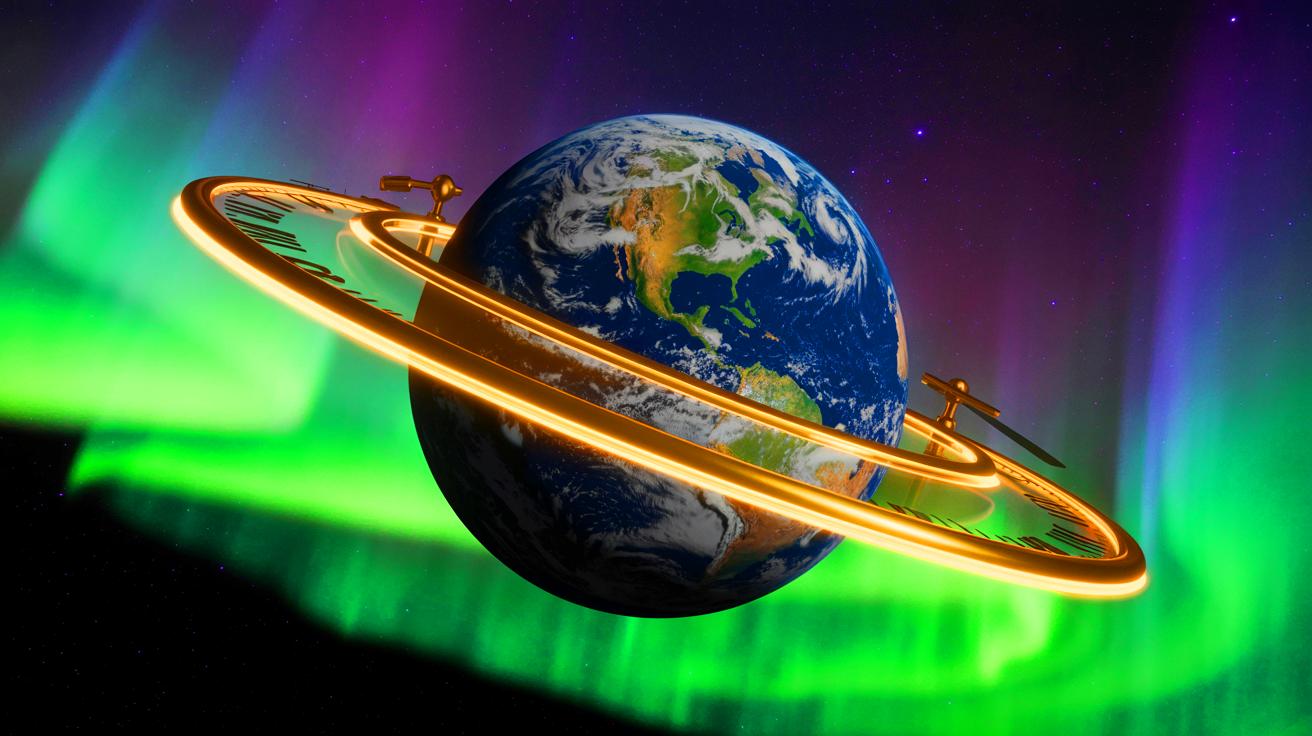
In the summer of 2025, an intriguing anomaly will occur as Earth completes its rotation 1.51 milliseconds earlier than the standard 24-hour day. This seemingly minor variation is sparking significant debate among scientists who are puzzled by the cause of this acceleration. Traditional explanations, including ice melt and lunar gravity, fail to adequately explain this phenomenon. As researchers delve into this mystery, they are not only questioning the reasons behind this shift but also exploring its potential implications on our technological and societal systems. This event underscores a broader question of our planet’s stability and our reliance on precise timing in a connected world.
The Heart of Earth Speeds Up, but the Mystery Deepens
Over the past few years, Earth’s rotation has unexpectedly accelerated, reversing a long-standing trend of a gradual slowdown. Historically, Earth’s rotation has lengthened, with days lasting approximately 23 hours during the dinosaur era. However, since 2020, data indicates an increase in rotational speed, and the underlying reasons remain unclear. Conventional factors like ice melting, seismic activity, atmospheric pressure, or lunar gravitational forces do not adequately explain this shift.
Leonid Zotov, an expert on Earth’s rotation at Moscow State University, has expressed his bewilderment over the unexplained acceleration. He noted that the phenomenon likely originates from internal processes within Earth, as current oceanic and atmospheric models fail to account for this rapid change. Despite the mystery, the evidence is irrefutable. On July 5, 2024, Earth completed its rotation 1.66 milliseconds faster than expected. With the upcoming anomaly in August 2025, scientists are racing to understand what is driving these changes.
August 20, 2025: The Shortest Day of the Year
As Earth approaches August 20, 2025, this date stands out as the fastest rotational day of the year, with the planet completing its spin 1.51 milliseconds ahead of the typical 86,400-second day. This acceleration is most pronounced on specific dates, including July 9 and July 22, which coincide with the Moon’s position farthest from the equator. This configuration temporarily lessens the Moon’s decelerating effect on Earth, resulting in a slight increase in speed.
Despite this acceleration, the impact on daily life will be negligible. Household clocks will remain unchanged, and daily routines will proceed as usual. However, the potential ripple effects on systems requiring absolute precision, such as atomic clocks, could be significant. This subtle shift may not be noticeable in our daily lives, yet it holds the potential for profound systemic impacts.
A Second Disappears: Chaos on the Horizon?
Since 1972, the global standard for timekeeping has incorporated 27 leap seconds to align atomic time with Earth’s variable rotation. In an unprecedented scenario, there might soon be a need to remove a second—a negative leap second. If Earth’s acceleration continues, this adjustment could be necessary by 2029. This would present a significant challenge to systems that rely on precise timing, such as computer networks, GPS, financial markets, and communication infrastructures.
Past leap second adjustments have already caused disruptions, with platforms like Reddit, Amazon, and Qantas experiencing bugs and delays. Companies like Google have adopted strategies like the “leap smear” to mitigate impacts by spreading the adjustment over several hours. However, the possibility of a negative leap second introduces a new challenge in maintaining the integrity of Universal Coordinated Time (UTC).
Time Disrupts… and So Do We?
While this micro-acceleration might seem inconsequential, it highlights the fragility of a world dependent on precise time synchronization. Scientists have until 2035 to decide on implementing a negative leap second. This decision encompasses not only technical considerations but also broader political and social implications. The phenomenon underscores our vulnerability to a planetary system we perceive as stable but which is subject to silent fluctuations.
As Earth spins faster, we must confront the reality that our assumptions about time and stability may need reevaluation. This raises a pertinent question: how prepared are our technological and social infrastructures to adapt to a world where even the fundamental concept of time is subject to change?

Wow, this sounds like something out of a sci-fi movie! 🌍
Does this mean that my birthday will come 1.51 milliseconds faster? 😂
Why don’t traditional explanations like ice melting fully account for this phenomenon?
Great article! Thanks for the detailed explanation. 🙏
Does this acceleration affect climate change predictions or is it unrelated?
Leap seconds were already confusing, and now negative leap seconds? Oh boy! 🤯
Can someone explain what a negative leap second is? I’m lost here.