




| IN A NUTSHELL |
|
The recent appearance of several enormous oarfish on the shores of Tasmania and New Zealand has rekindled interest and speculation about these mysterious sea creatures. Often referred to as the “fish of the apocalypse,” oarfish are rarely seen, making their presence a spectacle that captivates the public imagination. While folklore ties these sightings to impending disasters, scientists are urging a rational approach, emphasizing that these occurrences are not prophetic. This article delves into the myths, realities, and scientific intrigue surrounding these elusive ocean dwellers.
The Rare Sightings of Oarfish
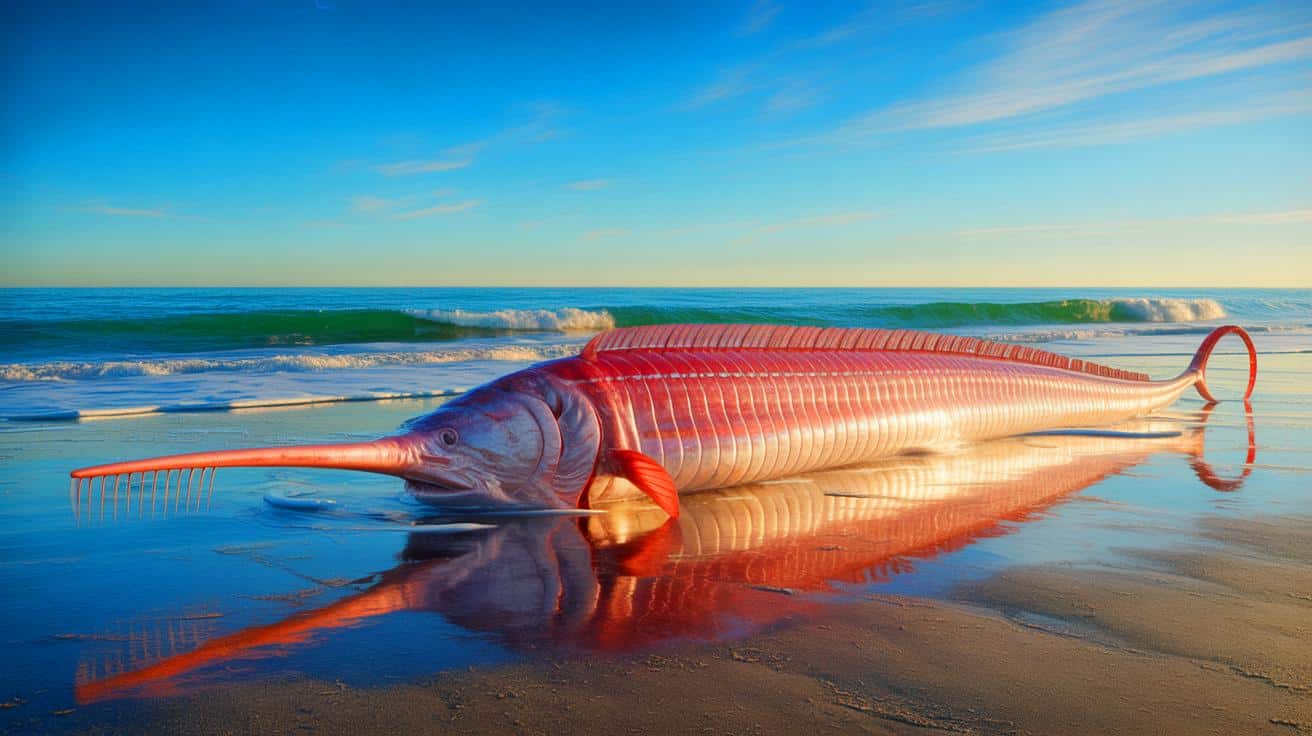
Oarfish sightings are a rare occurrence, making recent events in Tasmania and New Zealand particularly intriguing. The first oarfish was discovered on Tasmania’s west coast, with two more found shortly thereafter on New Zealand’s South Island. These unusual findings, especially when the creatures are headless, stir curiosity and speculation. Known for their impressive length—up to 26 feet—and shimmering blue and crimson hues, oarfish are hard to miss, even in the vastness of the ocean.
Andrew Stewart, a fish curator at New Zealand’s Te Papa Tongarewa Museum, describes these creatures as “magnificent and otherworldly.” He emphasizes their repetitive body structure, likening them to a series of identical segments stretching across their entire length. Despite their dramatic appearance, oarfish remain elusive. Only about twenty confirmed sightings have occurred in New Zealand, as noted by Stewart. The museum sought to secure one of the recent specimens for research, but scavenging seagulls thwarted these efforts by consuming the heads.
Challenging Myths: Oarfish and Natural Disasters
The oarfish’s eerie look and rare appearances have long been associated with myths of impending natural disasters, such as earthquakes. However, scientific studies, including one from 2019, show no correlation between oarfish sightings and seismic activity. Andrew Stewart highlights the importance of science-based approaches to understanding these creatures, steering clear of superstition. In Japan, the oarfish is known as ryugu no tsukai and is thought to be a messenger from the sea, warning of future calamities.
Nick Ling, a fish ecologist from the University of Waikato, explains that the oarfish’s deep-ocean habitat makes encounters rare, which adds to their mystique. Their unique vertical swimming style, undulating their dorsal fins, further distinguishes them. Ling describes them as “truly beautiful fish” with an “extraordinary lifestyle.” While their appearances may be rare, they offer valuable opportunities for scientific study, shedding light on deep-sea ecosystems.
The Enigma of Abyssal Creatures
Oarfish captivate scientists and the public alike due to their enigmatic nature. These deep-sea inhabitants remain largely a mystery, with much of their biology and behavior still unknown. Their sudden appearances on shores provide rare opportunities for study, though such opportunities are often limited by environmental factors or natural predators. The allure of the oarfish lies not only in their size and appearance but also in the secrets they hold about the Earth’s most uncharted frontiers.
For researchers, examining these creatures up close can provide invaluable insights into deep-sea ecosystems. However, the challenges of accessing intact specimens often limit scientific understanding. Despite these hurdles, oarfish continue to fascinate, drawing interest from marine biologists and enthusiasts worldwide. Their allure lies in the secrets they hold about the Earth’s most uncharted frontiers.
Chloé’s Transition from Sports to Wildlife Reporting
Chloé’s journalism career began in sports media, focusing on rugby and tennis. However, her passion for wildlife and travel led her to pivot her career toward exploring natural wonders. Her adventures, from volunteering at a wildlife clinic in South Africa to swimming with orcas in Norway, enrich her storytelling. Now writing for GEO.FR, Chloé shares tales of the natural world, highlighting the interconnectedness between humans and the environment.
Her stories invite readers to ponder the delicate balance of nature and the role we play in preserving it. As we marvel at the enigmatic oarfish and the stories they inspire, we are reminded of the vast unknowns that still exist in our oceans. These creatures, while shrouded in mystery, challenge us to deepen our understanding of marine life.
The recent oarfish sightings serve as a reminder of the mysteries that lie beneath the ocean’s surface. As scientists continue to study these elusive creatures, one question lingers: What other secrets might the deep ocean hold, waiting to be discovered by curious minds?


Are these oarfish sightings a sign of an upcoming apocalypse? 🤔
The photos of the oarfish are incredible! 😲
Does the article mention any conservation efforts for oarfish?
Chloé, your stories always open my eyes to the wonders of nature.
What other “mystical” creatures do scientists study like this?
Feels like a movie plot—giant fish, scientists, and omens! 🎬
Can we expect more oarfish sightings in the future?
This is fascinating! The ocean is truly the last frontier.
How do scientists track these elusive creatures?
Why do these fish have such a bad reputation?
I always enjoy reading your articles, Chloé! Keep them coming!
Great article! I love learning about deep-sea creatures. 🌊
Are there any theories on why they wash ashore?
It’s good to see skepticism around the apocalyptic myths.
How do oarfish survive so deep underwater?
Would love to see more articles about deep-sea creatures! 🐙
Why are they so rare to find if they’re so big?
The folklore around these fish is both eerie and fascinating.
How long do oarfish typically live?
Chloé, your writing is as captivating as the oarfish itself!
This article makes me want to learn more about marine biology. 📚
How do they catch these fish for study?
Is there a reason why they appear more in certain regions?
How do oarfish contribute to the ocean’s ecosystem?
Should we be worried about more frequent sightings?
I heard about this on the news, your article added so much detail!
Is there any evidence that these fish actually predict natural disasters?
Any chance of seeing more articles on similar topics?
What’s next for Chloé after this amazing piece?
Why did the seagulls have to ruin the research specimen?
Chloé’s transition to wildlife reporting is inspiring! Keep it up! 🐠
Is it common for oarfish to wash ashore without heads?
Thank you for debunking the myths about oarfish. More science, less superstition! 🔬
Love the mix of science and storytelling in this article.
I’m skeptical. Why only three in one week?
Why are these fish called “fish of the apocalypse” anyway?