


| IN A NUTSHELL |
|
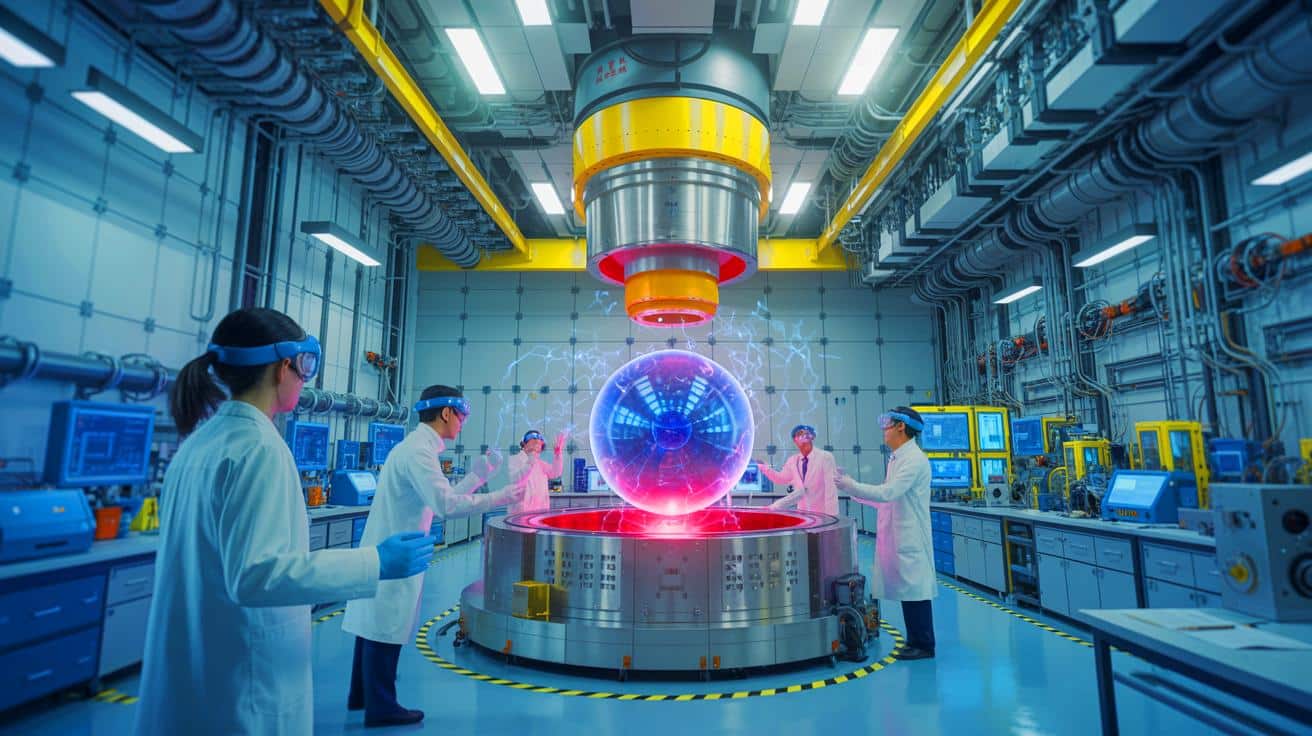
In an era where scientific advancements continually reshape our understanding of the world, China has once again positioned itself at the forefront of innovation with a groundbreaking achievement in superconducting technology. Researchers from the Chinese Academy of Sciences have successfully generated a steady magnetic field of 351,000 gauss using a fully superconducting magnet, setting a new world record. This milestone not only surpasses the previous record of 323,500 gauss but also demonstrates China’s rapid progress in the field of advanced magnet technology. With this achievement, the potential applications in fields like fusion research, space propulsion, and power transmission are vast and promising.
Importance of the Breakthrough
The creation of this powerful magnetic field represents more than just a technical accomplishment; it paves the way for significant advancements across multiple industries. The research team highlights that the development will accelerate the commercialization of advanced superconducting scientific instruments. Nuclear magnetic resonance spectrometers, which play a crucial role in medical imaging and chemical analysis, stand to benefit greatly from this innovation.
Beyond these applications, the magnet’s capabilities extend to other cutting-edge technologies. It offers essential technical support for fusion magnet systems, space electromagnetic propulsion, and superconducting induction heating. These areas require exceptionally strong and stable magnetic fields to achieve optimal performance. According to Liu Fang, a researcher at the Institute of Plasma Physics of the Chinese Academy of Sciences (ASIPP), the magnet employs high-temperature superconducting insert-coil technology. This is combined with low-temperature superconducting magnets to maintain stability under extreme conditions.
Overcoming Technical Challenges
Developing a magnet of this capability was not without its hurdles. The engineering team faced several significant challenges in achieving the record-breaking performance. Issues such as stress concentration, shielding current effects, and multi-field coupling effects posed obstacles in the low-temperature and high-field environments necessary for the magnet's operation.
By addressing these technical challenges, the researchers were able to enhance both the mechanical stability and electromagnetic performance of the magnet. The new design ensures that the system can remain stable during prolonged operations without performance degradation. During testing, the magnet was energized to 35.1 tesla and maintained steady operation for 30 minutes, after which it was safely demagnetized. This successful trial confirmed the reliability of the new approach, indicating that the technology can endure extended use under demanding conditions.
Applications in Fusion and Beyond
Superconducting magnets are integral to the development of magnetic confinement fusion devices, which rely on powerful magnetic fields to contain plasma at extremely high temperatures. This containment is essential for sustaining nuclear fusion reactions, a potential source of virtually limitless clean energy. ASIPP has been a leader in fusion research, achieving complete localization of superconducting materials and systems in China, thereby reducing the need for imports.
As a primary Chinese participant in the International Thermonuclear Experimental Reactor (ITER) project, ASIPP is responsible for several critical components, including superconductors, correction coils, and magnet feeders. These components are crucial for supporting the world’s largest fusion experiment, highlighting China's significant contribution to global fusion research efforts. The new record in superconducting magnet performance not only enhances China's role in this international endeavor but also sets the stage for a new generation of technological advancements.
The Global Impact of China's Achievement
China's latest milestone in superconducting technology has implications that extend far beyond its borders. The magnetic field strength achieved is over 700,000 times that of Earth’s natural magnetic field, emphasizing the magnitude of this breakthrough. Such advancements could lead to major developments in space exploration, where powerful magnetic fields are crucial for propulsion and navigation.
Moreover, the ability to generate and maintain stable, high-intensity magnetic fields can revolutionize power transmission systems. This technology could facilitate the development of more efficient power grids, reducing energy loss during transmission and potentially lowering costs for consumers. As nations around the world seek sustainable and efficient energy solutions, China’s achievement offers a promising avenue for international collaboration and innovation.
As the world continues to grapple with the challenges of energy and technology, China’s record-setting superconducting magnet opens new doors for scientific and industrial progress. The implications of this breakthrough are vast, impacting fields as diverse as medical technology, energy efficiency, and space exploration. As these developments unfold, how will they reshape our global landscape and what new challenges and opportunities will they present for future generations?




Wow, 351,000 gauss? That’s off the charts! What’s next, levitating cities? 😄
Wow, 351,000 Gauss! Is it just me, or does this sound like sci-fi becoming reality? 🤯
Does this mean China will have an edge in space exploration now?
Can someone explain what “gauss” is in layman’s terms? I’m a bit lost here.
Seems like China is really focusing on fusion energy. Are other countries keeping up?
Can someone explain what a gauss is? I’m lost here. 😅
This seems like a huge leap forward for superconducting technology. Congrats to the team!
Are there any environmental concerns with generating such powerful magnetic fields?
Should we be worried about this tech falling into military hands? 🤔
Thanks for the in-depth article! Superconducting magnets sound amazing! 🔥
Impressive work by the Chinese scientists. But what about the ethical implications of this technology?
I’m curious, how does this impact the ITER project? More fusion energy sooner?
Fusion research is exciting, but will it really solve global energy problems?