




| IN A NUTSHELL |
|
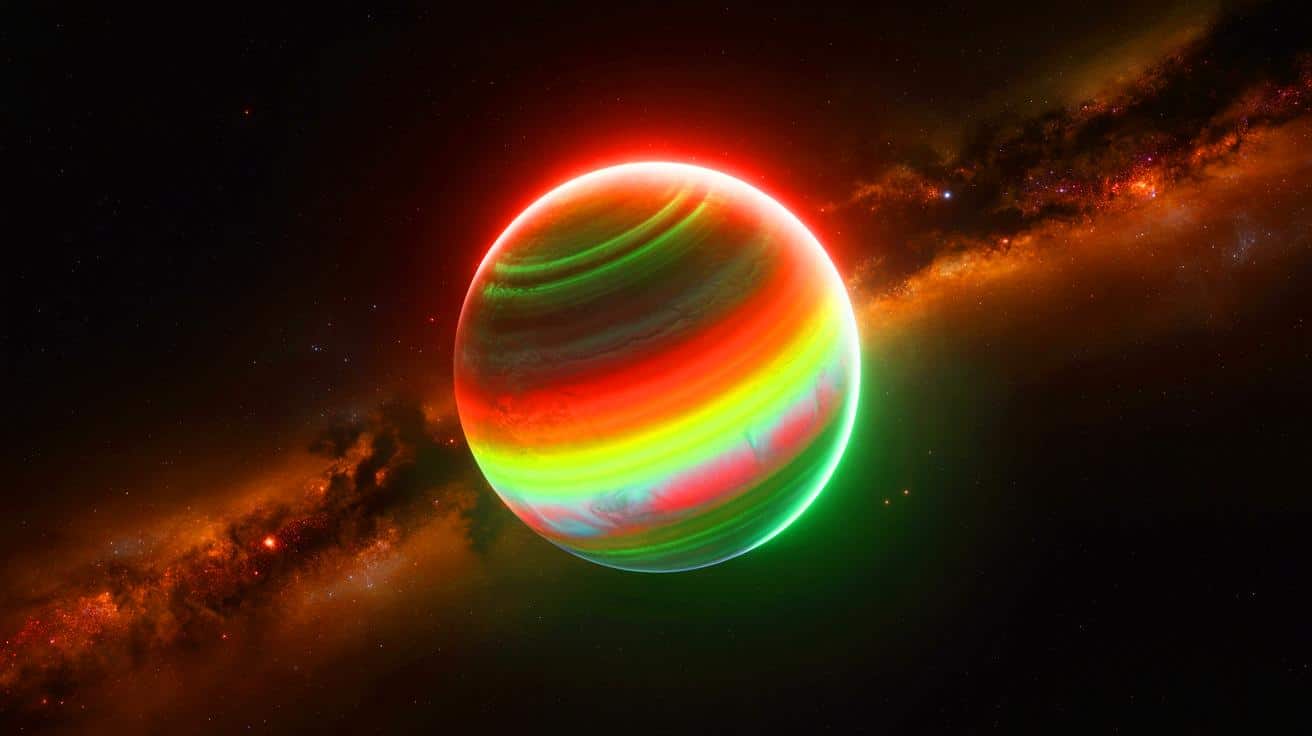
In the quest to understand the universe and its myriad celestial bodies, rogue planets present a particularly intriguing subject. Unlike typical planets that orbit stars, rogue planets drift alone through space. The recent study published in Astronomy & Astrophysics sheds new light on one such planet, SIMP-0136. Using the James Webb Space Telescope (JWST), researchers have explored its atmospheric composition, temperature, and auroras. Their findings offer profound insights into planetary formation and evolution, challenging preconceived notions and expanding our understanding of these solitary wanderers.
Rogue Planets: A Celestial Mystery
Rogue planets, as their name suggests, do not orbit a star. This absence of a host star makes them enigmatic objects in the cosmos, capturing the attention of astronomers worldwide. Theories concerning their formation include being ejected from their original star systems or evolving as sub-brown dwarf stars. Despite their abundance—estimated to number in the billions or even trillions in the Milky Way—rogue planets remain elusive. The SIMP-0136, located approximately 20 light-years from Earth, is a prime example. It challenges our understanding of planetary systems and raises questions about the forces that created these solitary wanderers.
The study of SIMP-0136 is significant because it provides a glimpse into the atmospheric dynamics of a planet without the influence of a nearby star. Unlike Earth, with its solar-driven weather patterns, rogue planets like SIMP-0136 have atmospheric behaviors that defy conventional expectations. This research contributes to a growing body of knowledge that aims to decode the mysteries of such celestial bodies.
Auroras and Atmospheric Anomalies
Auroras on Earth are a breathtaking sight, but observing them on a rogue planet is a groundbreaking achievement. The researchers discovered that the auroras of SIMP-0136 play a critical role in its atmospheric dynamics. These auroras heat the planet's upper atmosphere, leading to a unique thermal inversion where temperatures increase with altitude. This phenomenon contrasts sharply with Earth's atmosphere, where temperatures typically decrease as altitude rises.
Furthermore, the study revealed constant global cloud coverage on SIMP-0136, composed of silicate grains rather than water droplets or ice crystals. This discovery adds another layer of complexity to our understanding of atmospheric compositions in celestial bodies. The presence of silicate clouds suggests that the atmospheric processes on rogue planets differ significantly from those on planets within a solar system. These findings underscore the importance of studying rogue planets to gain insights into the diverse range of planetary atmospheres.
Technological Advances in Astronomical Research
The advancements in astronomical technology have been pivotal in studying rogue planets. The James Webb Space Telescope, with its cutting-edge capabilities, has enabled astronomers to conduct in-depth analyses of distant celestial bodies like SIMP-0136. This study represents one of the most precise measurements of any extrasolar object's atmosphere, marking a milestone in astronomical research.
The observations made using the JWST allow scientists to detect subtle changes in temperature and chemical composition. Such precision is crucial in understanding the atmospheric dynamics of rogue planets. The study's lead author, Dr. Evert Nasedkin, highlighted the ability to record temperature changes as small as 5°C, offering insights into potential storm activities similar to Jupiter's Great Red Spot. These technological breakthroughs have opened new avenues for exploring the cosmos, providing valuable data that will inform future research.
Future Implications and Discoveries
The findings from the study of SIMP-0136 have far-reaching implications for our understanding of rogue planets and planetary science as a whole. The discovery of thermal inversion and silicate clouds on a rogue planet challenges existing models of atmospheric dynamics. It also raises questions about the processes that govern these isolated celestial bodies. As the field of astronomy continues to evolve, researchers anticipate that future missions and telescopes, such as the upcoming Nancy Grace Roman Space Telescope, will further refine our knowledge of rogue planets.
Understanding rogue planets is not only about satisfying scientific curiosity; it also has practical implications. By studying these planets, astronomers can gain insights into planetary formation and evolution applicable to both rogue and non-rogue planets. As research progresses, the scientific community remains optimistic about uncovering new discoveries that will enrich our understanding of the universe.
The study of rogue planets like SIMP-0136 represents a frontier in astronomical research, expanding our knowledge of planetary systems beyond the familiar confines of our Solar System. As technology advances and new missions take flight, what further mysteries will we unravel about these celestial wanderers? The potential for discovery is vast, inviting ongoing exploration and inquiry into the nature of the universe.




Wow, auroras on a rogue planet? That’s a cosmic light show I’d love to see! 🌌
Wow, rogue planets with auroras! 🌌 That’s some next-level space magic!
Could these auroras be a sign of some hidden life forms on SIMP-0136? 🤔
Does this mean rogue planets could support life, or are they too cold without a star? 🤔
How do astronomers even spot something so far away? Amazing!
How does the JWST capture such detailed information from 20 light-years away? Impressive!
This article is fascinating! Thanks for sharing these discoveries. 🌟
Great read, but aren’t rogue planets just wandering in space? How do they stay warm?
Can the auroras on SIMP-0136 be observed in real-time? That would be mind-blowing!
Why are they called rogue planets? Sounds like they’re up to no good! 😂
The universe just keeps getting weirder and more wonderful. Thanks for sharing this!
I hope future telescopes can uncover more about these lonely worlds.
Rogue planets sound lonely. Maybe they need a solar system to call home. 😢
If SIMP-0136 doesn’t orbit a star, how does it have an atmosphere? 🤨