




| IN A NUTSHELL |
|
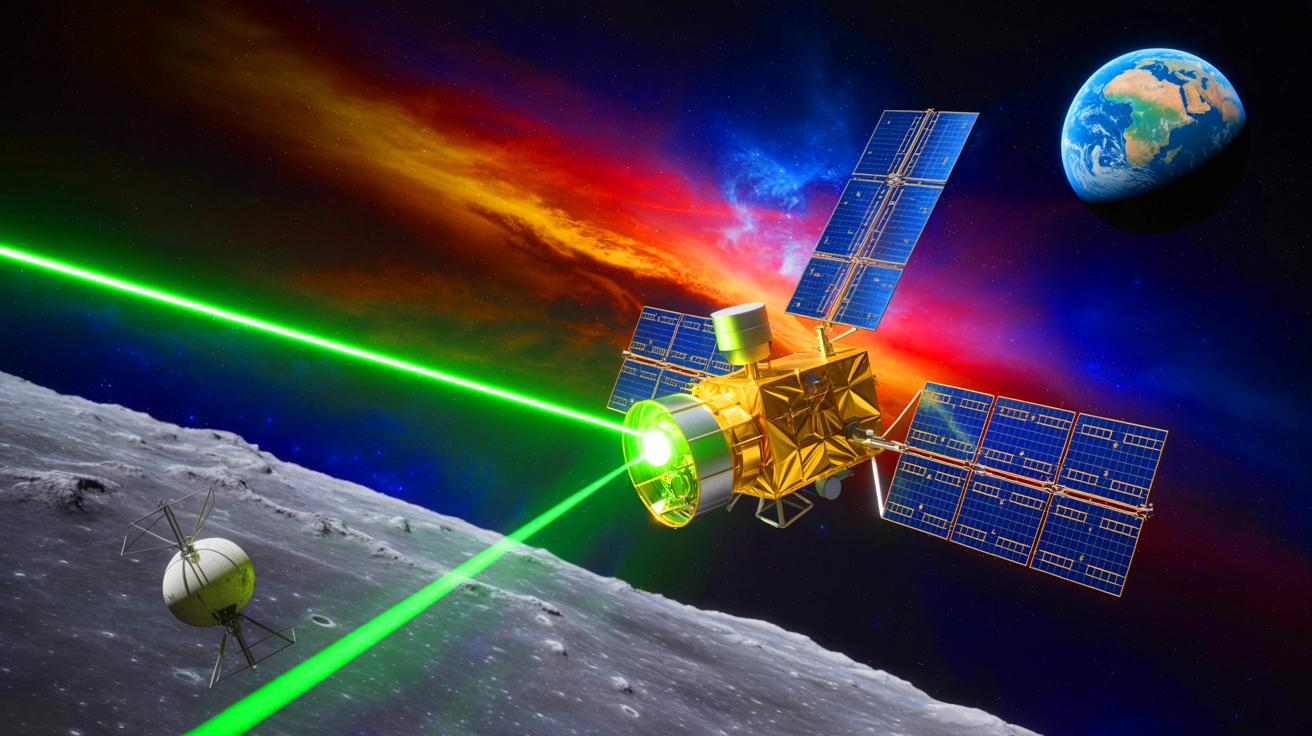
In a remarkable display of technological prowess, China has achieved a significant milestone in space exploration by successfully using a laser to target a satellite orbiting the Moon in broad daylight. This achievement, carried out by the Deep Space Exploration Laboratory (DSEL), marks a pivotal advancement in deep-space navigation and communication. The precision of this operation, which has been compared to hitting a single hair from over six miles away, is set to enhance the reliability of future lunar missions. As China continues to expand its capabilities in space technology, this breakthrough holds great promise for upcoming endeavors in lunar exploration.
Unprecedented Precision in Space Targeting
The success of China’s laser targeting is a testament to the country’s growing expertise in space technology. Achieving such precision required overcoming numerous challenges, including the fast-paced movement of satellites and the complexities of cislunar space. The operation’s accuracy, described as akin to targeting a single strand of hair from 6.2 miles away, exemplifies the high level of technological sophistication that China has reached. This success provides China with the capability to gather data whenever the satellite is visible, substantially improving the accuracy of positional data for future missions.
The Tiandu-1 satellite, which is part of a trio launched in March 2024, plays a crucial role in China’s ambitious Queqiao relay constellation. This network is designed to facilitate communication and navigation between Earth and the Moon, supporting a wide range of lunar activities. These include the deployment of landers, rovers, and potentially crewed missions, all of which are planned before the end of the decade. This successful laser targeting experiment underscores the robustness of the systems that will support these missions, marking a significant advancement toward sustained lunar exploration.
Transforming Lunar Communication and Autonomy
China’s ability to conduct laser ranging in daylight represents a major breakthrough in Earth-Moon tracking, eliminating a significant barrier in autonomous spacecraft operations. This capability is essential for providing high-precision landing guidance and coordinating rover fleets on the Moon’s surface. The technology is set to become an integral component of approach, descent, and landing systems for future lunar missions, especially those targeting the Moon’s challenging south pole region.
This achievement is part of a broader trend of advancements within China’s lunar exploration program. Following the successful Chang’e-6 mission, which returned samples from the Moon’s far side, China is preparing for the Chang’e-8 mission in 2028. This mission aims to test small nuclear reactors and other critical infrastructure for the planned International Lunar Research Station. As China continues to develop its lunar capabilities, it solidifies its position as a leader in space exploration, fostering innovation and encouraging international collaboration.
Implications for Space Infrastructure
The ability to perform daylight laser ranging has profound implications for deep-space infrastructure. By overcoming solar interference, China can now maintain continuous navigation and communication between Earth and the Moon, a critical component for sustained lunar operations. This advancement is expected to improve the efficiency and reliability of deep-space missions, laying the groundwork for future exploration and research endeavors.
The successful deployment of the Tiandu-1 satellite and its counterparts, Tiandu-2 and Queqiao-2, is a significant step toward establishing a comprehensive Earth-Moon network. This network will not only support scientific research but also enable commercial activities and foster international partnerships. As China advances its space capabilities, new opportunities for deep-space exploration and collaboration arise, opening the door to innovative discoveries and developments.
China’s Expanding Lunar Vision
China’s recent accomplishments in lunar exploration are part of a broader vision to establish a lasting presence on the Moon. By developing advanced technologies and infrastructure, China aims to create a sustainable environment for research and exploration, promoting international cooperation and technological innovation. The success of the daylight laser ranging experiment is a crucial step in this journey, highlighting China’s commitment to advancing the frontiers of space exploration.
As China continues to progress in its lunar exploration efforts, the international community observes with interest. These developments not only have the potential to revolutionize future missions but also inspire a new generation of scientists and engineers. With the prospect of groundbreaking discoveries and unprecedented collaboration, one might ask: What new frontiers will China explore next?




Wow, this is like something straight out of a sci-fi movie! 🌌
Great job, China! Looking forward to seeing more advancements! 🇨🇳
This is amazing! What are the implications for future space travel?
What if the laser misses and hits something else?
Incredible precision! The future is here. 🌟
Lasers? Moon? Daylight? This sounds like a plot twist! 😄
Grateful for the detailed explanation in the article, thanks!
I’m skeptical. How can they be sure it worked with just a laser?
Does this mean we can expect faster internet on the Moon? 🌕
Is there any international regulation about firing lasers in space?
I hope this leads to peaceful space exploration efforts. 🤞
So cool! Can’t wait for the next Star Wars movie! 😂
China’s really pushing the boundaries with this one. Kudos!
Why is daylight laser ranging such a big deal?
Who knew lasers would play such a big role in space exploration?
What are the next plans for China’s lunar exploration?
How does shooting a laser at the Moon improve communication?
This is the future of space tech—exciting times ahead! 🚀
Gotta admit, this is pretty impressive engineering. 👏
When will other countries catch up to China’s space tech? 🤔
Sounds cool, but what about potential risks involved?
Wow, China’s really aiming for the moon, literally! 🌕
Impressive tech, but why isn’t this getting more media coverage? 🤔
Did they really hit a satellite or is this just a publicity stunt? 🚀
Can someone explain how daylight laser ranging works?
Am I the only one concerned about lasers being fired at the Moon? 😬