




| IN A NUTSHELL |
|
In a significant development for global maritime defense, a Swedish company has introduced a cutting-edge missile system designed to address the increasing threats at sea. The Coastal Defense Missile System (CDMS), developed by Saab, emerges as a formidable shore-based anti-ship platform. Built around the proven RBS15 missile series, this new system promises to enhance coastal defenses by offering a cost-effective and highly efficient solution. As tensions rise in maritime regions worldwide, the unveiling of the CDMS marks a pivotal moment in modern military technology, promising to reshape how nations protect their coastlines.
Advanced Weapon System
Saab’s latest offering in the realm of military technology capitalizes on significant advancements in missile, software, and sensor technologies. The Coastal Defense Missile System (CDMS) boasts a notable increase in range and lethality, significantly enhancing the probability of neutralizing enemy vessels. The CDMS can be equipped with the RBS15 Mk3 missile, which has a range exceeding 124 miles, or the forthcoming RBS15 Mk4, anticipated to reach distances beyond 186 miles when deliveries commence in the late 2020s.
Both missile variants are designed to operate in all weather conditions, employing a fire-and-forget strategy. They travel just above the water’s surface at high-subsonic speeds, delivering high-explosive warheads capable of achieving a one-hit-one-kill outcome. Their low-altitude, rapid sea-skimming trajectory makes them exceptionally challenging for target vessels to detect and evade. Moreover, these missiles provide operators with secondary land-attack capabilities, broadening their tactical utility on the battlefield.
Based on RBS15 Missiles
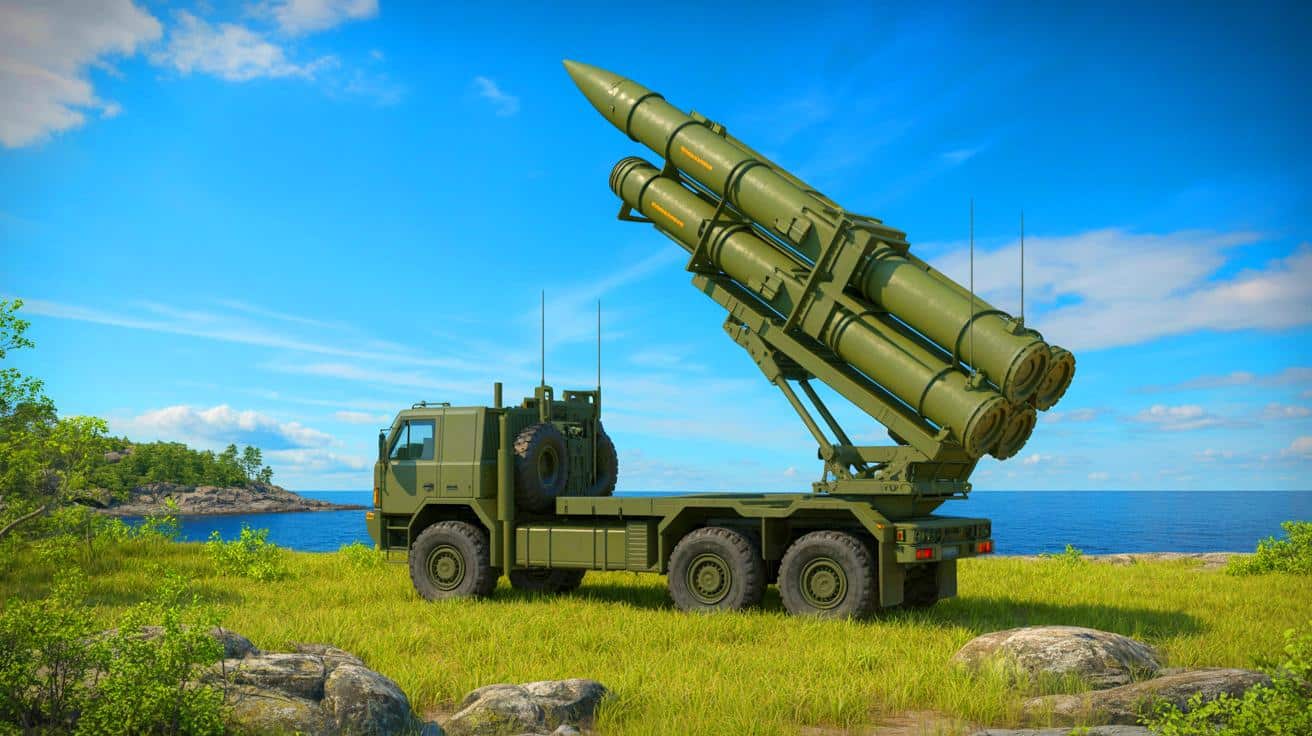
Central to the CDMS are its missile system vehicles, which are essentially truck-based launchers. Each vehicle is equipped with four RBS15 missiles mounted on a specially designed launcher unit, conforming to the dimensions of a 20-foot ISO Standard shipping container. This design not only ensures transportation ease but also facilitates deployment flexibility.
One of the most significant advantages of the CDMS is its ability to alleviate pressure on other coastal defense assets. By ensuring robust land-based defenses, surface warfare vessels can be deployed away from the coast for alternative missions, confident in the CDMS’s capacity to fend off maritime threats. This capability effectively offers the potent anti-ship capacity of a high-cost surface warfare vessel at a fraction of the financial outlay. The strategic disruption posed by the CDMS lies in its operational agility and cost-efficiency, allowing nations to secure extensive coastlines without the exorbitant costs associated with traditional naval forces.
Global Strategic Implications
The strategic implications of the CDMS extend far beyond its technical specifications. By providing a credible maritime strike capability at a reduced cost, the system offers nations a compelling alternative to traditional naval forces. Saab asserts that a limited number of CDMS batteries could effectively secure hundreds of miles of coastline, delivering a maritime deterrent at a fraction of the cost of conventional surface combatants.
The silent operational mode of each launcher, which remains passive until activation, adds a layer of stealth that complicates enemy reconnaissance and targeting efforts. This covert capability enhances the system’s overall effectiveness, rendering it a formidable deterrent in contested maritime regions. The widespread use of RBS15 missiles by numerous nations, including several NATO members, facilitates resource sharing and interoperability, further reinforcing the strategic value of the CDMS on the global stage.
Widespread Adoption and Future Prospects
The RBS15 missile family, integral to the CDMS, is already employed by a diverse array of nations, including Sweden, Finland, Germany, Poland, Bulgaria, and Croatia. This extensive user base underscores the system’s reliability and effectiveness in real-world scenarios. The global adoption of the RBS15 also ensures that resources can be efficiently shared among allied nations, enhancing collective defense capabilities.
As the CDMS is poised for broader deployment, its potential to transform coastal defense strategies cannot be overstated. By offering an affordable yet highly effective solution, the system could redefine how nations approach maritime security. The ongoing development of the RBS15 Mk4 further promises to extend the system’s capabilities, ensuring that it remains at the forefront of coastal defense technology well into the future.
As Saab’s Coastal Defense Missile System gains traction on the international stage, it prompts a critical question: How will this new technology influence the broader dynamics of maritime security and defense alliances worldwide?




Wow, this sounds like a game-changer for coastal defense! 🚀
Wow, this sounds like a game-changer for coastal defenses! 🚀
How does the CDMS compare to existing systems in terms of cost and effectiveness?
How does the cost of the CDMS compare to traditional naval ships?
This is impressive, but what about the environmental impact of this new missile system?
Interesting development! But can it really replace a full naval fleet?
Thank you, Sweden, for bringing innovation to coastal defense! 🇸🇪
Thank you for the informative article! Sweden’s innovation never ceases to amaze me. 🇸🇪
Can the CDMS be integrated with existing naval systems?
How reliable is the RBS15 missile in real combat situations? 🤔