



| IN A NUTSHELL |
|
The unveiling of the Golden Dome missile defense system’s projected costs has ignited a heated debate within defense circles. Todd Harrison, a senior fellow at the American Enterprise Institute, recently released staggering figures through a tool called the “Defense Futures Simulator.” His estimate of $3.6 trillion over two decades starkly contrasts with other reports, including one by President Trump, which pegged the cost at $175 billion over three years. The system aims to protect the continental U.S. from various missile threats, but the enormous cost variation has raised eyebrows and questions about the underlying assumptions driving these estimates.
Understanding the Golden Dome System
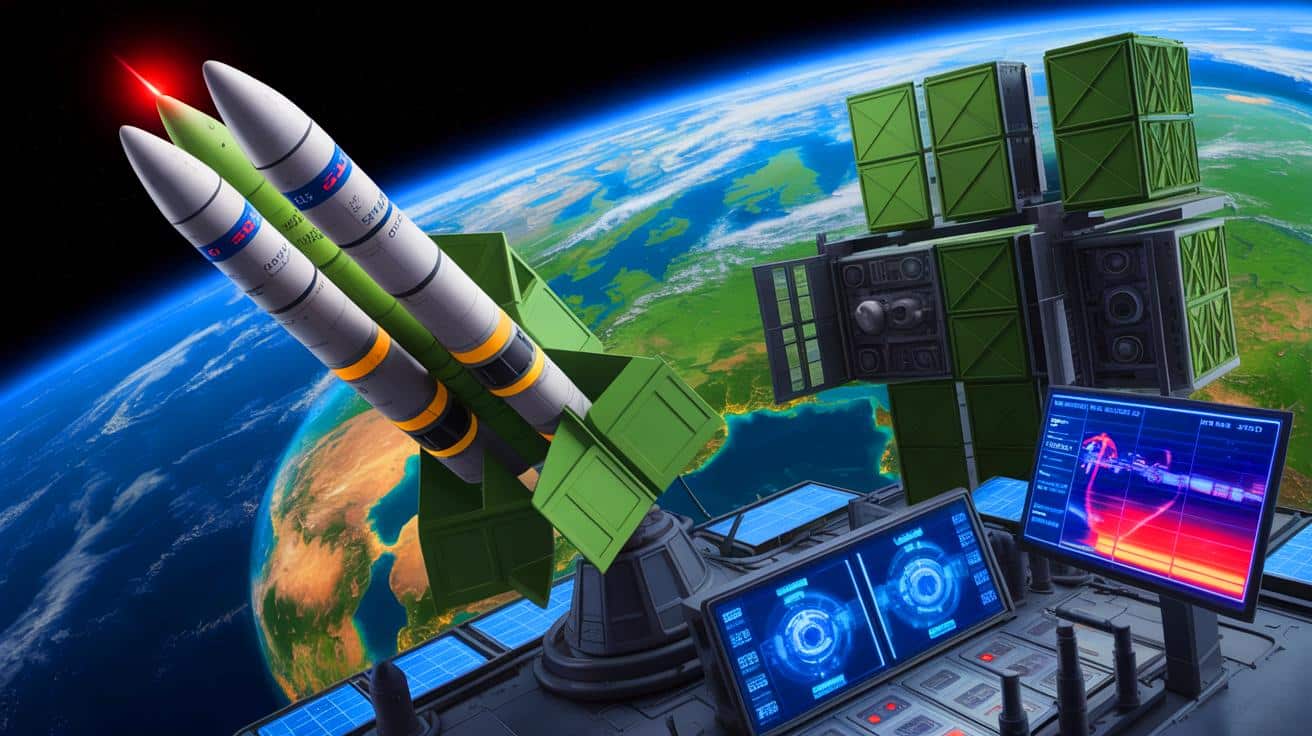
The Golden Dome system, mandated by a 2025 executive order from President Trump, is designed to shield the U.S. from ballistic, hypersonic, and cruise missiles. A crucial component is a network of space-based interceptors intended to detect and neutralize threats early. Congress has already allocated an initial $25 billion, but the total expense remains contentious. The costs primarily depend on the number and capability of interceptors orbiting the Earth. The simulator developed by Harrison explores nine different interceptor options, each with varying implications for cost and coverage.
According to the simulator, the numbers quickly escalate. For example, intercepting five missiles launched simultaneously in the boost phase would require 5,000 orbiting interceptors. This number balloons to 250,000 interceptors for a defense robust enough to handle 250 missiles. Harrison points out that even this would be insufficient if Russia and China launched their entire ICBM arsenals. The daunting requirement for numerous interceptors stems from their limited range and the necessity for global coverage at all times.
The Role of Delta-V in Cost Projections
A critical factor influencing the system's cost is the delta-V of each interceptor, which refers to its ability to change velocity. This capability determines how much propellant each interceptor must carry, directly impacting its operational range. Harrison explains that while some studies assume a delta-V of 4 or 6 kilometers per second, the U.S. Space Force has requested a delta-V of 10 kilometers per second. A higher delta-V allows each interceptor to cover a larger area, potentially reducing the total number needed.
Other cost considerations include the type of propellant used by threat missiles. Solid propellants burn faster than liquid ones, affecting the dynamics and timing of interception. Harrison emphasizes the importance of staying grounded in financial reality by ensuring that the Golden Dome's cost does not exceed a quarter of the U.S. defense budget annually. This constraint prevents a single program from consuming an unsustainable portion of defense resources.
Challenges of Boost-Phase Interception
The Trump administration's emphasis on intercepting missiles during their boost phase substantially inflates costs. Targeting missiles in this early phase—before they can deploy countermeasures or decoys—requires a disproportionately high number of interceptors. Harrison describes the belief in boost-phase space-based interceptors as almost a matter of faith within some defense circles, despite the significant cost implications.
If the focus shifted to midcourse defense, interceptors could engage missiles after they have coasted through space, allowing each interceptor to cover more ground. This approach would necessitate fewer interceptors, offering a potentially more economical solution. However, the current mandate for boost-phase interception continues to drive up the projected costs.
Looking Ahead: Future Developments
General Michael Guetlein, head of the Golden Dome program, is working on a proposed system architecture. This plan is expected to balance space-based and ground-based defenses against various threats. Harrison believes that the initial proposal will focus on the broader architecture rather than specific interceptor details. The space-based interceptors are meant to complement existing ground- and sea-based systems, enhancing the overall defensive capabilities.
Harrison underscores the importance of data-backed scenarios, noting, “You can come up with lots of different numbers, but they would be backed by data.”
The challenge remains to craft a feasible and fiscally responsible strategy that addresses the diverse threats facing the U.S. How should policymakers balance cutting-edge defense technology with budgetary constraints, ensuring national security without overspending?


Wow, $3.6 trillion? That’s more than the GDP of some countries! 🤯
Wow, $3.6 trillion? That’s a lot of zeroes! 💸
Can someone explain why the cost difference is so massive between $175 billion and $3.6 trillion?
Is this really the best use of our tax dollars? 🤔
Is this article for real? Those numbers sound like a sci-fi movie plot. 🤔
Thanks for the detailed analysis, but I’m still confused about why the costs are so high.
Thanks for breaking down the delta-V aspect. Never realized how crucial it is for interceptors.
Couldn’t we just use that money to buy a bunch of really big umbrellas? ☔️😂
Is the Golden Dome system actually feasible, or just a pipe dream?
How accurate are these simulations? Can they really predict costs that precisely?
The more I read about this, the more it sounds like a money pit.
Isn’t this another example of government spending gone wild?
Why is boost-phase interception so expensive compared to midcourse defense?
Great article, very informative! Keep up the good work.
Can we trust these cost projections, or are they just scare tactics?