

Close Menu
  • Featured
    • News
    • Consumption
    • Environment
    • Industry
    • Opinion
    • Policy
    • Production
    • Storage
    • Transmission
  • About Us
  • Advertise
  • Contact Us

Subscribe to Our Newsletter

News, investigations, and analysis — our top stories every morning to start your day right.

Trending
The Key Benefits of Oil
CO2 Emissions: How Carbon Dioxide Affects the Environment and the Planet
Ocean Warming: A Growing Threat to Marine Ecosystems and the Global Environment
Facebook X (Twitter) LinkedIn YouTube TikTok
Energy Reporters
Facebook X (Twitter) RSS
Subscribe
  • Featured
  • News

    Researchers Discover That Diamonds Can Generate Electricity

    09/03/2026

    South Africa: Thousands of Dead Sardines Disrupt Koeberg Nuclear Power Plant

    08/28/2026
    Illustration of Abu Dhabi National Oil Company's $11 billion financing deal for future gas production projects.

    ADNOC Secures $11 Billion for Gas Expansion, Transforming Energy Future and Boosting Local Economies

    12/19/2025
    Illustration of Energy Transfer LP's Lake Charles LNG project suspension and strategic shift to pipeline infrastructure.

    Energy Transfer Suspends Lake Charles LNG Project, Sparking Concerns Over Job Losses and Future Energy Solutions

    12/19/2025
    Illustration of a U.S. judge blocking Michigan's attempt to shut down Enbridge's Line 5 pipeline.

    Judge Blocks Michigan’s Effort to Shut Down Enbridge’s Line 5 Pipeline, Sparking Environmental and Economic Debate

    12/18/2025
  • Use

    How energy subsidies affect the market and consumers

    08/11/2026

    Steps to make your business more energy efficient

    06/16/2026

    How to conduct an energy audit for your home

    05/19/2026

    The impact of energy consumption on climate change

    05/12/2026

    Tips for choosing the best energy provider

    05/05/2026
  • Climate

    CO2 Emissions: How Carbon Dioxide Affects the Environment and the Planet

    10/14/2026

    Ocean Warming: A Growing Threat to Marine Ecosystems and the Global Environment

    10/09/2026
    renewable energy industry

    The Benefits of Renewable Energy for the Climate

    09/15/2026

    How to evaluate the carbon footprint of your energy use

    07/21/2026

    The connection between energy use and water resources

    07/07/2026
  • Industry

    How France Produces Its Electricity: Nuclear Power at the Heart of a Changing Energy Mix

    10/02/2026

    The Importance of Oil in Logistics

    09/10/2026
    A bunch of black and white objects with a green arrow above them

    The Ongoing Bribery Case Against Hithium’s Chairman Wu Zuyu Highlights the Stakes for Battery Investors

    02/22/2026
    Illustration of Ford's strategic shift from electric vehicles to gas and hybrid models.

    Ford Reveals $19.5 Billion Charge as EV Strategy Unravels, Impacting Jobs and Future Mobility Choices

    12/17/2025

    US Drillers Cut Oil and Gas Rigs Again, Exposing Potential Economic and Environmental Impacts on Local Communities

    12/13/2025
  • Opinion
    lighted city skyline at night

    Korean Companies Are Losing Ground to China: Why Governance Failures at Conglomerates Like Young Poong Group Matter More Than Ever

    03/22/2026

    Pulling back the curtain on Turkey’s natural gas strategy

    09/01/2020

    How West Africa can expand power supply and meet climate goals

    06/15/2020

    Review: Oil and the Great Powers: Britain and Germany, 1914 to 1945

    06/09/2020

    Eastern Mediterranean gas: testing the field

    05/27/2020
  • Policy

    Understanding dynamic pricing in electricity markets

    06/23/2026

    The influence of artificial intelligence on energy management

    06/02/2026
    renewable energy industry

    How government policies are shaping the energy sector

    04/14/2026

    What you need to know about smart energy management

    02/24/2026

    Trump Administration Faces Delays in Finalizing 2026 Biofuel Quotas, Raising Questions About Future Energy Policies

    12/14/2025
  • Output

    The Key Benefits of Oil

    10/20/2026

    How France Produces Its Electricity: Nuclear Power at the Heart of a Changing Energy Mix

    10/02/2026

    The Importance of Oil in Logistics

    09/10/2026

    Researchers Discover That Diamonds Can Generate Electricity

    09/03/2026

    South Africa: Thousands of Dead Sardines Disrupt Koeberg Nuclear Power Plant

    08/28/2026
  • Storage
    renewable energy industry

    How energy storage can stabilize renewable sources

    06/30/2026

    Innovations in battery technology for energy storage

    03/17/2026
    Illustration of Venezuela's oil storage facilities nearing maximum capacity amid U.S. sanctions.

    Venezuela Faces Oil Storage Crisis as Tanker Restrictions Expose Vulnerabilities in Energy Infrastructure and Economy

    12/18/2025
    time lapse photography of square containers at night

    ‘Mega Batteries’ are Powering the Future of Energy Consumption

    10/23/2025
    Illustration of a gravity-based energy storage system integrated into a skyscraper, utilizing renewable energy sources.

    Gravity Battery Innovation Transforms Skyscrapers into Renewable Energy Storage, Revealing New Possibilities for Urban Sustainability

    10/18/2025
  • Grid

    Understanding energy grids and their modernization

    04/28/2026
    Illustration of Ovintiv and Pembina's collaboration on LNG export from the Cedar LNG facility.

    Ovintiv Agreement for Cedar LNG Capacity Sparks New Era in North American Energy Collaboration and Innovation

    12/16/2025
    Illustration of Star Catcher Industries' power beaming technology at NASA's Kennedy Space Center.

    Star Catcher Achieves Breakthrough, Sets New 1.1-kW Power Beaming Record, Transforming Future Energy Solutions

    11/25/2025
    Illustration of U.S. LNG exports navigating global market challenges and expanding into Asian regions amidst rising competition.

    US LNG Export Dominance Faces Challenge as Sellers Explore New Markets Beyond Europe’s Energy Demand

    11/23/2025
    Illustration of the race to develop new pipelines in response to California refinery closures and rising fuel prices.

    California Refinery Closures Drive Urgent Pipeline Race, Transforming Energy Supply Dynamics on the West Coast

    11/19/2025
Energy Reporters

“Scientists Panic as Satellites Die Without Warning”: Los Alamos Discovers Electron Buildup Creates Deadly 45-Minute Death Countdown for Space Equipment

After decades of uncertainty, scientists at Los Alamos National Laboratory have identified electrical discharges from electron accumulation as the primary cause of sudden satellite failures, offering new hope for preventing these costly disruptions.
Rosemary PotterRosemary Potter09/15/202516
Share Twitter Facebook LinkedIn Telegram WhatsApp Email Copy Link
Follow Us
Google News
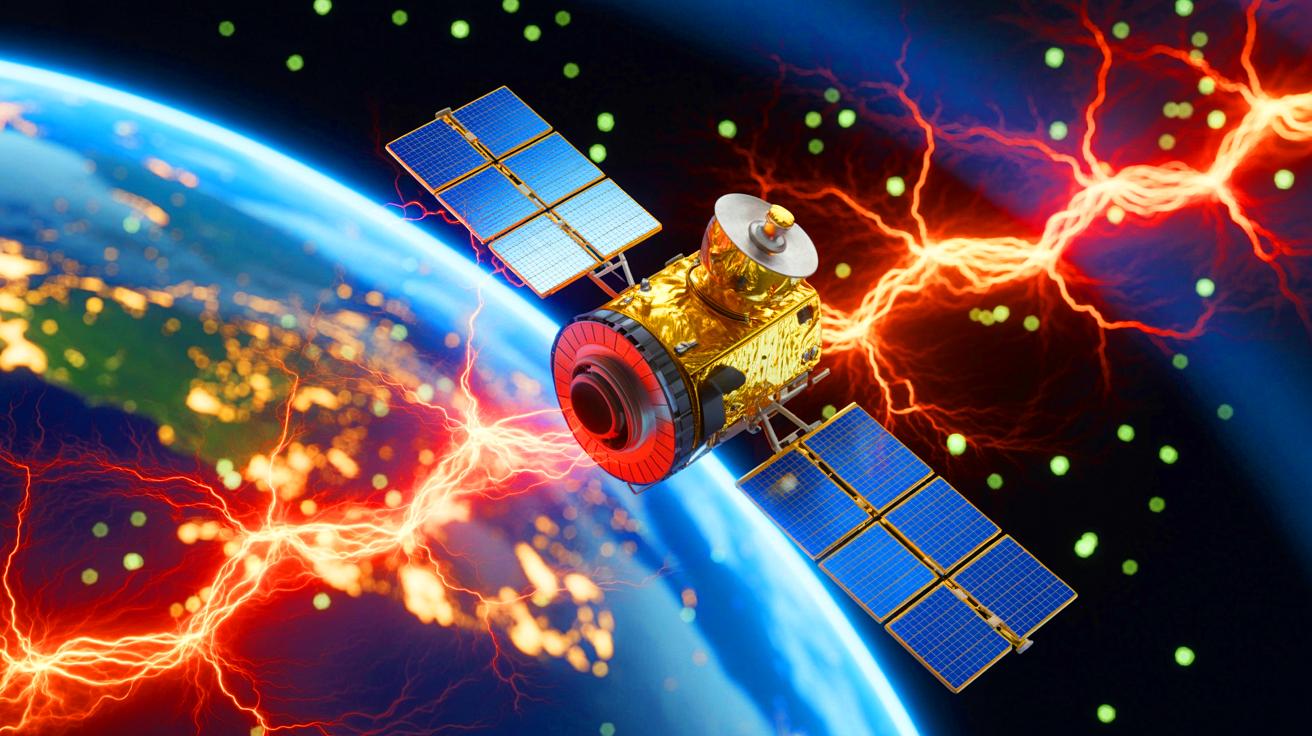
Illustration of sudden satellite failures caused by electrical discharges from electron accumulation.
Share
Twitter Facebook LinkedIn WhatsApp Email Copy Link
IN A NUTSHELL
  • 🔍 Researchers at Los Alamos identified electron accumulation as a key factor in satellite failures.
  • ⚡ Sudden electrical discharges, known as Spacecraft Environment Discharges, can damage satellite electronics.
  • 📊 The study found a 75% correlation between electron peaks and discharges, allowing for potential prediction systems.
  • 🚀 Future satellites could benefit from continuous electron monitoring to prevent unexpected disruptions.

For decades, the space industry has grappled with the mystery of sudden satellite failures. These unexpected disruptions have posed significant challenges, leading to costly losses and operational setbacks. Recently, researchers at the Los Alamos National Laboratory in the United States have identified a crucial factor contributing to these malfunctions: electrical discharges resulting from the accumulation of electrons. This revelation offers the potential to predict and potentially mitigate these failures, paving the way for more reliable satellite operations in the future.

The Science Behind Satellite Failures

Satellite failures have long been a vexing issue for engineers and scientists. A critical factor in these failures is believed to be the accumulation and subsequent discharge of electrons in the satellite’s environment. As satellites orbit Earth, they encounter varying electron densities. This leads to a build-up of electrical charge over time. When the charge reaches a critical level, it can discharge suddenly, akin to a spark, causing significant damage to the onboard electronics.

Researchers have discovered that these Spacecraft Environment Discharges (SEDs) are closely linked to the number of electrons in the satellite’s immediate vicinity. Historical events, such as the 1994 solar storm that disabled two Canadian television satellites, illustrate the vulnerability of space equipment to these phenomena. The Los Alamos study underscores the importance of understanding electron activity and its impact on satellite reliability.

“$60 Million Orbital Platform”: US Space Force and Gravitics Develop Aircraft Carrier That Launches Satellites Directly From Earth’s Orbit

Understanding the Los Alamos Study

The groundbreaking study from Los Alamos utilized advanced sensors to measure electron activity and radio signals on satellites. By employing two sensors on a single satellite, researchers could quantify electronic activity and analyze radio signals simultaneously. This dual-sensor approach was pivotal in establishing a clear correlation between electron peaks and SED occurrences.

Over a twelve-month period, the study documented hundreds of instances where high electron activity preceded SEDs. Remarkably, 75% of these discharges were preceded by a surge in electron activity, with a short lead time of thirty to forty-five minutes. This finding is significant because it suggests the possibility of developing an onboard prediction system to alert operators before a failure occurs.

“293.67 Miles Per Hour”: Chinese BYD Supercar Smashes Electric Vehicle Speed Record on German Test Track

Potential Solutions for Future Satellites

The implications of the Los Alamos study are profound. With the ability to predict SEDs, future satellite missions could incorporate continuous electron monitoring systems. This proactive approach would enable operators to anticipate and potentially avert sudden electronic failures, enhancing the resilience of satellites against unpredictable space weather.

Such advancements could signal an end to the longstanding issue of random satellite malfunctions. By equipping satellites with advanced monitoring technology, the industry could reduce the risk of unexpected disruptions. This would lead to improved operational reliability and reduced costs associated with satellite repairs and replacements.

“25% Greater Range Than F-35C”: US Navy’s F/A-XX Sixth Generation Fighter Exceeds 1,700 Mile Operational Reach

Challenges and Opportunities Ahead

While the findings from Los Alamos offer promising solutions, implementing these measures comes with challenges. Developing and deploying advanced monitoring systems will require significant investment and collaboration among industry stakeholders. Additionally, the unpredictable nature of space weather poses ongoing challenges that must be addressed through innovative solutions.

Nevertheless, the potential benefits of enhanced satellite reliability are immense. As space becomes increasingly critical to global communications and navigation, ensuring the resilience of these systems is paramount. The ability to predict and prevent satellite failures could transform the industry, leading to greater confidence and investment in satellite technology.

The Los Alamos study marks a significant step forward in understanding and mitigating satellite failures. As researchers continue to explore the complexities of space weather and its effects on satellites, the future of space technology looks brighter. Will the industry embrace these findings to enhance satellite resilience, or will further challenges emerge on the horizon?


This article is based on verified sources and supported by editorial technologies.

Subscribe to Our Newsletter

News, investigations, and analysis — our top stories every morning to start your day right.

Los Alamos National Laboratory Satellite Technology Space Weather
Follow on Google News Follow on X (Twitter)
Share. Facebook Twitter LinkedIn Telegram WhatsApp Email Copy Link
Previous Article“Pentagon Faces Drone Crisis Against Russia-China Alliance”: U.S. Military Urgently Needs Mass Production of Long-Range Attack Systems
Next Article “Japanese Drones Catch Lightning Like Pokémon”: Revolutionary Flying Machines Trigger One Billion Joules of Electrical Power While Surviving Direct Lightning Strikes
Rosemary Potter
  • X (Twitter)

Rosemary Potter is a Berlin-based journalist for Energy Reporters, covering European energy markets, cross-border policy, industry innovation, and the challenges of energy transition. With journalism training in the U.S., she combines investigative depth with a continental outlook. Her reporting amplifies the perspectives shaping Europe’s energy future across sectors, borders, and technologies. Contact: rosemary.potter@energy-reporters.com

Keep Reading

Researchers Discover That Diamonds Can Generate Electricity

South Africa: Thousands of Dead Sardines Disrupt Koeberg Nuclear Power Plant

Illustration of Abu Dhabi National Oil Company's $11 billion financing deal for future gas production projects.

ADNOC Secures $11 Billion for Gas Expansion, Transforming Energy Future and Boosting Local Economies

View 16 Comments
16 Comments
  1. John-Paul_unicorn on 09/15/2025 6:14 AM

    Wow, a 45-minute countdown sounds like something out of a sci-fi movie! 🚀

    Reply
  2. Bruce on 09/15/2025 6:15 AM

    Wow, this sounds like something out of a sci-fi movie! 😲

    Reply
  3. christopher_thunder on 09/15/2025 6:46 AM

    Is this electron buildup a new discovery, or have scientists known about it for a while?

    Reply
  4. lauren on 09/15/2025 7:07 AM

    If they’ve figured out the cause, why are they panicking?

    Reply
  5. Faith_wisdom on 09/15/2025 7:19 AM

    Thank you for shedding light on this! I’ve always wondered why satellites just stop working suddenly.

    Reply
  6. samanthafairytale2 on 09/15/2025 7:51 AM

    Does this mean we need to worry about our GPS going haywire now? 🤔

    Reply
  7. jeremy on 09/15/2025 7:59 AM

    Seems like a huge step forward for space technology. Kudos to Los Alamos! 👏

    Reply
  8. Kamal on 09/15/2025 8:21 AM

    Grateful for the researchers at Los Alamos. This could save millions in satellite repairs.

    Reply
  9. Emilia on 09/15/2025 8:51 AM

    Is there any way to prevent the buildup of electrons in the first place?

    Reply
  10. Celine_waves7 on 09/15/2025 8:54 AM

    Why aren’t existing satellites already equipped with these electron monitors?

    Reply
  11. Paulinewaves5 on 09/15/2025 9:24 AM

    Sounds like we need to install a giant space vacuum cleaner! 😂

    Reply
  12. fabianmelody on 09/15/2025 9:44 AM

    45 minutes isn’t much time to react. Can they extend that countdown?

    Reply
  13. Paula on 09/15/2025 9:58 AM

    This is fascinating! Could electron buildup also affect the International Space Station?

    Reply
  14. ali on 09/15/2025 10:29 AM

    How long will it take to implement these changes in new satellite designs?

    Reply
  15. Williamghost on 09/15/2025 10:36 AM

    Wait, so satellites can just die out of nowhere? That’s terrifying. 😬

    Reply
  16. Lucy on 09/15/2025 11:02 AM

    Is there a way to shield satellites from these discharges?

    Reply
Leave A Reply Cancel Reply

Subscribe to Our Newsletter

News, investigations, and analysis — our top stories every morning to start your day right.

Trending
The Key Benefits of Oil
CO2 Emissions: How Carbon Dioxide Affects the Environment and the Planet
Ocean Warming: A Growing Threat to Marine Ecosystems and the Global Environment
News by category
  • Featured
  • News
  • Use
  • Climate
  • Industry
  • Opinion
  • Policy
  • Output
  • Storage
  • Grid
Information
  • About Us
  • Advertise
  • Meet the Team
  • Contact Us
  • Legal Notice
  • Privacy Policy

Subscribe to Our Newsletter

News, investigations, and analysis — our top stories every morning to start your day right.

Facebook X (Twitter) RSS
© Energy-Reporters.com. All rights reserved.

Type above and press Enter to search. Press Esc to cancel.