



| IN A NUTSHELL |
|
In a remarkable achievement, the Experimental Advanced Superconducting Tokamak (EAST) in Hefei, China, has made significant strides in nuclear fusion research. On January 20, 2025, the device successfully maintained a stable plasma for 1,066 seconds, reaching temperatures exceeding 100 million degrees Celsius. This accomplishment not only surpassed its previous world record but also moved humanity closer to harnessing the power of the stars. The EAST, often referred to as an “artificial sun,” aims to replicate the process of star formation by achieving nuclear fusion. This milestone is a crucial step in the quest for a sustainable and clean energy source, which could revolutionize global energy production.
The Science Behind Nuclear Fusion
Nuclear fusion is the process that powers the sun and other stars. It involves the merging of two light atomic nuclei to form a heavier nucleus, releasing a tremendous amount of energy in the process. The challenge in replicating this process on Earth lies in achieving the extreme conditions necessary for fusion: high temperatures, pressure, and confinement.
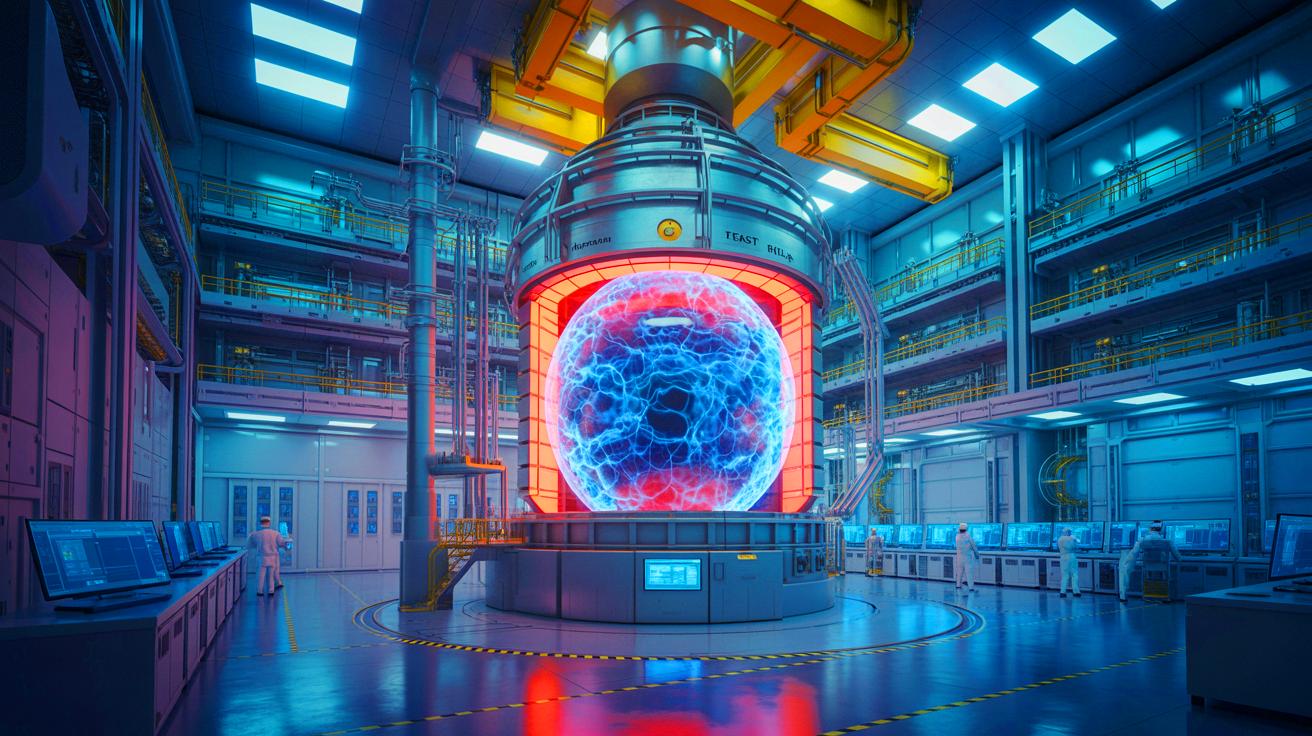
The EAST operates as a tokamak, a device designed to confine hot plasma using magnetic fields. In this process, gas is injected into a vacuum chamber shaped like a donut and heated to temperatures over 100 million degrees Celsius. Electromagnets keep the plasma from touching the chamber walls, increasing the likelihood of nuclear fusion.
Achieving stable and sustained fusion is a monumental scientific challenge. The ultimate goal is to reach a point where the fusion reaction becomes self-sustaining, requiring no additional energy input. This would mimic the natural processes occurring in stars, providing a potentially limitless and clean energy source for humanity.
Breaking Records: A New Milestone in Fusion Research
On January 20, 2025, the EAST set a new world record by maintaining stable plasma for 1,066 seconds. This achievement surpasses the previous record of 403 seconds, marking a significant advancement in fusion research. During this time, the plasma was kept at a temperature exceeding 100 million degrees Celsius, a critical threshold for fusion reactions.
This extended duration of plasma confinement is a testament to the progress made in fusion technology. The ability to maintain such high temperatures for an extended period is crucial for the development of future fusion power plants. However, researchers acknowledge that much work remains to be done before fusion becomes a viable energy source.
According to Song Yuntao, director of the Chinese Academy of Sciences, “A fusion device must operate stably and efficiently for thousands of seconds to allow the autonomous circulation of plasma.” This stability is essential for the continuous energy production required by future fusion power plants.
The Path to Sustainable Energy
The successful experiments with the EAST are part of a broader effort to develop nuclear fusion as a sustainable energy source. The international collaboration on the International Thermonuclear Experimental Reactor (ITER) project, which includes China as a member, aims to build on these advancements. ITER’s goal is to demonstrate the feasibility of nuclear fusion as a large-scale and carbon-free power source.
Despite the progress, challenges remain in achieving the conditions necessary for continuous energy production. The ITER project, located in Cadarache, France, has faced delays and increased costs. Initially planned for completion in the 2020s, the site is now expected to become operational in 2039.
The lessons learned from the EAST experiments will inform the development of ITER and other fusion research initiatives worldwide. The potential for fusion energy to provide an abundant, clean, and safe power source makes it a highly attractive option for addressing the world’s energy needs.
Challenges and Future Prospects
While the EAST’s recent success represents a significant step forward, the journey toward practical fusion energy is fraught with challenges. Achieving the necessary conditions for sustained fusion is technically demanding and requires significant investment in research and development.
One of the primary challenges is maintaining the stability of the plasma at high temperatures for extended periods. Researchers must also develop materials capable of withstanding the extreme conditions inside a fusion reactor. Additionally, the economic viability of fusion energy remains uncertain, as current projects require substantial financial resources.
Despite these challenges, the potential benefits of fusion energy are immense. As nations seek to reduce their reliance on fossil fuels and mitigate climate change, fusion offers a promising alternative. The success of projects like the EAST and ITER will be crucial in determining the future of fusion energy.
The recent achievements of the EAST highlight the potential of nuclear fusion as a revolutionary energy source. As researchers continue to push the boundaries of what is possible, the prospect of harnessing the power of the stars remains an inspiring goal. Could fusion energy become the key to a sustainable and clean energy future?

Wow, 100 million degrees? That’s hotter than my morning coffee! ☕
Wow, 100 million degrees! That’s hotter than my morning coffee! ☕️
Can this technology really be scaled up to power cities? 🤔
Can this technology be scaled up for commercial use soon?
How long before we see fusion reactors in every country? Seems like it’s still a long way off.
Amazing achievement, but how much energy was consumed to reach those temperatures?
How does China’s reactor compare to the ITER project in France? Are they in competition?
Does this mean we can have our own “mini suns” on Earth? 🔆
Thank you for the detailed explanation. It’s amazing to see such advancements in fusion energy! 🌟
How does this compare to the ITER project? Are they working together?
Impressive, but how close are we actually to practical fusion energy? 🤔
Thanks for the informative article! Keep up the great work. 🙌
100 million degrees? That’s hot enough to roast marshmallows in seconds! 🔥
What are the environmental impacts of building and running such reactors?
So, will my energy bills finally go down? Asking for my wallet. 💸
This sounds promising, but what about the waste products from fusion?
Is there any danger of this thing going supernova? 😅
Thank you for explaining nuclear fusion in simple terms!
How long before other countries catch up to China with their own reactors?
Are there any health risks for scientists working on this project?
Fantastic news! Can’t wait to see the day when fusion powers my home. 🏠⚡
Could this technology be used in space exploration?
Fusion energy sounds too good to be true. What’s the catch? 🤨
Will this tech help reduce global warming in the long run?
How reliable are these reactors in case of an emergency?
Is the cost of building such reactors justified by their energy output?
Why does it take so long to make fusion a reality? Hurry up, science! 😜
A step in the right direction, but how many steps are left?
It’s about time we harness the power of the stars! 🚀
How do they keep the plasma from melting the reactor itself?
Thanks for keeping us updated on such groundbreaking developments!