



| IN A NUTSHELL |
|
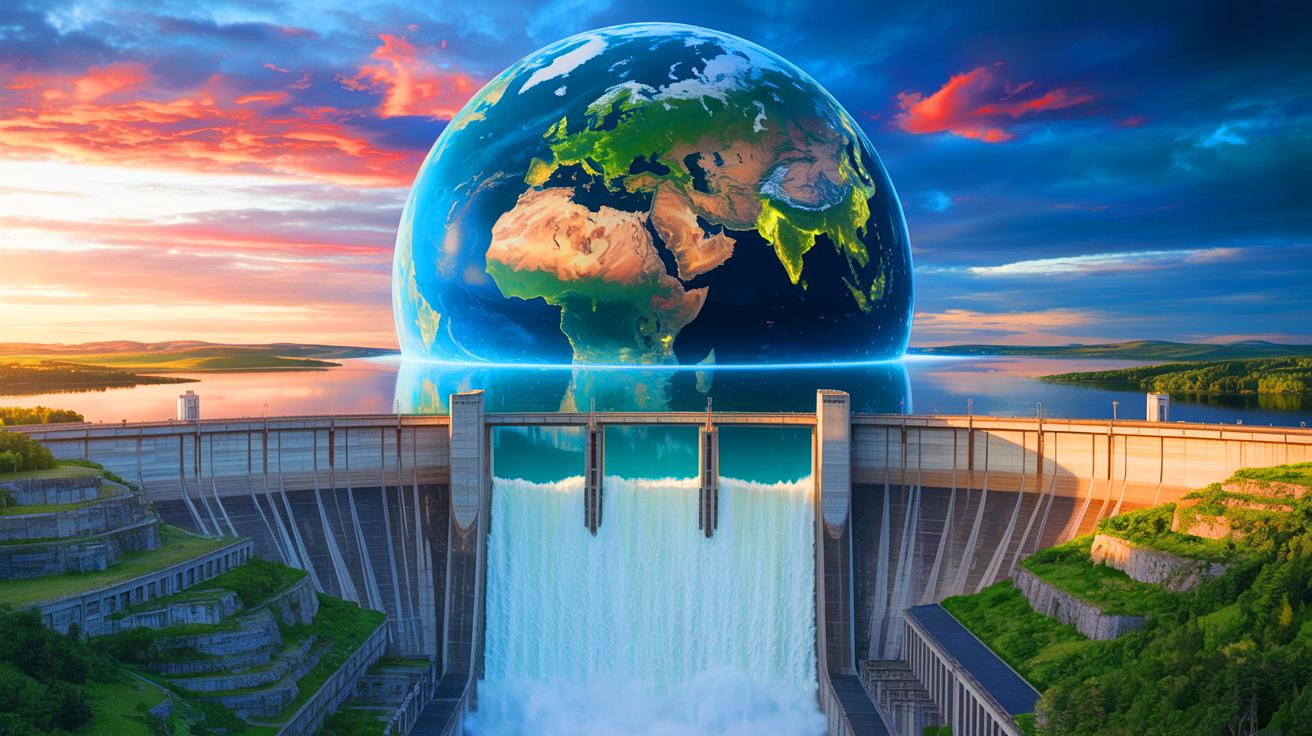
For nearly two centuries, human ingenuity has shaped the landscapes of our planet, particularly through the massive construction of dams designed to retain water for irrigation, energy production, and potable water supply. These colossal hydraulic structures have an unexpected impact beyond their economic and social roles: they have altered the position of the Earth’s poles. A recent study published in Geophysical Research Letters reveals how the redistribution of water across the globe causes a slight yet real shift in our planet’s rotational axis. This revelation underscores the profound and sometimes unforeseen effects of human activities on the Earth’s physical characteristics.
The Earth-Shift Phenomenon
The polar drift phenomenon is rooted in the redistribution of mass on the Earth’s surface. Our planet consists of several layers, with the solid crust we inhabit resting on a viscous, malleable mantle. When substantial amounts of water are held back by a dam, it exerts considerable pressure on the Earth’s crust, locally altering mass distribution. This new arrangement results in a slight shift of the crust relative to the mantle, leading to a change in the positions of the poles.
This process is known as “true polar wander,” which involves the displacement of the Earth’s rotational axis relative to its surface. While this movement is relatively minor from a human perspective, it remains measurable and holds significant implications for geophysics, navigation, and climate understanding. The study highlights the complex interplay between human infrastructure and natural processes, prompting further research into the broader consequences of these interactions.
An Unnoticed Motion Since 1835
Scientists have long understood that human activities can influence polar drift. Previous studies have demonstrated that massive groundwater extraction or accelerated polar ice melting due to climate change contributes to shifting the Earth’s axis. However, the new study focuses on a frequently overlooked factor: the impact of dams constructed worldwide.
Between 1835 and 2011, more than 6,800 dams were built at different times and in various regions. These structures have retained a volume of water significant enough to fill the Grand Canyon twice. By accumulating this water far from the oceans, these dams have not only lowered the global sea level by about 0.9 inches but have also contributed to shifting the poles’ position by approximately 3.6 feet. The implications of these shifts extend to various scientific and technical domains, necessitating careful consideration and understanding.
A Modest but Significant Impact
At first glance, a one-meter shift of the poles over nearly two centuries may seem negligible. It is true that this movement does not threaten the planet’s stability or global climatic conditions in the short term. However, it remains a factor to be considered in several scientific and technical fields.
For instance, GPS navigation systems, geodetic surveys, and climate models rely on precise knowledge of the poles’ positions. Even a slight displacement can lead to errors in these areas, emphasizing the importance of understanding and modeling these shifts accurately. Additionally, the impact of dams on sea levels is particularly crucial. The reduction of nearly 0.9 inches due to water retention in these structures represents about a quarter of the global sea level rise observed in the 20th century, which amounts to 4.7 to 6.7 inches.
Towards Better Integration of Human Factors in Climate Models
This study encourages the scientific community to further integrate the impact of dams into projections regarding the future evolution of Earth’s poles and sea levels. The ongoing construction of new hydraulic infrastructures, particularly in Asia and Africa, could continue to alter the distribution of water on Earth, exacerbating these phenomena.
Beyond the scientific implications, this discovery highlights how profoundly and durably human activity influences our planet, even affecting fundamental mechanisms such as the Earth’s rotation. It serves as a striking example of the interconnectedness between our technological choices and the Earth’s natural equilibrium, warranting a deeper understanding to anticipate future environmental challenges.
As we continue to build and reshape our world, the study raises critical questions about the long-term consequences of our engineering endeavors. How might future developments in hydraulic infrastructure further impact Earth’s natural systems, and what steps can be taken to mitigate potential adverse effects?

Wow, I had no idea dams could have such a big impact on the Earth’s poles! 😮
Is this shift in the Earth’s axis something we should be worried about?
3.6 feet doesn’t sound like a lot, but I guess it’s significant for the planet. 🤔
So, are the dams to blame for my GPS always getting me lost? 😂
I’m skeptical. How do they measure such small changes in the Earth’s axis?
Thank you for shedding light on this fascinating topic! 🌍
Could this axis shift affect weather patterns in the long run?
Interesting read, but why are we still building so many dams?
How can we compensate for the impact of dams on sea levels?