



| IN A NUTSHELL |
|
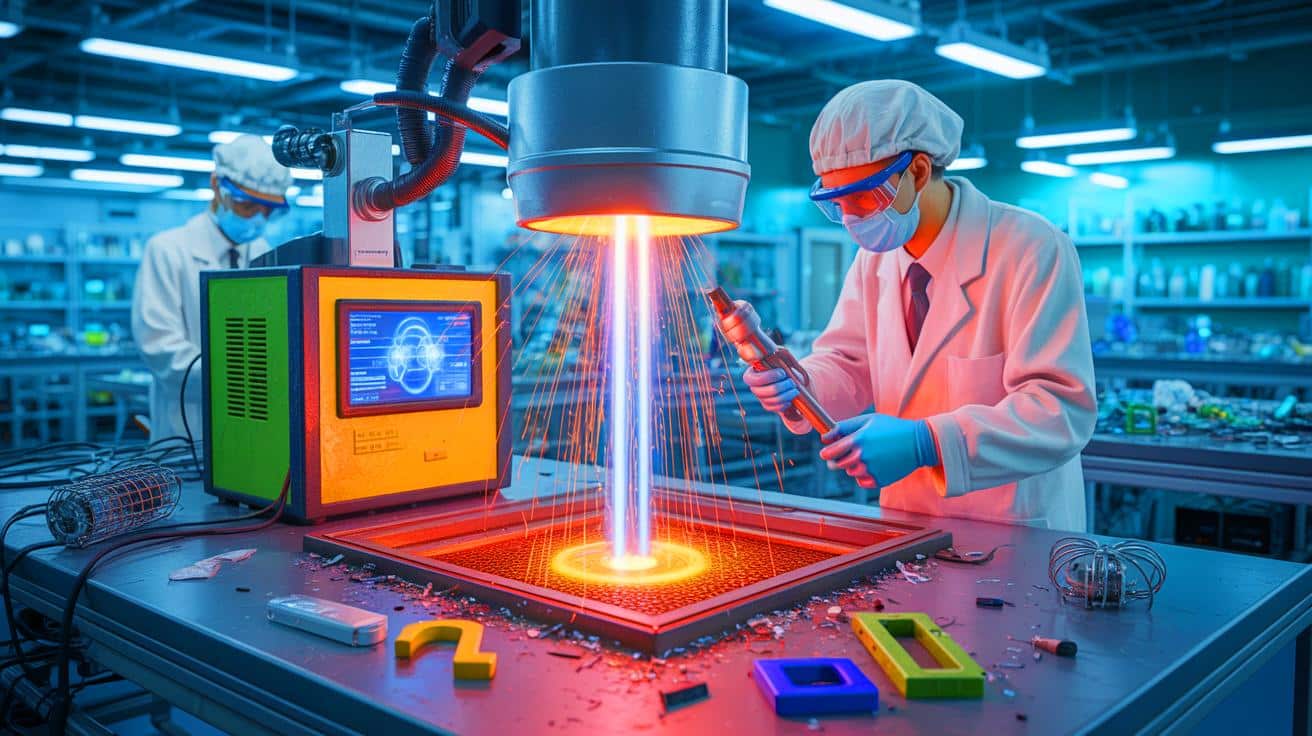
In a groundbreaking development, researchers at Rice University have pioneered a method for recovering rare earth elements (REEs) from discarded magnets using flash Joule heating. This innovative approach, led by James Tour and Shichen Xu, offers substantial environmental and economic benefits compared to traditional recycling methods. By rapidly raising temperatures to thousands of degrees in milliseconds and employing chlorine gas, this technique extracts REEs in seconds without water or acids. The implications are significant, aligning with U.S. efforts to bolster domestic mineral supplies and reduce reliance on imports. This new method promises a leap forward in creating a resilient and circular supply chain.
Thermodynamics Drives Selective Recovery
The research team at Rice University explored the thermodynamic properties of materials to optimize the recovery of REEs from magnet waste. Their hypothesis was that flash Joule heating, in combination with chlorine gas, could leverage differences in Gibbs free energy and boiling points to selectively remove non-REE elements. This approach proved highly effective, as materials like iron and cobalt chlorinate and vaporize first, leaving behind valuable REE oxides.
Experiments conducted on neodymium iron boron and samarium cobalt magnet waste demonstrated the method’s efficiency. By carefully controlling temperatures, non-REEs converted into volatile chlorides, allowing them to separate cleanly from the solid REEs. As Shichen Xu, the study’s first author, noted, this thermodynamic advantage made the process both efficient and clean. It works in a fraction of the time compared to traditional methods, avoiding the use of water or acids, which was previously thought impossible.
The team supported their findings with life cycle assessments (LCA) and techno-economic analyses (TEA), achieving over 90 percent purity and yield. These assessments highlighted an 87 percent reduction in energy use, an 84 percent decrease in greenhouse gas emissions, and a 54 percent cut in operating costs compared to conventional hydrometallurgy.
Toward Circular Rare Earth Economy
The ultrafast process developed by Rice University researchers holds promise for establishing a circular economy for rare earth elements. By enabling localized recycling units near electronic waste collection points, this method can reduce shipping costs and environmental impact while processing used magnets efficiently. James Tour emphasized the practical implications of this research, stating that it represents more than an academic exercise; it offers a viable industrial pathway.
Rice University has already licensed the intellectual property to Flash Metals USA, a Texas-based startup planning to commence production by the first quarter of 2026. This collaboration marks a significant step toward scalable and environmentally responsible rare earth recovery, potentially transforming the global approach to critical material recovery. With support from entities like the Defense Advanced Research Projects Agency and the U.S. Army Corps of Engineers, the project is poised to influence the industry significantly.
This development underscores the potential for creating a sustainable and circular rare earth economy. By reducing dependency on imported materials and minimizing environmental impact, this method represents a paradigm shift in the way critical resources are managed worldwide.
Environmental and Economic Implications
The new method for recovering REEs offers profound environmental and economic benefits. Traditional recycling methods are not only energy-intensive but also produce significant amounts of toxic waste. In contrast, the flash Joule heating approach minimizes environmental impact by eliminating the need for water and acids. The reduction in energy use and greenhouse gas emissions further demonstrates its ecological advantages.
Economically, this method offers substantial savings. The reduction in operating costs compared to hydrometallurgy positions it as an attractive option for industries reliant on rare earth elements. The ability to localize recycling units near waste collection sites reduces logistics costs, making the process more financially viable. This economic feasibility is crucial for widespread adoption and the establishment of a circular economy for rare earth materials.
As industries continue to prioritize sustainability, the adoption of environmentally friendly and cost-effective methods for resource recovery becomes increasingly important. The flash Joule heating approach developed by Rice University researchers represents a significant step forward in achieving these goals.
Future Prospects and Challenges
While the flash Joule heating method holds great promise, several challenges and prospects lie ahead. Scaling up from laboratory experiments to industrial applications requires careful consideration of technical and logistical aspects. Ensuring consistent performance and reliability in larger-scale operations is crucial for widespread adoption.
Additionally, collaboration between academia, industry, and government entities will be essential for successful implementation. Support from organizations like the Defense Advanced Research Projects Agency and the U.S. Army Corps of Engineers highlights the importance of multi-stakeholder involvement in advancing this technology.
The potential transformation of the rare earth recovery industry hinges on overcoming these challenges. The development of localized recycling units and the establishment of a circular economy represent significant opportunities for reducing environmental impact and securing a sustainable supply of critical materials.
The introduction of the flash Joule heating method for rare earth recovery marks a significant milestone in sustainable technology. As industries and governments strive to reduce environmental impact and secure critical material supplies, this method offers a promising solution. However, its successful implementation will require collaboration and innovation across sectors. As the world moves toward a more sustainable future, how will industries adapt to embrace new technologies and ensure a resilient supply chain for critical resources?



This sounds revolutionary! 🌍 How soon can we expect this tech to be used globally?
This sounds like a game-changer! How soon can we expect to see this technology in widespread use? 🤔
Wait, is this really going to end our dependence on mining? Sounds too good to be true! 🤨
I’m skeptical. How can they ensure the purity of the recovered rare earths? 🤔
Thank you to the researchers at Rice University for leading the charge on sustainable tech! 🌍
What are the potential risks of using chlorine gas in this process?
Wow, this could really reduce our reliance on mining. Thanks for sharing such an important development! 😊
Is there a specific type of e-waste that works best with flash Joule heating?
Finally, a practical use for e-waste! Kudos to the team! 👏
Does this mean we can finally stop worrying about China’s dominance in rare earth supply?
Flash heating sounds futuristic! Are there other applications for this tech?
I’m curious, how does this impact the overall cost of electronics recycling?
Flash heating sounds like something out of a sci-fi movie. Are there any potential health risks involved?
Will this method work for other toxic elements in e-waste, like lead or mercury?