


| IN A NUTSHELL |
|
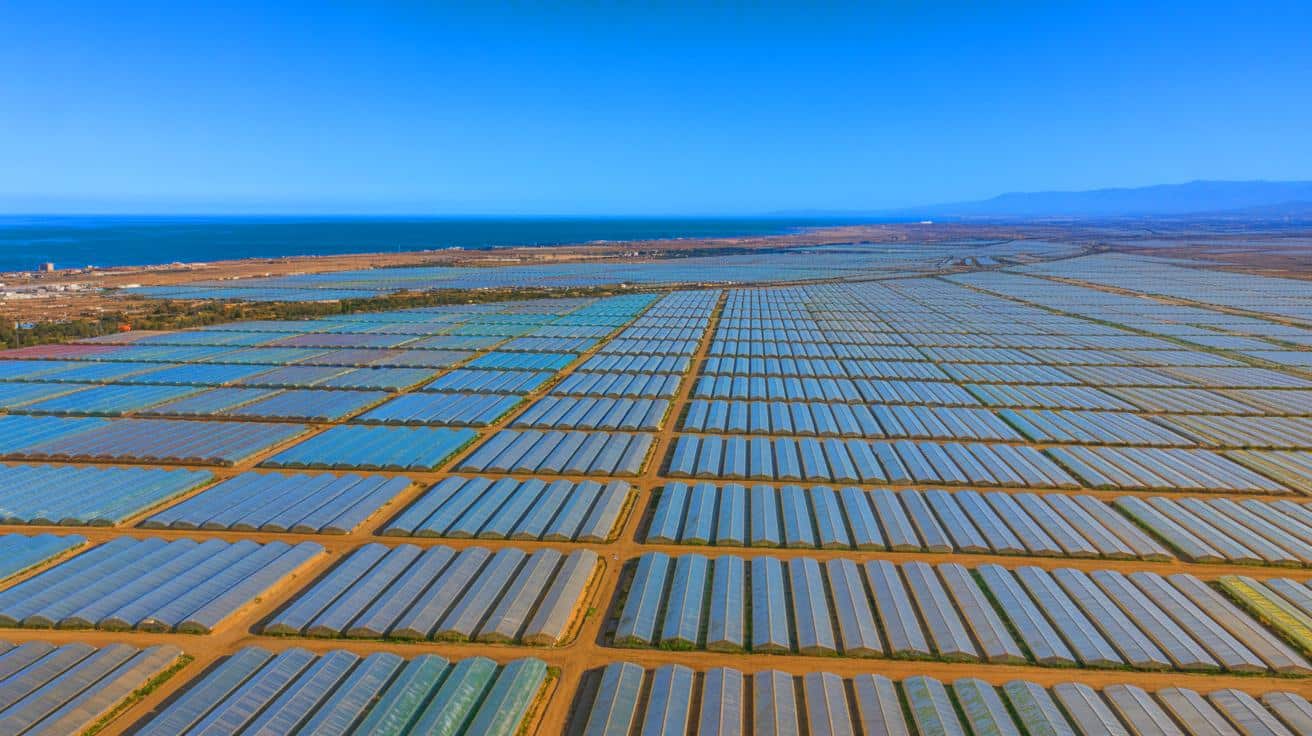
From the vantage point of space, the landscape of southern Spain reveals an unexpected marvel: a sprawling expanse of plastic greenhouses. Known as “the sea of plastic,” these structures cover more than 100,000 acres in the arid province of Almería. While the Great Wall of China and the Pyramids of Giza may capture imaginations, it is this sea of plastic that is reshaping both the climate and the food supply for much of Europe. This phenomenon is not just a testament to human ingenuity but also a reflection of the complex challenges that accompany such large-scale agricultural practices.
Turning a Desert Into Europe’s Winter Garden
In the 1950s, farmers in the Campo de Dalías region of Almería began experimenting with novel agricultural techniques to overcome their harsh environment. They faced numerous obstacles, including salty groundwater, wind erosion, and extreme dryness. Early innovations included simple plastic coverings and layered sand to protect crops. Over time, these evolved into full-scale greenhouses, known locally as invernaderos.
Today, this region of Spain has transformed from a barren desert into a vital part of Europe’s food supply chain. By employing advanced agricultural techniques such as hydroponics, artificial soils, and drip irrigation systems, farmers have created an environment where crops can thrive year-round. The area now produces between 2.5 and 3.5 million tons of fruits and vegetables annually, supplying markets across Germany, the United Kingdom, and beyond. This incredible transformation is a testament to the power of human innovation in overcoming environmental challenges.
A Surprise Cooling Effect, With Caveats
Researchers have discovered an intriguing climatic side-effect of Almería's greenhouses: they are cooling the local environment. Satellite data from NASA's Earth Observatory, collected between 1983 and 2006, shows that surface temperatures in Almería decreased by 0.5°F per decade, while surrounding regions experienced warming.
The phenomenon is attributed to the albedo effect, where the reflective plastic roofs of the greenhouses bounce solar radiation back into the atmosphere, reducing heat absorption. The University of Almería found that surface reflectivity in the region increased by nearly 10% during this period. While some see this as a potential climate adaptation strategy, experts like Dr. Andrés Mendoza caution against over-generalizing these findings. "This isn’t a scalable solution," he notes, emphasizing that the outcome is unique to Almería's specific conditions.
Environmental Cost of Feeding a Continent
Despite its success, Almería's plastic-covered landscape poses significant environmental challenges. The region's reliance on single-use plastics for greenhouse construction is creating waste management issues, as aging films degrade and require replacement. Improper disposal of these plastics can lead to pollution of nearby ecosystems and coastlines.
Water scarcity is another critical issue. Although drip irrigation has improved efficiency, the demand for freshwater remains high in this arid climate. Hydrologists warn that this demand may not be sustainable in the long term, given the stress on Spain's groundwater reserves. Additionally, the labor conditions within some greenhouse operations have raised concerns, with reports of low wages and difficult working environments for migrant workers.
Balancing Innovation With Sustainability
Almería's agricultural experiment is a striking example of human ingenuity, but it also serves as a cautionary tale. As researchers explore the implications of this Spanish outlier, they are mindful of the broader lessons it offers in terms of climate adaptation, agricultural innovation, and environmental stewardship. The region's story highlights the potential for engineering solutions to solve immediate problems, while also raising questions about the long-term sustainability of such approaches.
As the world grapples with climate change and food security, Almería's sea of plastic offers valuable insights into the delicate balance between innovation and sustainability. How can we continue to push the boundaries of agricultural production while ensuring that such efforts are environmentally and socially responsible?



Wow, I had no idea that plastic could have a cooling effect! Is this something we could use in other parts of the world? 🤔
Wow, I had no idea a desert could become a breadbasket! 🌾
Amazing transformation! But what about the plastic waste? 🤔
It’s amazing what they’ve done with the desert, but what happens when the plastic starts to break down? Isn’t that a big issue?
Is there any solution proposed for the water shortages in Almería?
Thank you for this enlightening article! I visited Almería last year, and it’s incredible to see how they’ve transformed the landscape. 🙌
This is fascinating, but it sounds like a ticking time bomb with all that plastic. 😬
Why not use biodegradable plastics to reduce the waste problem?
How sustainable is this really? All that plastic can’t be good for the environment in the long run. 😟
Incredible innovation! Thank you for shedding light on this topic. 👍
So let me get this straight, the desert is now a “breadbasket”? That’s quite the transformation! 🍞
Has anyone considered the impact of these greenhouses on local wildlife?
This could be a model for other desert regions. Has anyone tried?
Great article! Almería’s transformation sounds both impressive and concerning.
How do they address the labor issues mentioned in the article?
Is there any governmental regulation on the use of plastic in these greenhouses?
What other crops are grown in these greenhouses besides fruits and vegetables?
It’s amazing what humans can achieve with innovation. 👏
Why are single-use plastics still being used if they cause so many problems?
Do they export any of these methods to other parts of the world?
So the greenhouses actually cool the area? That’s a cool fact! 😄
I wonder what impact this has on the local economy.
Plastic cooling the earth? Who’d have thought! What are the lessons for other arid regions around the world?
Just imagine if similar projects were attempted in other deserts worldwide! 🌍
Great read, but it’s sad about the environmental cost. 😢
Could solar panels be integrated into these greenhouses for energy efficiency?
Is there a plan to address the groundwater depletion in the area?
I love how this article made me think about sustainability in a new way. 🤔
What are the local communities’ views on these greenhouses?
Are there any ongoing studies to find alternatives to single-use plastics here?
The cooling effect is an unexpected twist! 🌬️
How does the local government plan to tackle the waste management issues?
Thanks for the insightful article. It’s both inspiring and concerning. 🙏
Are the workers in these greenhouses locals or mostly migrants?
I wonder if this approach could be scaled up elsewhere without the plastic issues.
So much food grown, yet so many environmental challenges. 🤷♂️
This article highlights the pros and cons perfectly. Thank you!
Plastic sea? Sounds like a bad sci-fi movie title! 😂
Is it possible to replace these plastics with something more durable?
Can this method of agriculture cope with climate change long-term?
What’s the most surprising fact you learned from writing this article?
It’s a love-hate relationship with plastic, isn’t it? 🤦♀️
Is there any local opposition to these greenhouse projects?
Fascinating read! But what’s being done to address the water shortages? Seems like a ticking time bomb. ⏳💦
I hope they find a way to recycle that plastic efficiently. ♻️