




| IN A NUTSHELL |
|
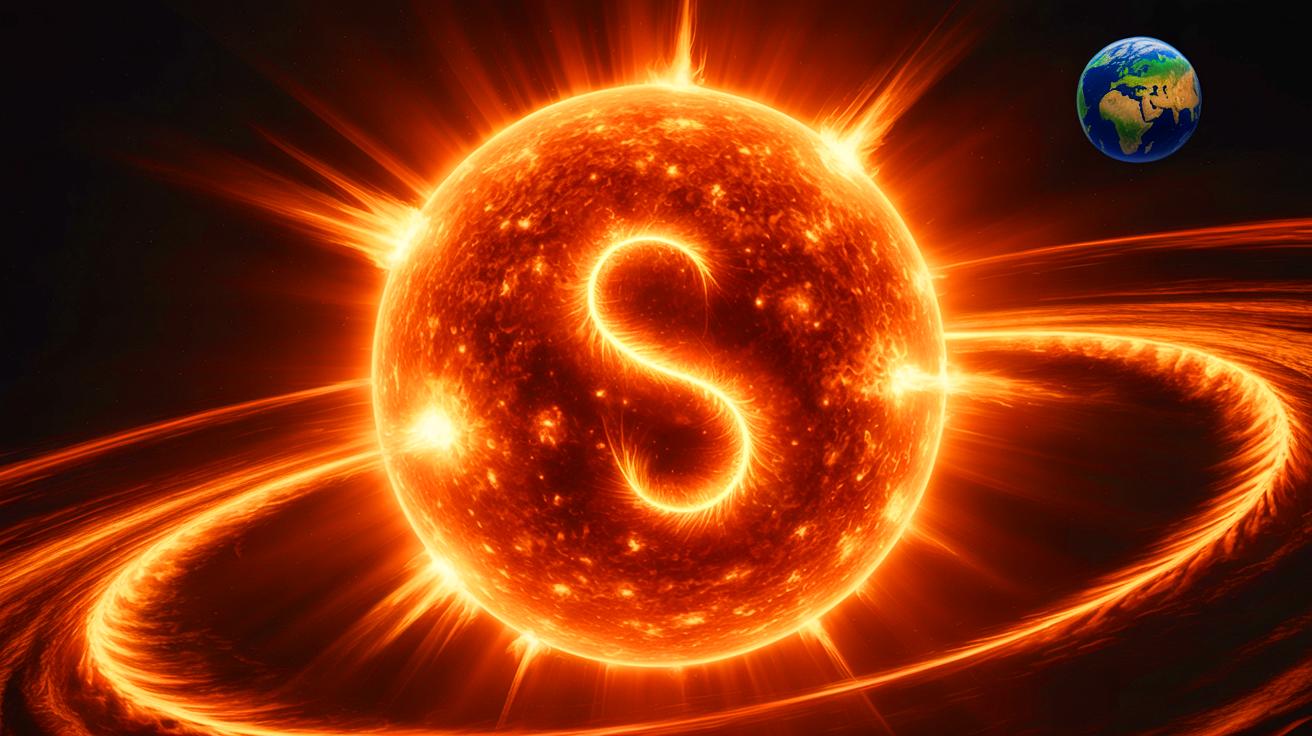
An intriguing event unfolded last week as a massive inverted “S” structure appeared at the center of the Sun, capturing the attention of scientists and enthusiasts alike. This colossal formation, spanning about 78,000 miles across, dwarfs our planet, being ten times the diameter of Earth. Interestingly, this solar phenomenon was closely followed by the ejection of an immense cloud of magnetized plasma, which reached Earth three days later, triggering a geomagnetic storm. As researchers delve into the implications of this event, questions arise about the Sun’s behavior and its potential impact on our planet.
Understanding the Recent Solar Phenomenon
On September 4, 2025, astronomers observed a significant and unusual event on the Sun: an inverted “S” shape, known scientifically as an “eruption sigmoïde,” formed above the solar equator. This structure is a striking example of the Sun’s dynamic magnetic field at work. Measuring approximately 78,000 miles in width, it was ten times the size of Earth. The distinctive shape preceded a coronal mass ejection—a massive release of solar material—by less than an hour.
Coronal mass ejections (CMEs) are significant because they can release billions of tons of plasma into space, potentially impacting Earth if directed towards our planet. In this instance, the CME traveled a staggering 435,000 miles before impacting Earth’s magnetic field on September 7. Despite the dramatic nature of the event, the resulting geomagnetic storm was categorized as G1, indicating a relatively low intensity.
The Impact of Geomagnetic Storms
Geomagnetic storms like the one observed can have various effects on Earth. The storm on September 7 was mild, causing only minor disturbances to Earth’s magnetic shield. Such events can disrupt satellite operations, affect power grids, and even create beautiful auroras near the poles. However, this storm did not produce spectacular auroras in mid-latitude regions.
Interestingly, this solar event coincided with a total lunar eclipse, known as a “blood moon,” visible in several parts of the world. While the eclipse itself was unrelated to the solar eruption, it added a layer of intrigue to the celestial events of the week. The synchronicity of these events highlights the interconnectedness of cosmic phenomena, underscoring the need for continued monitoring and understanding of solar activity.
The Science Behind Solar Eruptions
Solar eruptions are influenced by the Sun’s complex magnetic field. The “S” shape observed is indicative of twisted magnetic fields associated with sunspots. These fields can become unstable and break, leading to the ejection of solar material into space. This specific type of solar activity is often a precursor to significant solar eruptions.
According to data from Spaceweather.com, the appearance of such magnetic configurations frequently signals impending solar explosions. The “S” shape, reminiscent of the Greek letter sigma, serves as a visual cue for scientists studying solar dynamics. Understanding these patterns is crucial for predicting solar activity and mitigating its potential effects on Earth.
The Implications for Earth and Future Observations
While this recent geomagnetic storm was mild, it serves as a reminder of the Sun’s influence on our planet. As our reliance on technology grows, the potential impacts of more intense solar storms become increasingly significant. Disruptions to communication systems, navigation, and power infrastructure highlight the importance of preparing for such events.
Research into solar activity continues to be a priority for scientific communities worldwide. By studying solar eruptions and their precursors, scientists aim to improve predictive models, allowing for better preparation and response to future solar events. The recent “S” shaped eruption poses questions about the frequency and intensity of such occurrences and their potential long-term impacts on Earth.
The Sun remains a source of fascination and mystery, with each new observation adding to our understanding of its complex behavior. As scientists study the recent solar events, the question remains: How will ongoing solar activity shape our technological world and our understanding of the cosmos in the years to come?




Wow, this is mind-blowing! How often do these inverted “S” structures appear on the Sun? 🤯
Wow, a 78,000-mile structure on the Sun! That’s mind-blowing! 🌞
Why do these solar events always seem to happen when I’m trying to enjoy a peaceful weekend? 😂
I had no idea the Sun could be so dramatic! Thanks for shedding light on this! 🌞
Can someone explain what a “coronal mass ejection” actually is? I’m lost!
Thank you for the informative article. It’s fascinating to learn about solar phenomena.
Is there any chance that a more intense storm could actually damage our satellites?
Is there any chance these solar events could affect our internet connections?
435,000 miles is quite a journey for plasma! Amazing how it impacts Earth!
Great article, but I’m curious, why was this storm only classified as mild?
Not sure I believe all this. Sounds like science fiction. 🤔
Does this mean we’ll be seeing more auroras? That’s always a plus! 🌌
Can these solar storms be predicted in advance?
I wonder what would happen if it was a G5 storm. Scary thought!
Fascinating read! Do you think we’ll see more of these in the near future? 🔭
Great article, but you didn’t mention how this affects climate change.
Is it safe for astronauts during such solar activities?
How does this event compare to past solar eruptions?
How long do geomagnetic storms typically last?
Fascinating read! The Sun never ceases to amaze. ☀️
Is the “S” shape a common occurrence on the Sun?
Never knew the Sun could be so dynamic. Thanks for sharing!
Do these solar storms create any noticeable effects here on Earth?
Is there a way to protect power grids from these solar events?
Sounds like something out of a sci-fi movie. Incredible! 🚀
Why don’t we hear more about these solar events in the news?
I’m curious about the technology used to monitor these solar activities.
78,000 miles wide? That’s insane! How do they even measure that?
How often do these solar eruptions occur?
I’m a bit skeptical about the impact on Earth. Is it really that big of a deal?
The synchronicity with the lunar eclipse is just cosmic poetry!
Grateful for articles like this that explain complex topics so well. 😊
What are the long-term implications of such solar activities on Earth?
Can these solar storms impact GPS systems?
Does the “inverted S” shape have any symbolic meaning in science?
I wonder how these events affect wildlife, if at all.
I’m really interested in how scientists predict these solar eruptions.
How do solar activities like this influence space exploration efforts?
More articles like this, please! The universe is amazing! 🌌