




| IN A NUTSHELL |
|
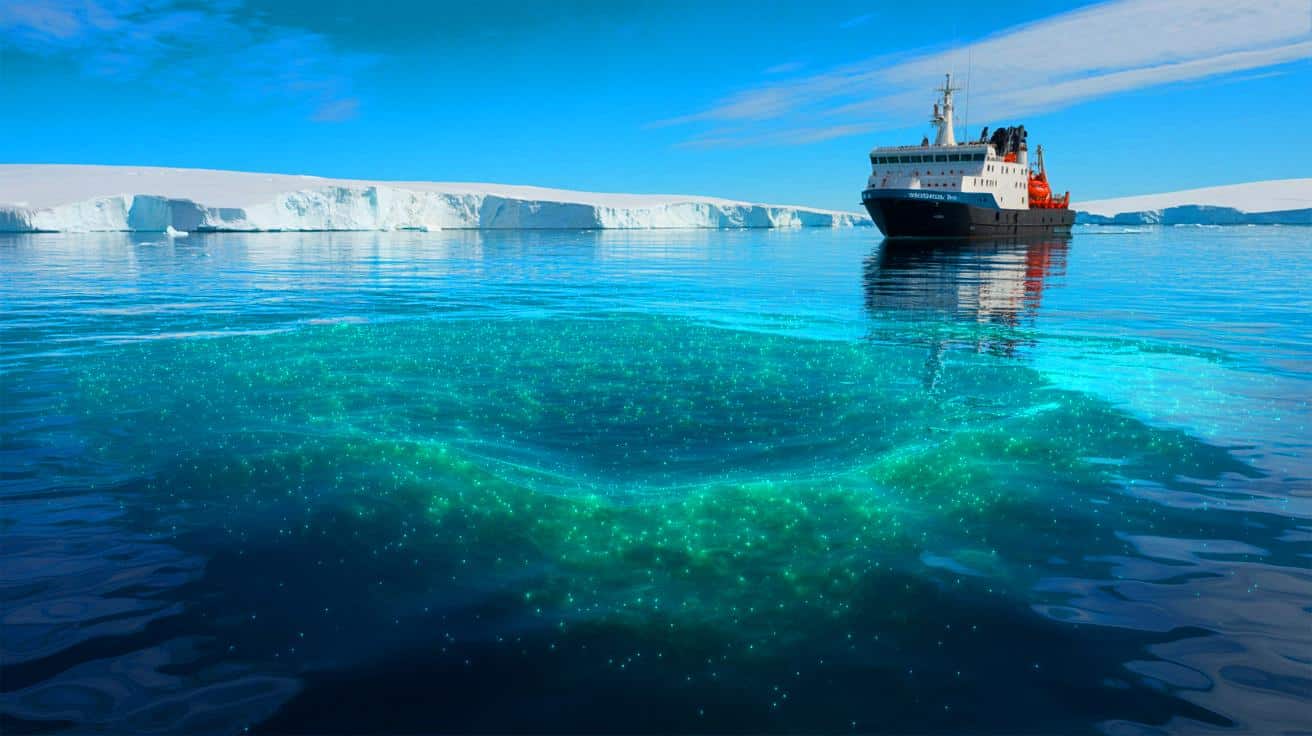
In recent years, a peculiar phenomenon in the Antarctic Ocean has captured the attention of scientists worldwide. A striking turquoise patch, visible in satellite images, has bewildered researchers since the early 2000s. Located near the great calcite belt—a region rich in calcium carbonate and home to coccolithophores, tiny marine organisms with reflective shells—this patch seemed too cold to support such life. However, a new study published in the journal Global Biogeochemical Cycles may finally provide answers. The research team embarked on an oceanic expedition, uncovering surprising details about this marine mystery and shedding light on the ocean’s carbon cycle processes.
Unraveling the Antarctic Ocean Mystery
For years, the Antarctic Ocean’s turquoise spot remained a conundrum. Scientists hypothesized that the icy waters were inhospitable for coccolithophores, whose calcite shells contribute to the ocean’s reflective properties. However, the recent study reveals that these organisms do, in fact, inhabit the frigid waters, albeit in smaller concentrations than within the calcite belt. This discovery challenges previous assumptions and broadens our understanding of marine life in extreme conditions.
Researchers ventured into these harsh waters aboard a research vessel, conducting detailed measurements at varying depths. Satellite images only capture the ocean’s surface, but the team’s in-depth analysis revealed a more complex ecosystem. As Bigelow Laboratory for Ocean Sciences senior research scientist Barney Balch noted, the findings provide a new perspective on the distribution of coccolithophores and their role in the carbon cycle.
The Battle of Plankton: Coccolithophores vs. Diatoms
The turquoise patch is not only home to coccolithophores but also to diatoms, another type of plankton crucial for marine food webs. Diatoms convert organic carbon into energy, making them a vital food source for marine life. The region south of the great calcite belt was previously thought to be a barren zone, a no-man's land between these plankton factions.
The study, however, reveals that moderate concentrations of coccolithophores and detached coccoliths extend southward. This finding suggests a more nuanced interaction between these plankton types, with the shiny layers of diatoms contributing significantly to the region's reflectiveness. The dynamic between coccolithophores and diatoms is essential for understanding the ocean's carbon absorption processes, as both play critical roles in sequestering atmospheric carbon.
“We Spent $36,000 To Prove The Earth Is Round,” Flat Earther Admits Shockingly
Implications for Global Carbon Cycles
The presence of coccolithophores in unexpected areas has significant implications for global carbon cycles. These organisms are vital carbon sinks, absorbing atmospheric carbon dioxide and helping mitigate climate change effects. The study's findings expand our knowledge of where coccolithophores thrive, suggesting that their carbon-absorbing capabilities might be more extensive than previously thought.
Understanding these patterns is crucial for predicting how marine ecosystems will respond to environmental changes. The study highlights the importance of comprehensive data collection, as noted by Balch, who emphasized the value of measuring phenomena in multiple ways to tell a more complete story. As climate change continues to alter oceanic conditions, such insights become increasingly pertinent.
Exploring Future Research Directions
The discovery of coccolithophores in the Antarctic Ocean opens new avenues for research. Scientists are now tasked with exploring how these organisms adapt to cold environments and what factors influence their distribution. Further studies could reveal more about the ecological interactions between coccolithophores and diatoms, providing a deeper understanding of their roles in marine ecosystems.
Additionally, the study raises questions about the potential for using plankton to combat climate change. Scientists are investigating ways to enhance plankton growth to increase carbon absorption from the atmosphere. As research progresses, understanding the complex dynamics of these tiny organisms will be crucial for developing effective climate solutions.
The Antarctic Ocean's turquoise mystery offers a fascinating glimpse into the intricacies of marine life and its impact on global processes. As scientists continue to investigate these phenomena, what other secrets might the ocean reveal about our planet's future?

Wow, who knew tiny organisms could have such a big impact on climate change! 🌍
Wow, nature never ceases to amaze me! 🌊 How do coccolithophores survive in such cold waters?
How long did it take for researchers to conduct this study? Must have been tough!
Is there any way to harness this process to combat climate change more effectively?
Great article! I never heard of coccolithophores before. Thanks for the info!
Are there similar phenomena happening in other cold waters worldwide?
I hope more research funding is allocated to these types of studies. They’re crucial!
Does this mean the Antarctic Ocean is getting warmer or is it just these organisms adapting?
Thank you for such an informative piece! Really opened my eyes to marine science.
How do coccolithophores survive in such cold temperatures? Are they evolving? ❄️
Satellites catching these turquoise patches is just mind-blowing! 🚀
This sounds like something from a sci-fi movie! The ocean is full of surprises. 🌊
Wait, so these tiny guys can actually help fight climate change? That’s incredible!
What are the potential negative impacts of this discovery? Or is it all positive?
Is there a way to track the growth of these organisms over time?
Could this discovery help in creating new strategies for reducing atmospheric CO2? 🌱
Why are researchers concerned about this discovery? Shouldn’t it be a good thing? 🤔
I’m a bit skeptical. How accurate are these satellite images in representing what’s happening underwater?
Are there any specific challenges researchers faced while studying in such cold conditions?
The balance between coccolithophores and diatoms seems crucial. How do they maintain it?
Could this discovery lead to new technologies or methods in carbon sequestration?
How do diatoms and coccolithophores interact exactly? Sounds like a micro battle! 🦠
I had no idea plankton could be so influential in climate change. Mind = blown!
Is there a risk of disrupting these ecosystems if we try to manipulate them for climate benefits?
Why haven’t we discovered this before? Are there more unknowns in the ocean waiting for us?
This is fascinating! How does the battle between coccolithophores and diatoms affect the food chain?
I wonder if this discovery will change how we monitor ocean health. Thoughts?
Are there any plans to replicate this research in other parts of the world?
Why were coccolithophores initially thought not to survive in cold waters?
The ocean never ceases to amaze me with its mysteries. Keep up the research!
So, could this mean the Antarctic Ocean is actually more alive than we thought? 🐟
This is a game-changer for ocean science! 🌍 Thanks for the insightful article!
I wonder how this discovery will affect our understanding of oceanic carbon cycles.
Can we expect any changes in marine conservation policies due to this new information?
Is there a possibility that coccolithophores could adapt to even colder conditions?
Does this mean we’ll see more satellite images of these patches in the future?