




| IN A NUTSHELL |
|
Recent archaeological discoveries at the Pyramid of Djoser in Egypt are reshaping our understanding of ancient engineering marvels. Researchers have uncovered a sophisticated water management system that highlights the advanced engineering techniques employed by the ancient Egyptians. These findings challenge long-held beliefs about the capabilities of ancient civilizations, revealing a complex network that harnessed seasonal floodwaters for monumental construction. As the implications of these discoveries unfold, they offer fresh perspectives on Egypt’s historical sites and the ingenious minds behind their creation.
Ingenious Stone Dam Capturing Desert Floodwaters
The enigmatic structure at Saqqara, known as Gisr el-Mudir, has long intrigued archaeologists due to its massive scale and ambiguous purpose. A recent breakthrough by Xavier Landreau and his team has shed light on its true function as a sophisticated stone dam. This impressive structure, extending nearly 1,180 feet, was designed to capture seasonal floodwaters from the surrounding wadis, providing a vital resource for large-scale construction projects.
Through careful analysis of the area’s topography, ancient waterways, and erosion patterns, researchers have pieced together the hydrology of the region. The dam could hold up to 14 million cubic feet of water, a capacity sufficient to maintain construction activities. Additionally, seasonal flooding deposited nutrient-rich sediments, thus enhancing the site’s agricultural potential. This discovery not only underscores the strategic significance of Saqqara but also highlights the dual religious and hydrological motivations behind its selection.
How Hydraulic Construction of Pyramids Worked
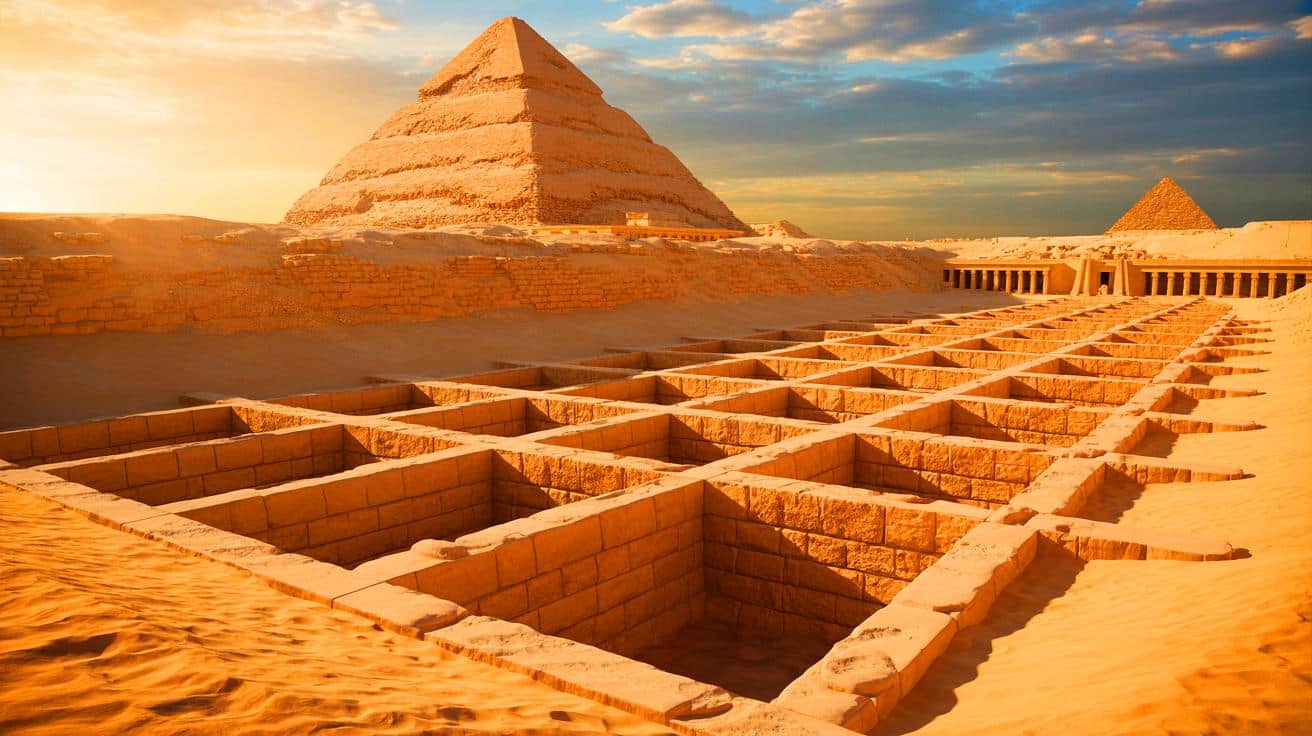
While the availability of water was crucial, the Pyramid of Djoser’s true innovation lay in its hydraulic engineering. Beneath the pyramid, a network of basins and shafts, known as the “Deep Trench,” was discovered. This complex system was more than just symbolic; it played a critical role in water purification and transportation.
This subterranean system likely facilitated a hydraulic elevator mechanism. By utilizing water pressure within vertical shafts, heavy limestone blocks could be floated on platforms and raised. This ingenious use of water minimized the mechanical effort needed for construction, providing a practical solution to the challenge of lifting massive stones. The structures found in the galleries and underground chambers support this theory, suggesting a sophisticated grasp of hydraulic principles.
Sophisticated Technology Matching Pharaohs’ Ambitions
The notion of hydraulic construction might seem daring, but it is backed by substantial evidence. The dam, basins, galleries, and shafts form an integrated system indicative of advanced engineering. The ancient Egyptians were not novices in hydraulic technology. Their expertise in irrigation, canal systems, and water management is well-documented, reflecting a profound understanding of hydraulic engineering.
This study proposes that such advanced techniques could have reduced the reliance on labor-intensive methods like huge ramps, thereby enhancing construction efficiency and precision. The Pyramid of Djoser, often regarded as a prototype, stands as a testament to the Old Kingdom’s technical prowess. It challenges the traditional narrative and highlights the Egyptians’ ability to adapt and innovate in response to environmental challenges.
How Saqqara’s Hydraulic Remains Alter Our Historical Perspective
Traditionally, the pyramids have been examined primarily for their architectural and symbolic importance. However, the discovery of a comprehensive hydraulic system at Saqqara alters this perspective. It demonstrates that the ancient builders were not just erecting religious monuments but also developing sustainable technical ecosystems.
This interdisciplinary approach, integrating archaeology, hydrology, and geotechnics, enriches our understanding of ancient Egypt. It reveals a sophisticated organization of work and resource management, suggesting that the construction of the pyramids was as much a feat of engineering as it was of manpower. This insight prompts a reevaluation of other historical sites, encouraging the search for similar hydraulic systems that may have been overlooked.
As we continue to unravel the engineering marvels of ancient Egypt, the question remains: What other technological innovations are hidden beneath the sands, waiting to redefine our understanding of history?


Wow, this changes everything we thought we knew about the pyramids! 💡
Is this theory widely accepted by the archaeological community?
Mind-blown by the ingenuity of ancient Egyptians! 🚀
Can’t believe how advanced they were. What else are we missing? 🤔
Why haven’t we heard about this sooner? Seems like a game-changer!