




| IN A NUTSHELL |
|
In an ambitious endeavor that signifies a major shift in nuclear energy development, a startup named Deep Fission Nuclear has secured $30 million to further its innovative plan. By July 4, 2026, the company aims to install a micro-reactor in a mile-deep borehole. This project is part of the U.S. Department of Energy’s Reactor Pilot Program. The idea may sound unconventional at first, yet it promises to address significant challenges facing nuclear power today: cost, safety, and security. This pioneering approach seeks to revolutionize how nuclear reactors are constructed and managed, potentially transforming the nuclear energy landscape.
Revolutionizing Nuclear Reactor Placement
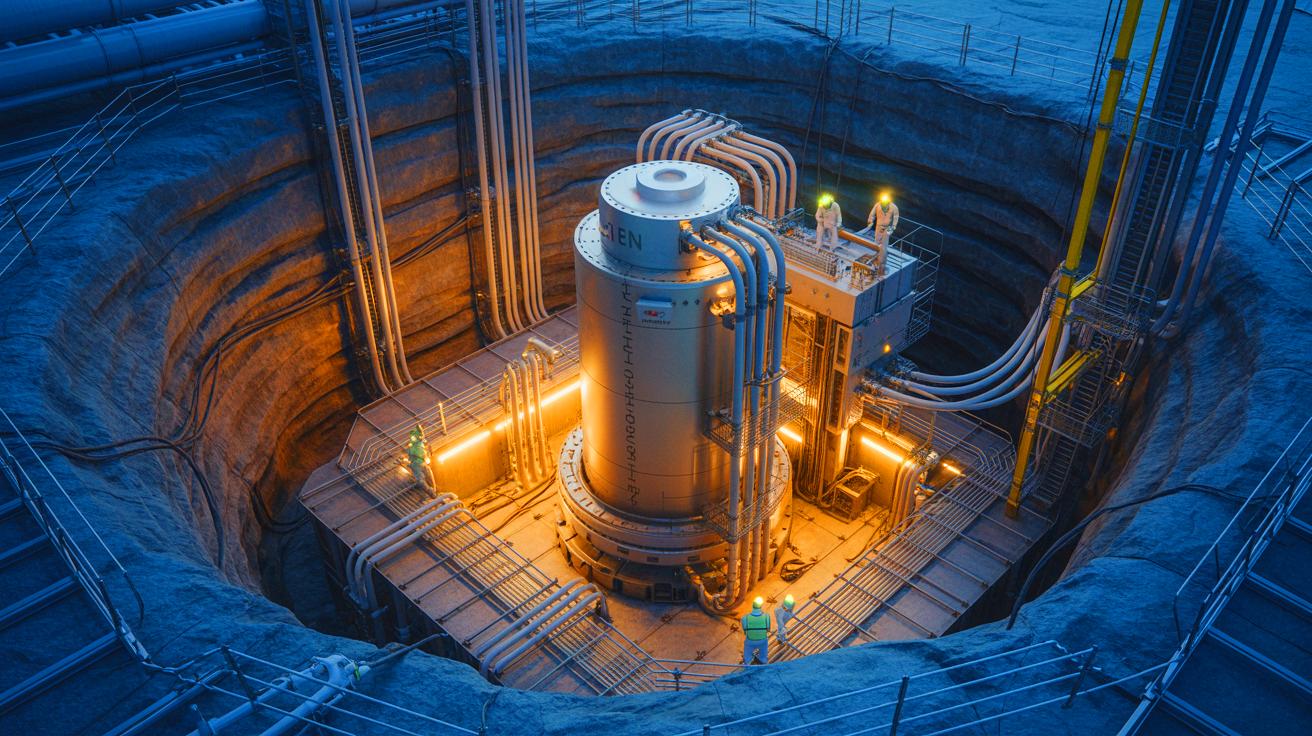
Deep Fission’s approach involves installing a nuclear reactor in a borehole drilled into solid rock, a mile beneath the Earth’s surface. This concept relies on the stability of geological formations to ensure safety and security. By situating the reactor underground, Deep Fission aims to reduce the extensive civil engineering costs typically associated with nuclear power plants. The company estimates that this could result in up to an 80% reduction in above-ground construction expenses.
The reactor itself is a self-contained 15-MWe modular unit, fueled with Low-Enriched Uranium (LEU). It operates at a temperature of 600 °F. The reactor is connected to the surface by two pipelines: one for water and another for non-radioactive steam. This steam powers turbines that generate electricity. The surrounding rock and water column naturally pressurize the reactor to 2,352 psi, eliminating the need for additional equipment.
Addressing Safety and Environmental Concerns
A significant advantage of Deep Fission’s underground approach is enhanced safety. By placing the reactor deep beyond the water table in a geologically stable area, the risk of contaminating drinking water sources is minimized. Moreover, should the reactor be damaged, it can be sealed off by filling the borehole with rubble and concrete. This method ensures that even in the event of an accident, the surrounding environment remains protected.
The underground location also provides inherent security benefits. The reactor’s placement makes it less vulnerable to terrorist attacks and other security threats. Furthermore, the natural containment offered by the rock eliminates the need for traditional containment structures, reducing both complexity and cost.
Economic Implications and Energy Efficiency
Deep Fission’s initiative promises not only to enhance safety and security but also to offer economic benefits. The streamlined design and reduced construction requirements mean that a pilot plant could be operational in as little as six months. If successful, the technology could be scaled to meet global energy demands efficiently and cost-effectively.
The company projects that electricity generated through this method could cost between five to seven cents per kWh. This competitive pricing could make nuclear energy a more attractive option for various industries, particularly those with high energy demands, such as AI data centers.
Future Prospects and Industry Impact
Liz Muller, Co-Founder and CEO of Deep Fission, emphasizes the transformative potential of this technology. “This is a unique moment for the nuclear industry,” she notes. With the recent funding, Deep Fission is poised to begin constructing its pilot reactor, targeting completion in 2026. The company’s scalable technology could play a critical role in meeting the growing global demand for clean energy.
Deep Fission’s innovative approach represents a significant departure from traditional nuclear power models. By leveraging underground placement, the company addresses key industry challenges while opening new avenues for energy production. As the world continues to seek sustainable energy solutions, such advancements could prove pivotal.
As Deep Fission moves forward with its groundbreaking project, questions remain about the broader implications for the nuclear industry. Will other companies follow suit and adopt similar underground technologies? How might this impact global energy policies and the transition towards cleaner power sources? The answers to these questions will shape the future of nuclear energy and its role in addressing the world’s energy needs.


Wow, burying a reactor underground sounds like a James Bond plot! 😄
Wow, burying a reactor a mile deep? That’s some serious sci-fi stuff! 🚀
How will they ensure there’s no leakage into the water table?
How do they plan to manage the heat generated by the reactor underground?
30 million dollars… is that enough for such an ambitious project?
Is $30 million really enough to pull off such an ambitious project?
Love the idea of reducing above-ground construction costs! 🚀
I’m curious about the environmental impact—will this truly be a cleaner energy source?
Is it just me, or does this sound like a risky venture? 🤔
Thank you for sharing this fascinating development in nuclear energy!
Finally, a nuclear innovation that doesn’t scare me! Thank you, Deep Fission!