




| IN A NUTSHELL |
|
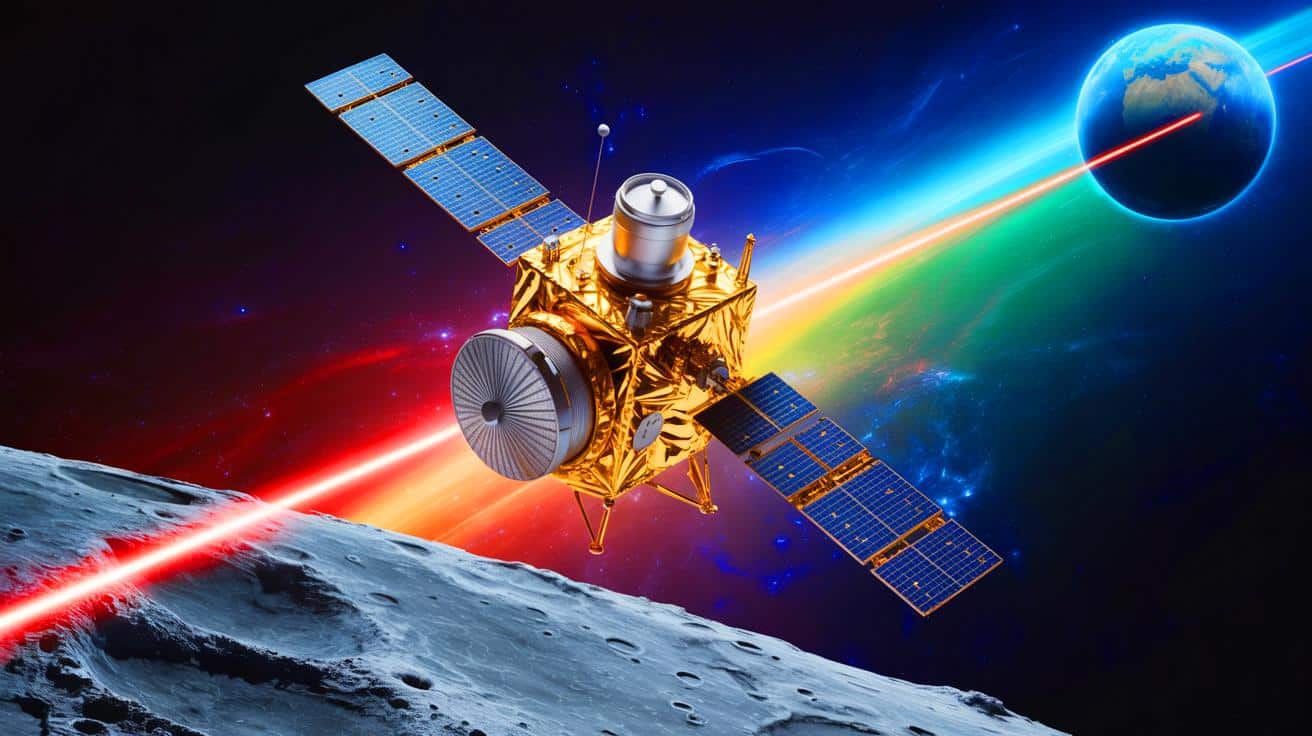
China’s recent advancement in space technology marks a significant milestone in lunar exploration. By precisely targeting a laser at a satellite orbiting the Moon during daylight, China has achieved what was once considered a formidable challenge. This success is a testament to the country’s commitment to establishing a sustainable presence on the Moon, paving the way for future exploration missions. It also highlights China’s dedication to international collaboration, as the implications of this milestone extend beyond national pride. As the global race for lunar exploration intensifies, China’s achievement underscores the nation’s growing influence in the field of space technology.
Revolutionizing Lunar Navigation and Communication
The recent success of China’s Deep Space Exploration Laboratory (DSEL) in laser targeting has far-reaching implications for lunar navigation. By achieving a level of precision comparable to “hitting a single hair from 6.2 miles away,” China has enhanced its capability to gather crucial data from satellites in orbit. This level of accuracy is vital for planning future exploration missions and ensuring their success.
The Tiandu-1 satellite, which was launched in March 2024, plays a pivotal role in this endeavor. It is part of China’s Queqiao relay constellation, designed to establish a comprehensive Earth-Moon communication network. This network aims to support a variety of lunar activities, from landing missions to potential crewed journeys. The success of the laser targeting experiment reinforces the strength of the infrastructure needed for sustainable lunar exploration.
Overcoming Challenges in Daylight Laser Ranging
China’s breakthrough in enabling laser ranging during daylight is a game-changer for Earth-Moon tracking. This capability eliminates a significant hurdle in autonomous spacecraft operations, allowing for more precise landing guidance and real-time coordination of rover fleets. Such advancements are crucial for future missions, especially those targeting the challenging terrain of the lunar south pole.
The development of this technology is part of a broader series of advancements in China’s lunar exploration program. The upcoming Chang’e-8 mission, scheduled for 2028, will further test critical infrastructure and technologies. These initiatives, including small nuclear reactors, are part of a joint project with Russia to develop the International Lunar Research Station. They underscore China’s leadership in space exploration and its commitment to fostering international partnerships.
Implications for Deep-Space Infrastructure
The ability to conduct laser ranging in daylight has profound implications for deep-space infrastructure. By overcoming the challenges posed by solar interference, China can maintain continuous navigation and communication between Earth and the Moon. This capability is crucial for the sustained operation of lunar missions and enhances the efficiency of deep-space exploration.
The deployment of the Tiandu-1 satellite and its counterparts is a critical step toward establishing a robust Earth-Moon network. This network will support scientific research, commercial endeavors, and international collaboration. As China continues to advance its space capabilities, the potential for new discoveries and innovations in deep-space exploration grows, offering exciting opportunities for the future.
China’s Broader Vision for Lunar Exploration
China’s recent achievements are part of a larger vision to create a permanent presence on the Moon. By developing advanced technologies and infrastructure, China aims to foster a sustainable environment for research and exploration. This vision emphasizes international cooperation and technological innovation, with the daylight laser ranging experiment serving as a pivotal milestone.
As China progresses in its lunar exploration efforts, the international community observes with keen interest. The advancements achieved not only promise to shape future missions but also inspire a new generation of scientists and engineers. With the potential for groundbreaking discoveries and unprecedented collaboration, the question remains: What new frontiers will China explore next?