




| IN A NUTSHELL |
|
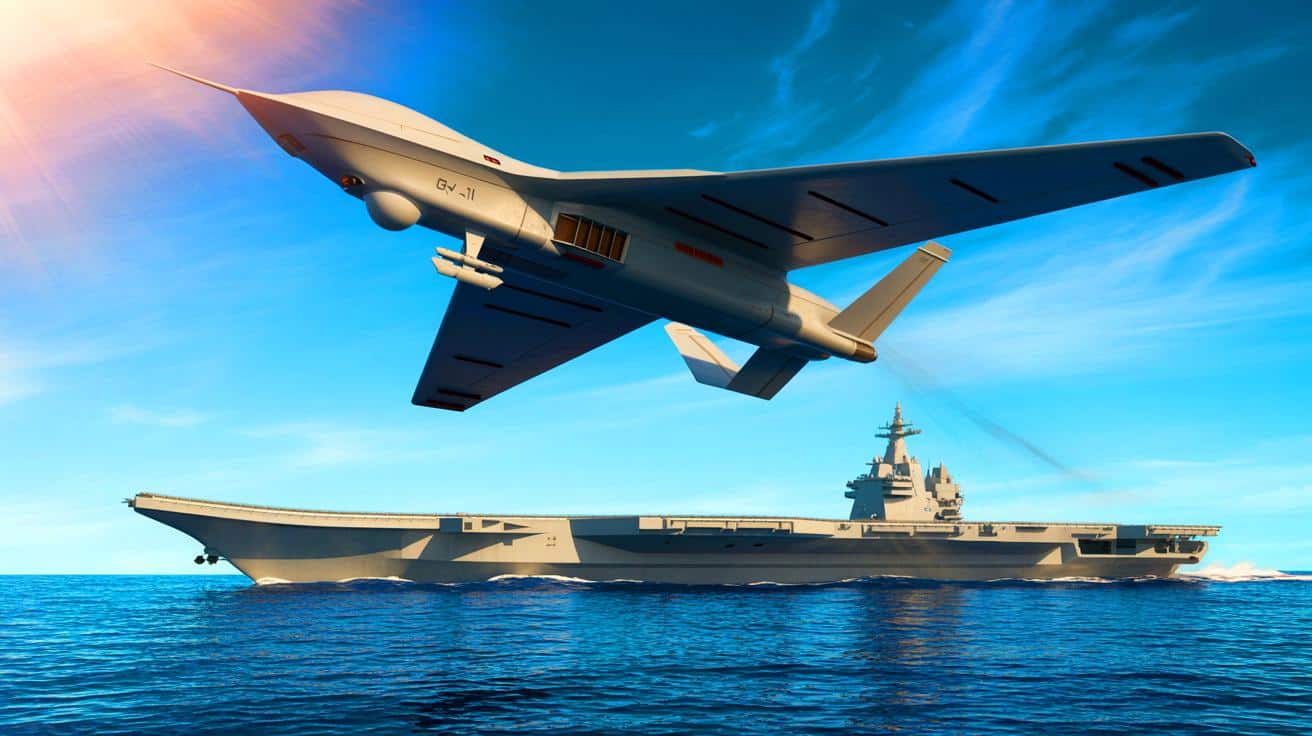
China’s recent unveiling of a ship-launched stealth combat drone, the GJ-11, marks a significant development in military technology. As nations around the globe focus on advancing their defense capabilities, China’s demonstration of this advanced drone technology has caught the world’s attention. The GJ-11, derived from the ‘Sharp Sword’ project, is manufactured by the Hongdu Aviation Industry Group, a subsidiary of the state-owned Aviation Industry Corporation of China (AVIC). This drone’s debut at the Victory Day Parade in Beijing underscores its strategic importance, highlighting China’s growing prowess in military innovation.
Development and Design of the GJ-11
The GJ-11 drone, with its roots in the Shenyang Aircraft Corporation’s ‘Sharp Sword’ project, represents years of Chinese military research and innovation. First flown in 2013 and officially revealed in 2019, this drone is a testament to China’s commitment to enhancing its aerial capabilities. Its flying wing design and fully blended body contribute to its low radar cross-section, making it difficult to detect.
At 32.8 feet in length and with a wingspan of 45.9 feet, the GJ-11 is designed for stealth. The air intake positioned on top of the drone effectively blocks radar waves from reaching the engine blades, enhancing its radar evasion capabilities. Furthermore, the drone’s coating, akin to that used on Chinese fighter jets, further minimizes radar visibility. Powered by a turbofan engine, the GJ-11 can reach speeds of up to 690 miles per hour, carrying a payload of 4,409 pounds. These features enable it to perform both reconnaissance and strike missions.
Innovative Weapon Systems and Operational Capabilities
The GJ-11 is equipped with two internal weapons bays capable of carrying multiple guided bombs, optimizing its strike efficiency. One of its standout features is its ability to function as a ‘loyal wingman’, automating core functions and enhancing operational flexibility. In 2022, the drone demonstrated its capability by flying alongside a J-20 crewed fighter jet, showcasing its potential as an escort drone.
With the ability to operate from aircraft carriers and amphibious vessels, the GJ-11 extends China's reach and influence in strategic regions. Its combat range of over 930 miles enables operations over key areas such as Japan and Taiwan. The drone's ability to autonomously execute missions using advanced artificial intelligence reduces the workload on operators and ensures efficient mission execution.
Strategic Implications and Global Impact
The introduction of the GJ-11 raises strategic concerns for global military powers. Its deployment could potentially alter the balance of power in the Asia-Pacific region, where tensions are already high. The drone's capabilities in reconnaissance, strike missions, and data transmission highlight the growing role of unmanned systems in modern warfare.
The GJ-11's operational flexibility, combined with its advanced stealth features, positions China as a formidable player in the realm of unmanned aerial combat. As the world’s first operational ship-launched stealth combat drone, its presence could prompt other nations to expedite their own drone development programs. This development could lead to an arms race in drone technology, influencing global military strategies and alliances.
Future Prospects for the GJ-11
As China prepares for the potential deployment of the GJ-11 on its Sichuan and Fujian aircraft carriers, the global military landscape stands on the brink of transformation. The drone's ability to conduct operations in challenging environments and its integration with existing military assets underscore its strategic value.
The GJ-11’s success might pave the way for further innovations in unmanned combat systems. As nations adapt to the evolving dynamics of warfare, the role of drones in strategic and tactical operations will likely expand. This advancement poses questions about the future of aerial combat and the measures other countries might take to counter such capabilities.
In an era where technological advancements shape military strategies, the GJ-11 stands as a symbol of China's growing defense capabilities. As nations worldwide grapple with the implications of this development, what steps will they take to address the challenges and opportunities presented by such advanced unmanned technologies?



Is this drone really invisible to radar? That sounds like something out of a sci-fi movie!
Wow, the GJ-11 sounds like something out of a sci-fi movie! 😲
Is this drone already in active service, or is it still in testing phases?
How does the GJ-11 compare to US drones like the MQ-9 Reaper? 🤔
The stealth features are impressive. I wonder how other countries will respond to this. 🤔
Great article! It’s fascinating to see how quickly drone technology is advancing. Thanks for sharing! 😊
4,400 pounds of payload? That’s a lot of potential damage.
So when do we get our own ‘loyal wingman’ drones? Asking for a friend.
I’m curious about the environmental impact of deploying such drones.
Wait, did I read that right? 4,400 pounds of “death”? That sounds both impressive and terrifying. 😱
Does anyone else think this will push other nations into a drone arms race?
Can these drones really alter global military dynamics, or is this just hype? 🤨
This drone’s capabilities are both amazing and terrifying at the same time. 😬
China’s really stepping up its game with these drones. The future of warfare is going to be wild! 🚀