


| IN A NUTSHELL |
|
Recent advancements in laser fusion technology in China have captured the world’s attention. The construction of a massive laser fusion center in Mianyang is poised to revolutionize energy production while simultaneously influencing global power dynamics. This cutting-edge project aims to replicate solar reactions, offering both clean energy potential and military applications. As China takes the lead in this technological frontier, questions arise about the strategic and scientific motivations behind this monumental development. How will this impact the geopolitical landscape, and what implications does it hold for the future of energy and defense?
A Giant Leap in Laser Fusion
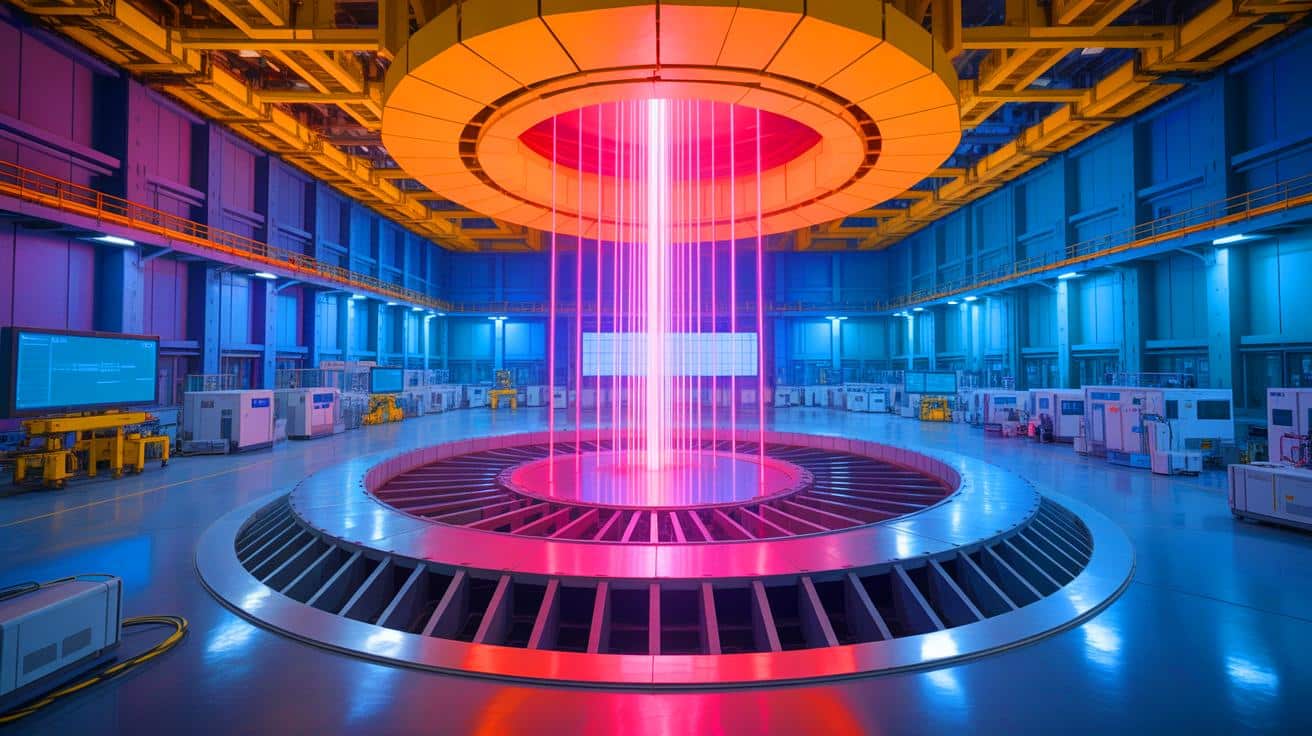
The Mianyang research facility in China represents a significant milestone in the race for laser fusion technology. Surpassing the size of the National Ignition Facility (NIF) in the United States, this installation could soon become the largest laser fusion site globally. With an experimental bay 50% larger than the NIF, it features a complex setup of four laser arms converging on a central chamber. This colossal infrastructure underscores China’s ambition to bridge its nuclear capabilities gap. Historically, China has conducted fewer nuclear tests than the United States or Russia. With this laboratory, China could simulate nuclear explosions and enhance its weaponry without actual testing. This technological advancement might bolster its nuclear capabilities while adhering to international treaties.
“This reactor dives to 5,200 feet: underground nuclear energy costs 80% less and produces 15 MW without accident risk for 5 cents per kWh.”
“The Plane That Can Survive Nuclear War” Inside America’s $13 Billion Doomsday Jet Ready for 2036
Laser Fusion: Energy and Defense
Laser fusion involves the compression of hydrogen isotopes using ultra-powerful lasers, initiating a nuclear reaction. This technology is often hailed for its potential to deliver clean and limitless energy. However, it also holds strategic military interest. By simulating the extreme conditions of a nuclear explosion, it aligns with international treaties like the Comprehensive Nuclear-Test-Ban Treaty (CTBT). These “subcritical” experiments do not trigger uncontrolled chain reactions but provide valuable insights into nuclear materials. For China, this laboratory could offer dual benefits—energy and military—while raising questions about its true intentions in a tense geopolitical climate.
“They want to launch a bomb: a secret space project promises to use nuclear power to propel a probe at incredible speeds.”
An International Implication
China is not alone in its quest to master laser fusion. The United States, France, and other nuclear powers have already invested in similar technologies. However, the scale of the Chinese project could reshape global strategic and technological balances. As the race for fusion accelerates, the international community must navigate between scientific collaboration and military risk prevention. The Chinese project exemplifies this dilemma, where each technological advancement could potentially serve peaceful or military purposes. The crucial question remains: how to regulate these developments to ensure global security?
“These mini-reactors adjust themselves automatically: America unveils its secret nuclear robots that operate without human supervision.”
Understanding Nuclear Fusion
Nuclear fusion is a process where two light atomic nuclei, such as those of hydrogen, merge to form a heavier nucleus. This phenomenon releases a substantial amount of energy. It is the same process that powers the Sun and stars, where temperatures and pressures are extreme. Unlike nuclear fission, which generates radioactive waste, fusion is considered a clean energy source. It uses abundant hydrogen isotopes, like deuterium and tritium, and emits no greenhouse gases. However, reproducing fusion on Earth is a significant technological challenge, requiring temperatures of millions of degrees and effective plasma confinement. Two primary approaches are being explored: magnetic confinement fusion and inertial confinement fusion. If fusion is mastered, it could revolutionize energy production.
As China advances in its laser fusion research, the implications of this technology on energy and military fronts are vast. Could this project truly transform global geopolitical and energy dynamics? What will be the long-term impacts of this advancement on power balance and international security?



Wow, China’s really stepping up in the fusion game! Is this the dawn of a new era or just another arms race? 🤔
Is this laser fusion tech actually going to replace nuclear fission? 🤔
China’s nuclear ambitions are always a bit unsettling. Should we be worried? 😟
Can this technology really provide limitless energy or is it just a pipe dream? 🌌
How does laser fusion actually work? This stuff sounds like sci-fi!
Thanks for keeping us informed. The implications of this are huge!
I’m not sure how to feel about this. Should we be worried about the military applications? 😟
Why isn’t the US building something like this? Are we falling behind?
Why is no one talking about the environmental impact of building such a massive facility? 🌍
Anyone else think this sounds like a Bond villain’s lair? 😂
Is it true that laser fusion is completely clean? No radioactive waste at all?
Great article! This is the kind of innovation we need for a cleaner future. 💡
More nuclear stuff? Just what the world needs… 🙄
Is this project a threat to global security, or just another step in technological evolution?
Are there any international regulations on laser fusion tech?