



| IN A NUTSHELL |
|
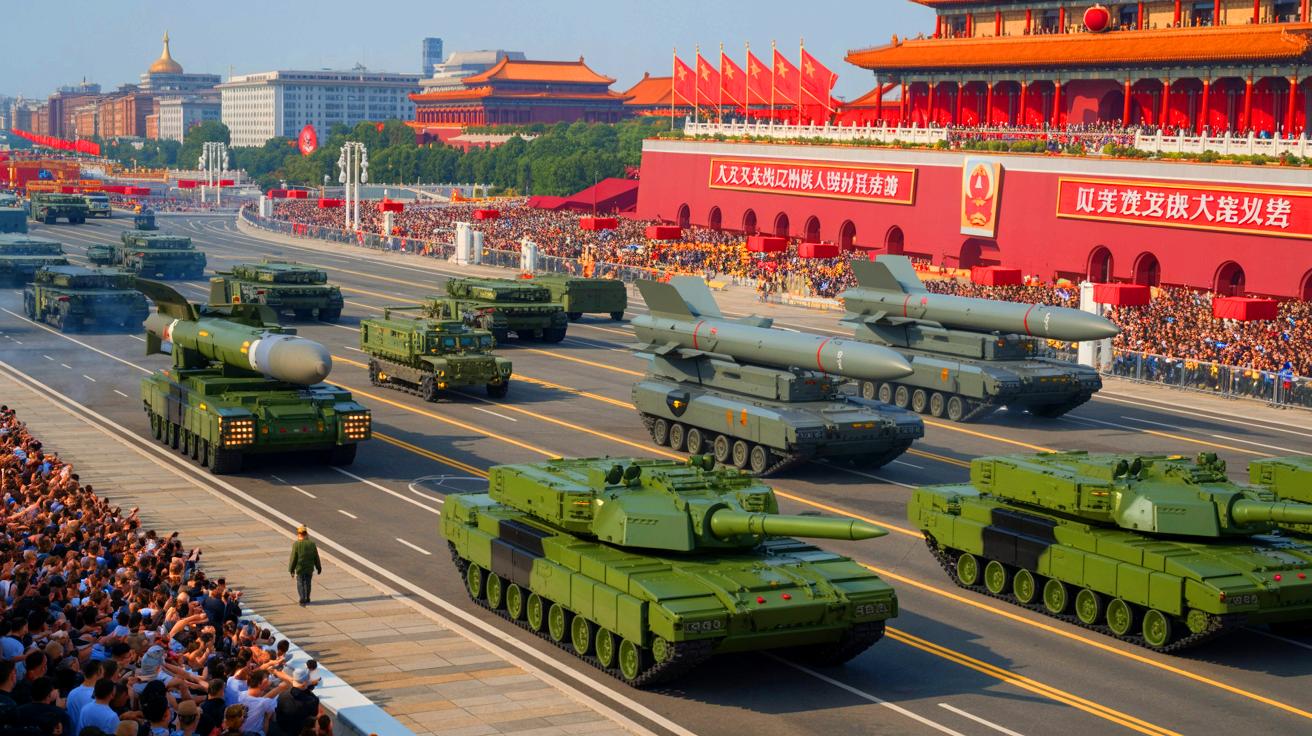
China is poised to showcase a significant leap in its military capabilities with an upcoming parade celebrating the 80th anniversary of its victory over Japan in World War II. Scheduled for September 3 in Beijing, the event is expected to be one of the most comprehensive displays of China’s military modernization in recent years. As the parade unfolds, it will highlight over 100 pieces of domestically produced, active-duty military equipment, including new hypersonic weapons and strategic missiles. This demonstration not only marks a milestone in China’s defense advancements but also serves as a strategic message to the international community.
China’s Largest Parade Ever
The parade will be conducted in two stages: a review and a march-past, lasting approximately 70 minutes. During the march-past, 45 formations will move through Tiananmen Square, commencing with the air flag guard echelon. This will be followed by foot and battle flag formations, equipment formations, and air echelons. The equipment formations will be organized into joint operational groups that reflect real-world combat roles, including land, maritime, air, and missile defense. Additionally, they will cover information operations, unmanned systems, logistics, and strategic strike capabilities.
The air echelons will feature early warning and command aircraft, fighters, bombers, and transports, showcasing nearly all active-duty types in the Chinese military. Notably, several aircraft are expected to make their public debut. According to Xinhua News Agency, the parade will display an array of strategic weapons, including precision hypersonic missiles, counter-unmanned equipment, electronic warfare systems, and directed-energy weapons. The emphasis on fourth-generation platforms underscores China’s progress in system-based joint combat operations.
New Hypersonic Cruise Missiles
The parade will also unveil new hypersonic cruise missiles, with four notable entries: YJ-15, YJ-17, YJ-19, and YJ-20. While their exact roles remain undisclosed, analysts suggest they represent a significant expansion of the People’s Liberation Army’s strike capabilities. The YJ-15 appears similar to the existing YJ-12, known for its supersonic anti-ship capabilities. Meanwhile, the YJ-17, with its sharp nose profile, hints at hypersonic performance, potentially functioning as a “waverider.”
Observers speculate that the YJ-17’s shape resembles an unpowered boost-glide vehicle that could complicate missile defense efforts. The YJ-19, featuring a visible air intake, likely utilizes advanced ramjet or scramjet propulsion, placing it in the high supersonic or hypersonic category. In contrast, the YJ-20 resembles a ballistic missile and could be compatible with vertical launch systems on future naval platforms. Collectively, these systems indicate a heavy investment in high-speed strike weapons, particularly for maritime operations.
New Intercontinental Ballistic Missiles
Beyond the YJ series, the parade rehearsals have sparked speculation about new intercontinental ballistic missiles (ICBMs) and long-range systems. At least one vehicle resembling equipment used to load ICBMs into silos has been spotted, reflecting China’s recent expansion of silo fields in its western deserts. Furthermore, rehearsals have revealed what may be a new stealthy, ground-launched cruise missile, bearing angular features and a resemblance to the US Tomahawk.
Air and missile defense systems are expected to feature prominently, with potential appearances by the HQ-11, HQ-16, and HQ-19 systems. Observers believe that higher-end systems, unofficially labeled HQ-29 and HQ-26, might also be showcased, offering capabilities similar to those of the US. An HQ-20 long-range surface-to-air system has been observed, further indicating advancements in missile defense technology. The parade includes armored vehicles, uncrewed underwater systems, and a flyover of drones and aircraft, highlighting China’s diverse military advancements.
Significance of the Military Modernization
This parade is more than just a display of military hardware; it is a strategic statement by Beijing. The 2019 parade first revealed the DF-17 hypersonic glide vehicle, which has since entered service, proving that such demonstrations often showcase real projects. With this year’s event, China is signaling both domestically and internationally that its military modernization is advancing across multiple domains, particularly in precision strike and missile defense.
These developments raise questions about the balance of power in the region and beyond. As China continues to enhance its military capabilities, other nations may need to reassess their defense strategies and diplomatic approaches. This evolving landscape underscores the importance of understanding the implications of China’s military advancements on global security dynamics.
As the world watches China’s military parade unfold, the event raises important questions about future geopolitical dynamics and military strategies. How will these advancements influence regional security, and what measures will other nations take in response to China’s growing military prowess? These questions remain open-ended, inviting further dialogue and analysis on the evolving global security landscape.