




| IN A NUTSHELL |
|
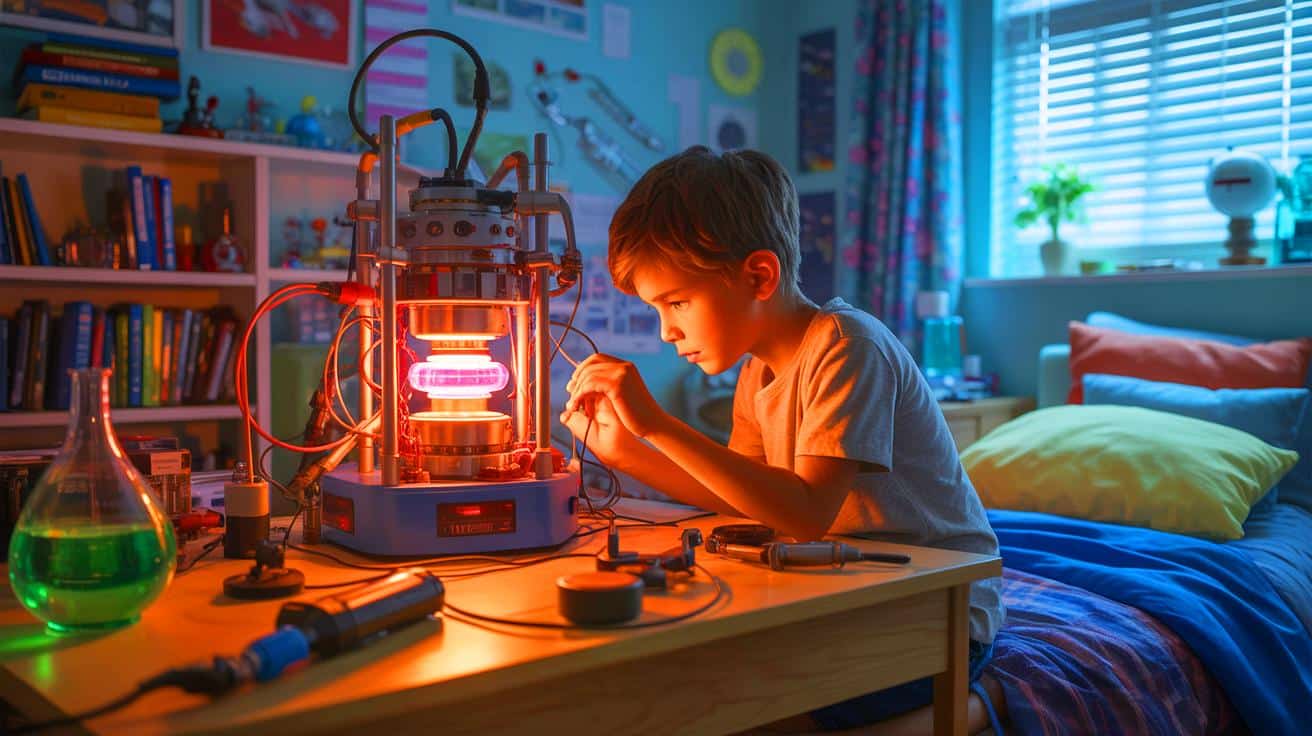
A 12-year-old boy from Memphis has become the youngest person to achieve nuclear fusion, catching the attention of the FBI and setting a Guinness World Record. Jackson Oswalt’s ambitious project, inspired by a TED talk given by Taylor Wilson, involved constructing a nuclear fusion reactor in his bedroom. His determination and ingenuity have sparked significant interest in both scientific circles and the general public, highlighting the potential of young minds in the field of science and technology.
Inspiration from a Young Innovator
Jackson Oswalt’s journey into nuclear fusion began after he watched a TED talk by Taylor Wilson, who achieved controlled nuclear fusion at the age of 14. Inspired by Wilson’s story, Jackson set out to prove that he could accomplish the same feat. His goal was not only to replicate Wilson’s success but to do so at an even younger age. His determination to achieve this goal was fueled by a desire to push the boundaries of what is possible for someone his age.
Jackson started by immersing himself in the underlying science of nuclear fusion. He constructed a “demo fusor,” a preliminary step in building a functional fusion reactor. His initial attempts were far from perfect, with the setup facing challenges such as overheating and component failure. However, these setbacks did not deter him. He continued to refine his design, sourcing parts online, including a turbomolecular pump and deuterium for fuel.
With financial support from his parents, Jackson was able to gather the necessary resources to further his project. His journey serves as a testament to the power of inspiration and the potential of young innovators when given the right encouragement and resources.
Overcoming Challenges and Achieving Success
Building a nuclear fusion reactor is no small feat, especially for someone as young as Jackson. The process was fraught with challenges, from sourcing the right materials to ensuring the safety and functionality of the reactor. Jackson had to overcome significant technical obstacles, such as constructing a vacuum chamber capable of withstanding the conditions necessary for fusion.
Throughout his project, Jackson faced the problem of the reactor's central grid melting during tests. To address this, he rebuilt the vacuum chamber and replaced the grid with one made of tantalum, a metal known for its high melting point and resistance to corrosion. His persistence paid off when, after numerous tests, he successfully achieved nuclear fusion just days before his 13th birthday.
Jackson's success was not only a personal achievement but also a significant contribution to the scientific community. His accomplishment was verified by Fusor.net and confirmed by fusion expert Richard Hull. The recognition of his work underscores the importance of young talent in advancing scientific knowledge and innovation.
Recognition and an Unexpected Visit
Jackson's achievement quickly gained widespread attention, earning him a Guinness World Record as the youngest person to achieve nuclear fusion. His story was covered by various media outlets, bringing him both fame and scrutiny. In addition to the accolades, Jackson received an unexpected visit from the FBI. The agents conducted a thorough inspection of his home to ensure there were no radiation hazards associated with his reactor.
The FBI's visit highlighted the importance of ensuring safety in scientific experiments, particularly those involving nuclear technology. Fortunately, Jackson's setup was deemed safe, and he was allowed to continue his experiments without any restrictions. This incident underscores the balance between encouraging scientific curiosity and ensuring public safety.
Despite the scrutiny, Jackson's achievement has opened doors for him to explore further opportunities in the scientific community. He has toured various startups and facilities across the country, gaining invaluable experience and insight into the world of scientific research and development.
The Future of Young Innovators in Science
Jackson Oswalt's story is a reminder of the untapped potential of young minds in the field of science and technology. His success has inspired other young innovators to pursue their interests and push the boundaries of what is possible. The support of parents, educators, and the scientific community plays a crucial role in nurturing this potential.
As Jackson continues his journey, he serves as a role model for aspiring young scientists. His story highlights the importance of providing resources and encouragement to young innovators, allowing them to explore their passions and contribute to scientific advancement. The impact of young innovators in science cannot be underestimated, as they bring fresh perspectives and ideas to the table.
The question remains: How can society further support and encourage young talent like Jackson's in the pursuit of scientific discovery and innovation?




Wow, this kid is going places! 🚀
Wow, Jackson is truly a genius! 🚀 How can I encourage my kids to pursue such innovative projects?
Is it safe for a 12-year-old to be messing around with nuclear fusion? 🤔
Is it safe for a child to handle nuclear materials, or was there adult supervision involved?
Impressive achievement! What are Jackson’s parents feeding him?
Does this mean we can have home reactors now? Asking for a friend.
Impressive feat! But what does this mean for the future of nuclear technology?
Congratulations, Jackson! You’re an inspiration to young scientists everywhere. 🏆
Why was the FBI involved? Seems a bit extreme for a kid’s science project.
Why didn’t the school system catch onto his brilliance sooner and nurture it?
I can’t even build IKEA furniture, and this kid built a fusion reactor!
This kid’s got some serious talent. Companies should be lining up to hire him in the future!
Sounds like the plot of a sci-fi movie! What’s next? A time machine? 😂
How much did this project cost? Must have been quite an investment!