




| IN A NUTSHELL |
|
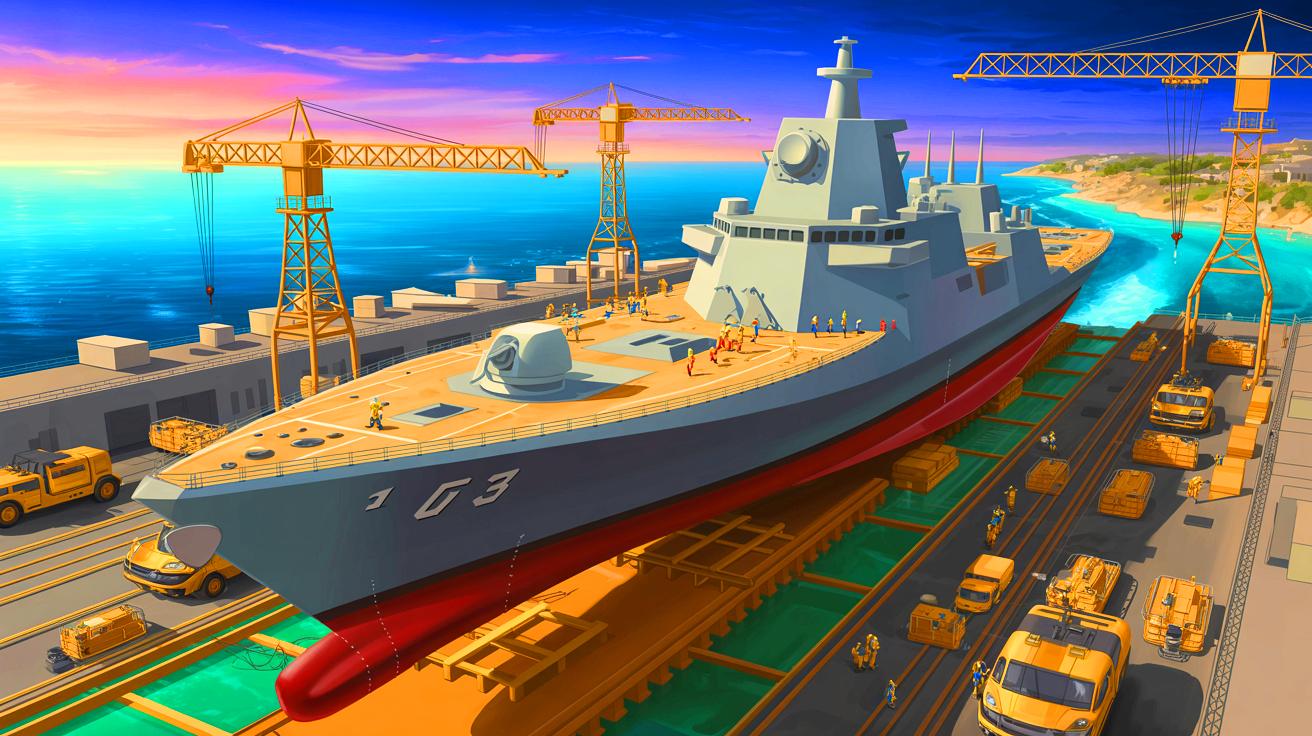
Recent satellite imagery has unveiled a significant development on North Korea’s western coast: the construction of a massive warship, potentially the largest in its naval history. This discovery, made by Maxar Technologies and Planet Labs, suggests that North Korea is making a bold leap in maritime capabilities. The ship, believed to be a guided-missile frigate, signifies a strategic shift in the region’s naval dynamics. This development comes amid strict international sanctions, raising questions about the technological advancements and foreign assistance that may be fueling North Korea’s military ambitions. The implications for regional security and global politics are profound.
Size, Capabilities, and Comparisons
The new warship under construction at the Namp’o shipyard measures approximately 459 feet in length, making it the largest vessel ever built in North Korea. In comparison, the U.S. Navy’s Arleigh Burke-class destroyers are about 505 feet long, while the upcoming Constellation-class frigates are expected to measure around 496 feet. This ambitious project underscores North Korea’s intent to enhance its naval power.
Images reveal ongoing work not only on the ship’s hull but also on its internal weapons systems. Of particular note are the vertical launch tubes, which are designed to fire missiles at both land and sea targets. This development marks a significant modernization effort for a fleet that has historically consisted of smaller, outdated vessels.
The construction of such a large and sophisticated ship suggests a major push by the North Korean government to advance its maritime capabilities. It signals a desire to project power and assert influence in regional waters, challenging neighboring countries and potentially altering the balance of naval power in East Asia.
A Modernization Push amid Sanctions
North Korea’s naval ambitions are unfolding in the context of stringent United Nations sanctions that limit its access to technology and materials for weapons development. Despite these restrictions, Pyongyang has made notable advancements in its military programs, particularly in missile technology.
Analysts suggest that North Korea’s growing ties with Russia could be playing a crucial role in overcoming these limitations. Since the start of the Ukraine conflict, there have been indications that Moscow might be supplying critical missile system technology to North Korea. This collaboration could be a key factor in the swift progress observed in the construction of the new warship.
The existence of this vessel is not surprising given Kim Jong Un’s military aspirations. However, the scale and sophistication of the build are noteworthy and could have significant implications for regional security dynamics. The possibility of foreign assistance in bypassing international sanctions adds another layer of complexity to the situation.
Design Features and Doubts
The new warship has been equipped with phased-array radar, a system that allows for efficient and accurate tracking of airborne and surface threats. This represents a major upgrade from North Korea’s previous capabilities and positions the vessel as a formidable addition to its navy.
However, some analysts express skepticism about North Korea’s ability to support such an advanced vessel. Former U.S. Navy captain Carl Schuster notes that while constructing the hull and propulsion systems is achievable, integrating communications, electronics, sensors, and weapons systems presents a significant challenge.
In addition to technical hurdles, there are operational demands to consider. South Korean lawmaker Kim Byung-kee points out that staffing, fueling, and maintaining such a ship would require substantial resources. Furthermore, support vessels would be necessary to escort the frigate, adding to the logistical complexities of deploying this advanced warship.
A Broader Naval Strategy in Motion
The new warship is part of a broader naval strategy by North Korea. The country is reportedly also developing a nuclear-powered submarine at its Sinpo shipyard and may be constructing another frigate or destroyer in Chongjin. This expansion has prompted the construction of new naval ports to accommodate the larger vessels.
“Now that we are soon to possess large surface warships and submarines which cannot be anchored at the existing facilities for mooring warships, the construction of a naval base for running the latest large warships has become a pressing task.”
According to a 2021 U.S. Defense Intelligence Agency report, North Korea’s navy comprises around 400 patrol vessels and 70 submarines. However, most of these are small and outdated, with the country’s two known Najin-class frigates dating back to the 1970s. Analysts warn that the introduction of the new frigate could shift the regional military equation, especially if it is equipped with advanced missile systems.
The unveiling of North Korea’s new warship raises significant questions about the nation’s military capabilities and strategic intentions. As the country continues to modernize its navy, regional powers must grapple with the potential implications for security and stability in East Asia. How will neighboring countries respond to this escalation in maritime power, and what measures might be taken to address the evolving security landscape?




Wow, a 459-foot frigate! What’s North Korea planning to do with this big guy? 🤔
Wow, a 459-foot warship? That’s like a floating skyscraper! 🚢
How is North Korea even affording this with all those sanctions? 🤔
Isn’t it concerning that Russia might be helping them? Seems like we should be worried. 😨
Does anyone else find it ironic that a ship built with Russian tech is meant to oppose Western powers?
How are they funding this? Sanctions are supposed to be biting hard, right?
This sounds like bad news for regional stability. What are the implications for South Korea and Japan?
Another warship? Hope they don’t forget about the people suffering in their own country. 😟
Great article! It’s fascinating to see how countries bypass sanctions creatively.
Can we trust the satellite images? Maybe it’s not as advanced as it seems.
Will this ship actually make a difference in North Korea’s naval capabilities, or is it just for show?
Russia helping with tech? Just another chapter in the international game of chess. ♟️
Are the vertical launch tubes really that advanced, or just a copy of existing tech?
Why aren’t the sanctions working? Feels like there’s always a way around them. 🤷