




| IN A NUTSHELL |
|
The universe, vast and mysterious, holds secrets that continue to baffle scientists. One such mystery is dark matter, a substance that does not emit light and remains invisible to traditional observational methods. Recently, a team of astronomers made a groundbreaking discovery of the lowest-mass dark object ever observed, utilizing a global network of telescopes. This achievement could potentially unravel some of the enigmas surrounding dark matter, providing new insights into its nature and behavior. Through gravitational lensing, the team detected this elusive object, offering a new perspective on cosmic phenomena that could redefine our understanding of the universe.
Searching for Invisible Objects
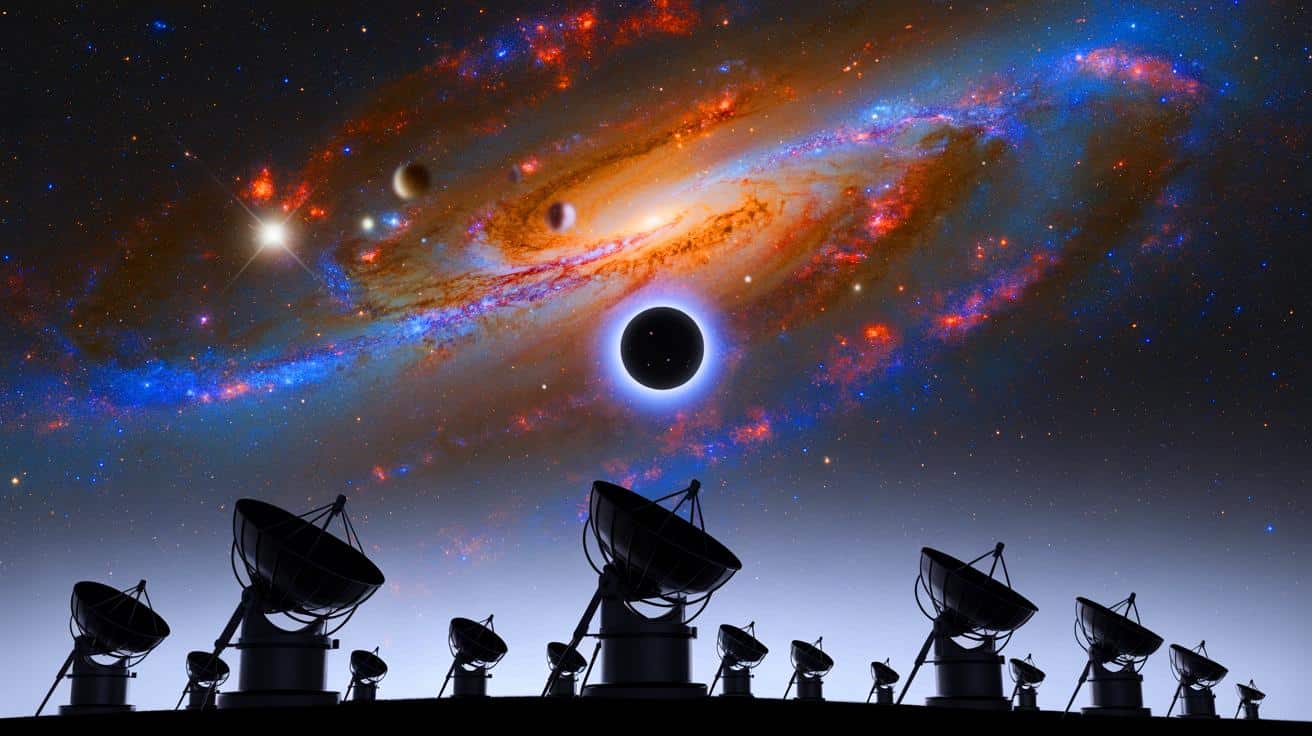
Detecting objects that emit no light presents a formidable challenge for astronomers. To overcome this, the team employed a vast network of telescopes, creating an “Earth-sized super telescope.” This network included the Green Bank Telescope in West Virginia, the Very Long Baseline Array in Hawaiʻi, and the European Very Long Baseline Interferometric Network. The latter spans across Europe, Asia, South Africa, and Puerto Rico. By collaborating internationally, the scientists harnessed the power of gravitational lensing to infer the presence of a dark object. When light from distant cosmic entities passes near a massive object, it curves and magnifies, allowing astronomers to perceive otherwise hidden features.
The findings were published in Nature Astronomy and Monthly Notices of the Royal Astronomical Society, detailing how gravitational lensing revealed the dark object. This method allowed astronomers to estimate the mass of invisible entities by analyzing light distortion. Chris Fassnacht, a co-author from the University of California, Davis, emphasized the significance of this achievement. “It’s an impressive achievement to detect such a low mass object at such a large distance from us,” he explained. Discovering low-mass objects is crucial for understanding dark matter’s nature and distribution in the universe.
Uncovering the Mystery of Dark Matter
The recent discovery has profound implications for the study of dark matter, which constitutes approximately a quarter of the universe. The detected dark object has a mass about a million times that of the sun, yet its exact nature remains a mystery. It may represent an inactive dwarf galaxy or a clump of dark matter significantly smaller than any previously observed. This finding challenges existing theories and suggests that dark matter could exist in isolated clumps, independent of nearby stars.
The mysterious object’s discovery through gravitational lensing marks a significant milestone in the ongoing quest to understand dark matter. According to Devon Powell, the lead author from the Max Planck Institute for Astrophysics, the team’s methods could pave the way for discovering similar objects. “Given the sensitivity of our data, we were expecting to find at least one dark object,” Powell noted, affirming the consistency of their discovery with the “cold dark matter theory,” a cornerstone of galaxy formation theories. The quest now is to find more such objects and verify whether they align with current models.
A Global Effort in Astronomy
The collaboration among various international observatories highlights the importance of global efforts in advancing astronomical research. By pooling resources and expertise, astronomers can achieve breakthroughs that would be impossible for individual institutions. The Green Bank Telescope, the Very Long Baseline Array, and the European Very Long Baseline Interferometric Network each played integral roles in this discovery. Together, they exemplify how scientific cooperation can lead to significant advancements in understanding the universe.
This achievement underscores the necessity of continued investment in collaborative space research. As astronomers push the boundaries of what is known about the cosmos, the importance of shared knowledge and technology becomes ever more apparent. The detection of this dark object is just one example of how international teamwork can yield groundbreaking discoveries, paving the way for future explorations into the vast unknown.
The Future of Dark Matter Research
The recent discovery opens new avenues for research into dark matter and its role in the universe. By identifying more low-mass dark objects, scientists can refine their models and theories about galaxy formation and cosmic evolution. The methods used in this discovery could be instrumental in locating other elusive dark matter clumps, thus expanding our understanding of this mysterious substance.
As researchers continue to explore these cosmic phenomena, they face the challenge of integrating new findings with existing theories. This ongoing process of discovery and adaptation is essential to the advancement of astrophysics. The latest findings not only enhance our comprehension of dark matter but also inspire further inquiry into the universe’s many hidden wonders.
The universe continues to amaze with its hidden wonders and complex phenomena. As astronomers delve deeper into the mysteries of dark matter, they uncover new questions and challenges that drive the pursuit of knowledge. What other secrets does the universe hold, and how will these discoveries shape our understanding of the cosmos in the years to come?




Wow, this is mind-blowing! How do they even find something that doesn’t emit light? 🤯
Wow, an “Earth-sized super telescope”? That sounds like something out of a sci-fi movie! 🌌
How can they be sure it’s the smallest dark object ever? Could there be even smaller ones we haven’t detected yet? 🤔
Could this discovery change our understanding of the universe?
This is mind-blowing! Dark objects and gravitational lensing sound like magic. Thanks for sharing!
I’m curious about the technology used to detect such objects. Can anyone explain gravitational lensing in simple terms?
I’m skeptical. How do they know it’s not just a regular object we can’t see yet?
This sounds like something out of a sci-fi movie! Awesome work, astronomers!
Great work by the astronomers! What a fascinating discovery. Can’t wait to see what they find next.
So what’s next? Are there more dark objects out there waiting to be discovered?