



| IN A NUTSHELL |
|
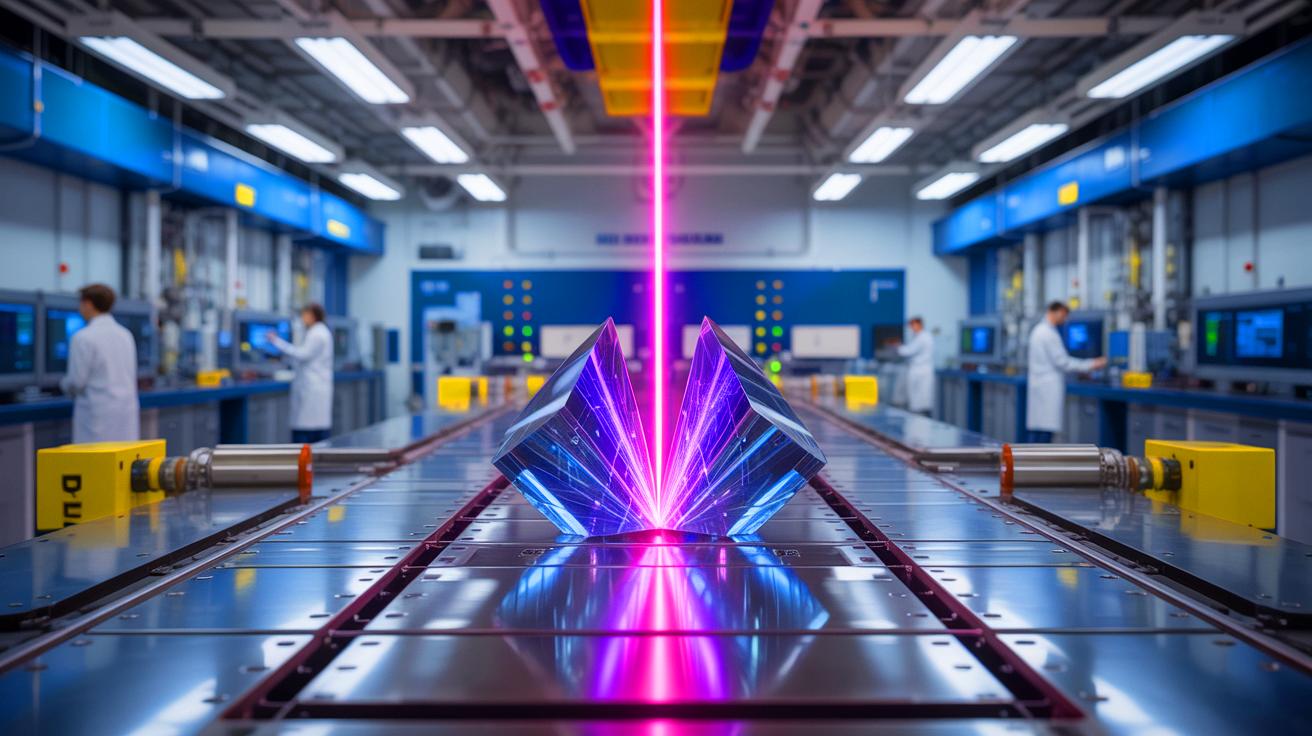
In a remarkable leap for high-power laser technology, the University of Michigan’s ZEUS facility has achieved a significant milestone. Funded by the National Science Foundation (NSF), ZEUS has successfully conducted its first experiment at 2 petawatts, making it the most powerful laser in the United States. This achievement not only surpasses the capabilities of other American lasers but also paves the way for groundbreaking research in various scientific fields. The laser’s immense power, albeit fleeting, holds promise for advancements in medicine, national security, and materials science, among other domains.
Unleashing New Frontiers in Scientific Research
The ZEUS laser facility is not just a pinnacle of optical engineering; it represents a new frontier in scientific research. With its unparalleled power, ZEUS facilitates experiments that delve into unexplored territories of high field science. As Karl Krushelnick, director of the Gérard Mourou Center for Ultrafast Optical Science, noted, this milestone heralds a new era of research opportunities. The laser’s ability to deliver such high-intensity pulses allows scientists to explore phenomena that were previously beyond reach.
Supported by the NSF, ZEUS operates as a user facility, welcoming research teams from across the globe. These teams submit proposals, which undergo a rigorous selection process to ensure that only the most promising projects are awarded time on the laser. This democratized access to cutting-edge technology is a boon for scientific progress, enabling a diverse array of experiments that could lead to significant discoveries and innovations.
Generating Particle Accelerator-Level Beams
One of the primary objectives of ZEUS is to produce electron beams with energies rivaling those generated by particle accelerators. Franklin Dollar’s team from the University of California, Irvine, is at the forefront of this endeavor. By utilizing two separate laser beams, the team aims to guide and accelerate electrons to unprecedented speeds. This process involves creating a plasma channel where electrons are propelled forward, akin to surfers catching waves.
The innovative approach involves using a longer and less dense target, allowing electrons more time to accelerate before surpassing the laser pulse. This technique, known as wakefield acceleration, represents a significant advancement in particle physics. It offers the potential to produce high-energy beams in a more compact and efficient manner compared to traditional accelerators, which typically span hundreds of meters.
Toward Zettawatt-Scale Experiments
ZEUS’s achievements at 2 petawatts are merely the beginning. The facility is gearing up for a landmark experiment expected to occur later this year, where accelerated electrons will collide with counter-propagating laser pulses. From the electrons’ perspective, these collisions will simulate interactions with a zettawatt-scale laser. This groundbreaking experiment is what gives ZEUS its full name: the “Zettawatt Equivalent Ultrashort laser pulse System.”
The implications of such experiments are vast. They could lead to advancements in imaging techniques for soft tissues, enhancing medical diagnostics and treatments. Additionally, the knowledge gained from these experiments could foster innovations in various technological domains, driving economic growth and reinforcing the United States’ position as a leader in scientific research.
Overcoming Challenges to Achieve Full Power
Reaching the current power level of 2 petawatts has been a meticulous process, fraught with challenges. The journey involved overcoming significant technical hurdles, such as sourcing a critical sapphire crystal infused with titanium atoms. This component, essential for the final amplification stage, took over four years to manufacture. Its successful integration is a testament to the dedication and expertise of the ZEUS team.
Another challenge involved managing carbon deposits on diffraction gratings, which threatened to impair the laser’s performance. The team had to determine safe operating conditions to prevent damage to the laser optics. Despite these obstacles, ZEUS has already hosted numerous user experiments, demonstrating the facility’s capability and the scientific community’s enthusiasm for this powerful tool.
The ZEUS facility’s achievements at the University of Michigan mark a significant milestone in laser technology and scientific research. As the laser continues its journey toward achieving full power, the possibilities for groundbreaking discoveries continue to expand. What new frontiers will ZEUS open next, and how will these advancements shape the future of science and technology?




Wow, a 2-petawatt laser? That’s some serious power! 🔥
Wow, 2 petawatts! That’s a lot of power. What kind of safety measures are in place? 🔒
Does the ZEUS facility have any plans for public tours or educational programs? 🏫
What safety measures are in place to prevent accidents with such a powerful laser?
Incredible achievement! Thank you, University of Michigan, for pushing the boundaries of science. 🌟
Isn’t 2 petawatts enough to power a small country? 😅
I’m curious about the environmental impact of operating a laser this powerful. Any insights?
Will this laser be used in any defense projects? 🤔
How does this compare to other global laser facilities?
This sounds straight out of a sci-fi movie! Has ZEUS been used in any films yet? 🎬
Why is it called a “death beam”? Sounds a bit dramatic! 😂
Great work by the University of Michigan! Keep pushing the boundaries of science! 👏
I’m curious about the environmental impact of running such a powerful laser.
ZEUS sounds like something out of a sci-fi movie. Amazing work! 🚀
How does the ZEUS laser compare to similar facilities around the world?
Is this related to the Large Hadron Collider experiments in any way?
What kind of research proposals are they looking for at ZEUS?
Thank you for sharing this breakthrough. It’s inspiring to see what’s possible with modern technology.
2 petawatts… I can’t even imagine that much power. 😲
Are there any risks associated with these high-power experiments?
This sounds like a huge leap for laser tech! What’s next on their agenda?
How long can the ZEUS laser maintain its 2-petawatt output?
Great work, but please tell me the “death beam” nickname is just for fun! 😬
Does this mean we could have smaller, more efficient particle accelerators in the future?
Thank you to the NSF for supporting projects like this! 🎉
How do they handle the heat generated by such a powerful laser?
I’m a bit skeptical about the “zettawatt-scale” claims. Can anyone clarify? 🤨
Is there a way to watch these experiments live online?
What are the potential applications of this technology in medicine? 💉
This is a huge milestone. Kudos to the whole team involved! 👏
I wonder how much it costs to run the ZEUS facility annually?
Can ZEUS be used for materials science research?
I’m amazed at how far laser tech has come. Keep up the great work!
How do they prevent potential accidents during these high-power tests? 😬
Does ZEUS have any collaborations with international research teams?
What kind of training do researchers need to work at ZEUS?
Are there any limitations to the types of experiments conducted at ZEUS?
Why did it take so long to create the critical sapphire crystal?
I’m excited to see what new discoveries come from this facility! 🔬
Can this laser technology be used in space exploration? 🚀