




| IN A NUTSHELL |
|
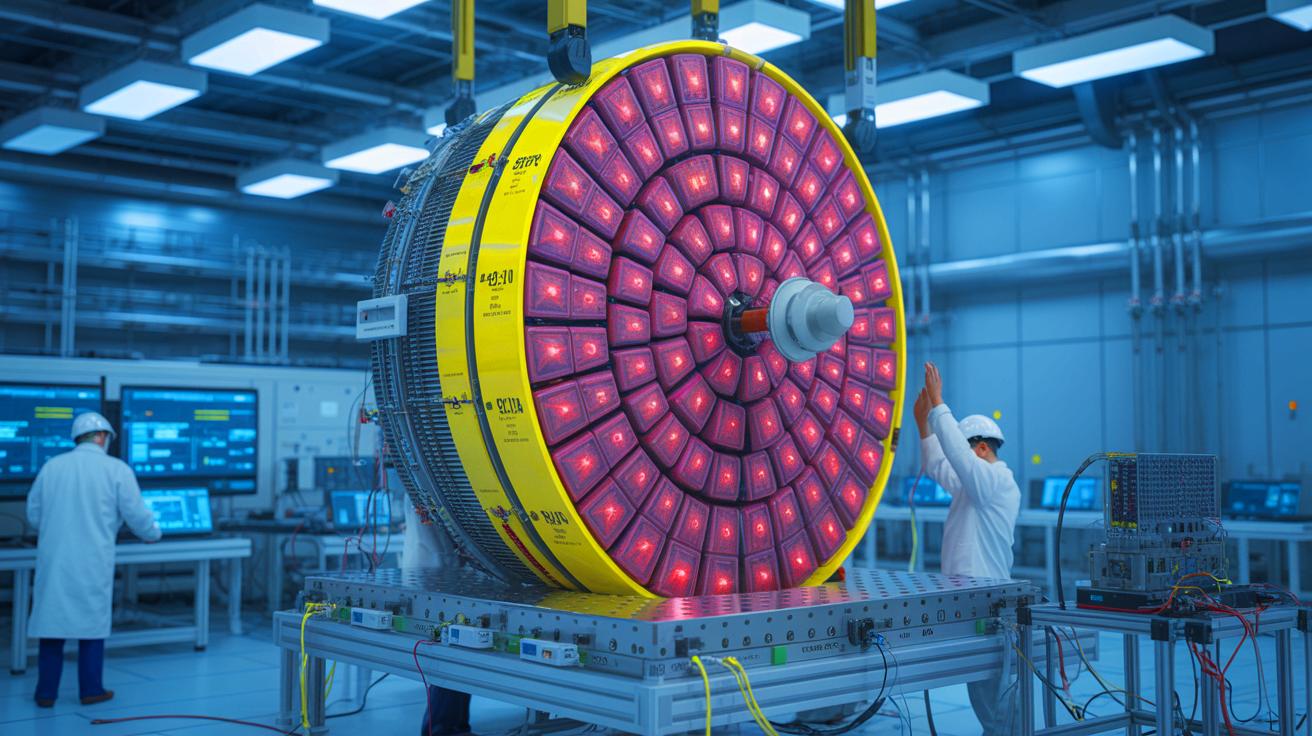
The world of nuclear physics is about to witness a groundbreaking development with the completion of the Gamma-Ray Energy Tracking Array (GRETA). This advanced nuclear detector, constructed under the auspices of the U.S. Department of Energy’s Lawrence Berkeley National Laboratory, promises to revolutionize our understanding of atomic nuclei. GRETA is designed to provide the most precise measurements of atomic structures to date, offering insights into the formation of heavy elements and the fundamental forces at play within the universe. Once operational at the Facility for Rare Isotope Beams (FRIB) at Michigan State University, GRETA is set to expand the boundaries of nuclear research.
Revolutionizing Nuclear Detection
At the heart of GRETA’s innovation is its ability to track gamma rays emitted from nuclear decays with exceptional precision. The device employs multiple high-purity germanium crystals to capture the energy and 3D paths of these rays. This technological advancement will allow researchers to delve deeper into the mysteries of how stars forge heavy elements and test the limits of nuclear stability. The construction of GRETA is a collaborative effort involving scientists and engineers from Berkeley Lab, Michigan State University, Argonne National Laboratory, and Oak Ridge National Laboratory.
Once installed at FRIB, GRETA will facilitate experiments by directing particle beams at targets positioned at its center. As these targets produce rare and energetic atoms, the gamma rays emitted provide a unique “fingerprint” for each isotope. Heather Crawford, deputy project director for GRETA, emphasized the importance of gamma-ray spectroscopy in understanding the atomic nucleus. She notes that these gamma rays offer insights into the forces that govern atomic structures.
Expanding Research Capabilities
The design and construction of GRETA build on the earlier GRETINA project, which utilized 12 germanium detector modules. GRETA enhances this by increasing the number to 30 modules, forming a complete sphere around the target for improved detection efficiency. Each module comprises four ultra-pure germanium crystals, precisely tapered and cooled to approximately minus 300 degrees Fahrenheit for optimal performance. The aluminum frame holding these modules is engineered with extreme precision, ensuring perfect alignment and safe module installation.
GRETA’s capabilities extend to studying rare isotopes and nuclear drip lines, exploring limits where neutrons or protons cannot remain bound. The detector’s sensitivity may reveal symmetry violations in nature and provide clues about the universe’s matter-antimatter imbalance. The FRIB’s potential to produce over 1,000 new isotopes will significantly broaden the scope of nuclear experiments, offering unprecedented opportunities for scientific discovery.
Technological Advancements and Testing
GRETA’s new electronic systems are capable of handling up to 50,000 signals per second from each crystal. During testing, the system exceeded expectations, processing 511,000 gamma-ray interactions per second. This high-performance capability is supported by a dedicated computing cluster, enabling real-time analysis of experimental data. The platform may also serve as the inaugural testbed for DELERIA, a high-speed data streaming system designed to transmit results over the DOE’s ESNet network to supercomputing facilities.
The flexibility and sensitivity of GRETA are poised to push the boundaries of nuclear science. Once installed at FRIB and later at Argonne National Laboratory, GRETA will be employed across multiple experimental stations. Researchers anticipate that this will lead to faster and more detailed insights into the fundamental building blocks of matter, advancing our understanding of the universe.
Looking to the Future of Nuclear Science
GRETA represents a significant milestone in the field of nuclear physics. Its ability to provide unprecedented detail in the study of atomic nuclei positions it as a critical tool for future research. The detector’s advanced capabilities promise to explore previously inaccessible areas of nuclear science, offering new perspectives on the forces that shape our universe. As scientists prepare to harness GRETA’s full potential, questions remain about the implications of these discoveries for our understanding of matter and the universe at large.
As GRETA moves closer to operational status, the scientific community eagerly anticipates the insights it will bring. The detector’s ability to probe atomic nuclei with unparalleled precision could reshape our understanding of fundamental forces and the origins of heavy elements. How will these advancements influence our perception of the universe and the fundamental nature of matter?




Wow, GRETA sounds amazing! How long did it take to build this nuclear detector? 🔬
Can GRETA be used for something other than nuclear research?
That’s a lot of gamma rays! What are the potential risks of working with such technology? 😅
How does GRETA compare to other nuclear detectors in terms of precision?
This is impressive but doesn’t it consume a lot of energy to operate? 🤔
Are there any commercial applications for GRETA down the road?
I’m curious, how do they keep the germanium crystals cooled at such low temperatures? 🥶
Thank you for the detailed article. Very informative and exciting! 🌟
Is GRETA going to be open for use by international researchers?
Can GRETA help us understand dark matter? Or is it strictly for nuclear research?